Dave is a marketing expert with 15 years experience in the tech and SaaS world. He specializes in educating IT and channel audiences, with a focus on security, privacy, compliance, and marketing technology. With a talent for storytelling and a deep understanding of the industry, Dave transforms complex IT topics into clear, engaging, and impactful narratives.
Email disclaimer examples and templates (25+ ready to use)
TL;DR
An email disclaimer is a short notice at the end of an email that names who the message is for and limits the sender's liability. Some also carry details the law requires. Keep it under 150 words.
Pick the type that matches the job. This guide has copy-ready wording for 20 types, grouped by confidentiality and privilege, liability limits, legal and regulatory details, and trust and expectations.
A disclaimer reduces risk without removing it, and it doesn't make an organization compliant with data protection or health privacy law. Review the wording with your legal team before you use it.
A confidentiality disclaimer example: "This email and any attachments are confidential and intended solely for the named recipient. If received in error, please notify the sender and delete all copies."
What should an email disclaimer say?
An email disclaimer, also called a disclaimer statement, is a short notice that helps protect the sender's organization and says what the recipient may and may not do with a message. It sits below the main message, next to the professional email signature.
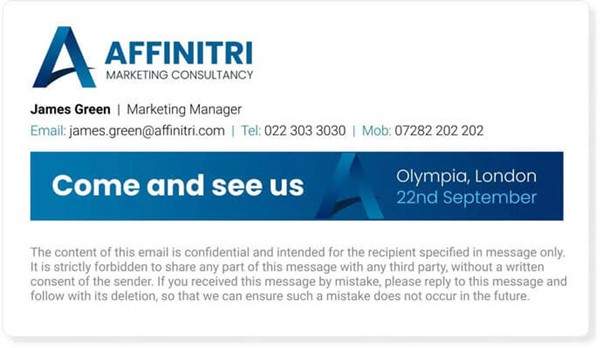
A good one names who the message is for and what to do if it reached the wrong person, then limits liability on the points that matter to your organization. Add company details or regulatory wording where your jurisdiction or industry calls for it. Every example in this guide is a common starting point. Adapt it with your legal or compliance team, and don't treat anything here as legal advice.
Element | Purpose | Example phrase |
|---|---|---|
Confidentiality | Reduces the chance of accidental disclosure | "This email is intended solely for the addressee and may contain confidential information." |
Liability for computer viruses | Limits liability for damage from malicious files | "Please scan all attachments for viruses. We accept no liability for damage caused." |
Unintentional contracts | Stops an email from creating a binding agreement | "No binding agreement may be formed via email without written confirmation." |
Negligent misstatement | Limits liability for unintentional inaccuracies | "We accept no liability for errors or omissions in this communication." |
Employer's liability | Separates an employee's views from the company's | "Views expressed are the sender's own and may not reflect company policy." |
Regional legal requirements | Carries company details some jurisdictions require | "Registered in England and Wales, Company No. 1234567." |
Environmental message | States a sustainability commitment | "Please consider the environment before printing this email." |
Which email disclaimer do I need?
What you need depends on what you send and where. The last column shows which rows a rule requires and which are best practice.
Disclaimer type | Use when | Template | Required? |
|---|---|---|---|
Confidentiality | Sending sensitive business, legal, or personal data | "This email and any attachments are confidential and intended solely for the named recipient. If received in error, please notify the sender and delete all copies." | Best practice. Sector rules can add requirements |
Legal privilege | Email involving attorney-client advice or work product | "This communication may contain attorney-client privileged information. If you are not the intended recipient, do not read, copy, or forward it. Notify the sender immediately and delete all copies." | Privilege rules vary by jurisdiction. Review with counsel |
Virus liability | Any outgoing email, especially with attachments | "This email may contain viruses or harmful content. Recipients are responsible for scanning all attachments. [Company Name] accepts no liability for damage caused, except where excluded by law." | Best practice. Enforceability varies by jurisdiction |
Phishing warning | Customer-facing email from banks, healthcare providers, online retailers, and SaaS companies | "[Company Name] will never request passwords, payment details, or login credentials by email. If you receive a suspicious message, forward it to [email protected] and delete it." | Not a general legal requirement |
No contract by email | Sales, procurement, and negotiation email | "Nothing in this email constitutes an offer, acceptance, or binding agreement. Any pricing or terms are indicative only and subject to a signed contract." | Adapt to local contract law |
GDPR (General Data Protection Regulation) | Email involving the personal data of people in the EU or European Economic Area (EEA) | "This email may contain personal data processed in accordance with GDPR. For privacy queries, see our Privacy Policy at [URL] or contact [email protected]." | Article 13 requires privacy information when you collect data. A footer line can point to it but doesn't replace it |
HIPAA (Health Insurance Portability and Accountability Act) | U.S. healthcare email involving patient information | "This message may contain protected health information intended only for the named recipient. Unauthorized use or disclosure is prohibited under HIPAA." | Not required. HIPAA doesn't prescribe wording for an email disclaimer |
Marketing and unsubscribe | Newsletters, promotions, and mailing list email | "You're receiving this because you subscribed to communications from [Company Name]. To unsubscribe: [link]. [Company Name], [Address]." | Sender details and an unsubscribe route are required for commercial email under the CAN-SPAM Act (U.S.), Canada's Anti-Spam Legislation (CASL), and GDPR (EU) |
"Disclaimers have been around for decades and are still treated like a checkbox, but each purpose ties back to reducing risk and reinforcing trust: limiting liability, signalling confidentiality, demonstrating professionalism, and keeping one consistent message across the business."
How is a disclaimer different from terms of service or a privacy policy?
A disclaimer covers specific content, while terms of service and a privacy policy cover a whole service and how it handles data.
Document | Purpose | Typical location |
|---|---|---|
Disclaimer statement | Limits liability for specific content or communications | Email footers, website footers, individual pages |
Terms of service | Sets the rules and conditions for using a website or service | Dedicated legal page, sign-up flows |
Privacy policy | Explains how personal data is collected, used, and protected | Dedicated legal page, referenced from GDPR and California Consumer Privacy Act (CCPA) notices |
Tip
Review your disclaimer at least once a year. Trigger an earlier review if any of the following change: relevant legislation (GDPR, CAN-SPAM, HIPAA, FINRA, UK Companies Act), your company's jurisdiction or corporate structure, your data processing activities, your marketing consent practices, or the industries or regions you operate in.
What are the best confidentiality and privilege disclaimers?
The email disclaimer examples below show how to cover different legal, compliance, and professional requirements. Use these templates to standardize your organization’s email disclaimers and ensure every message remains consistent and compliant.
Tip
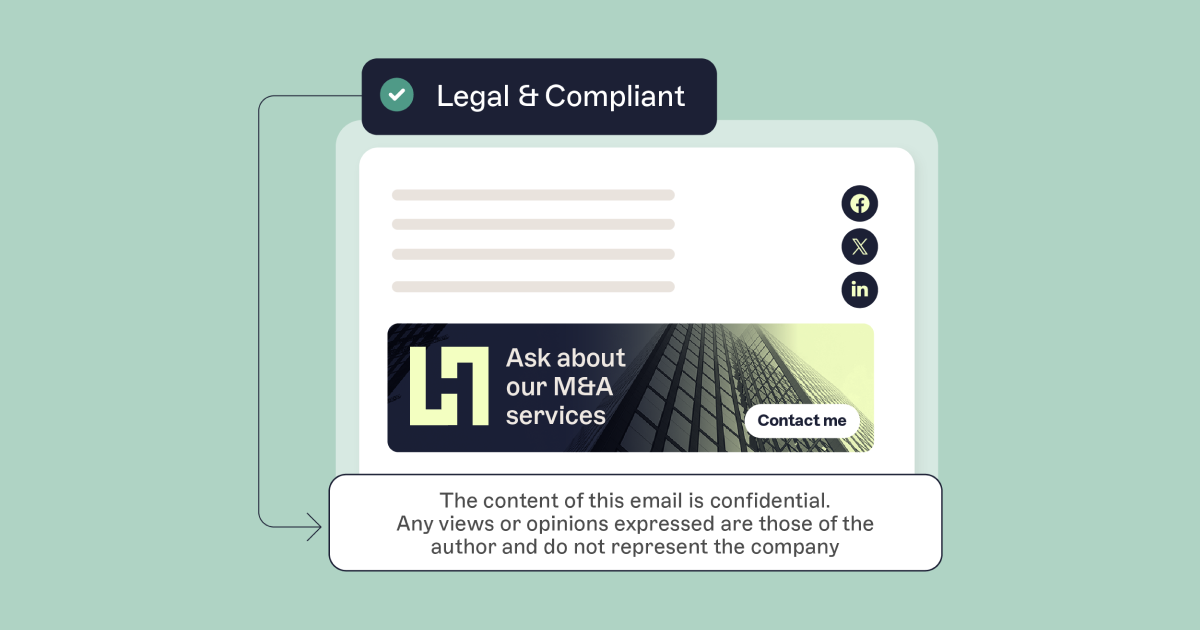
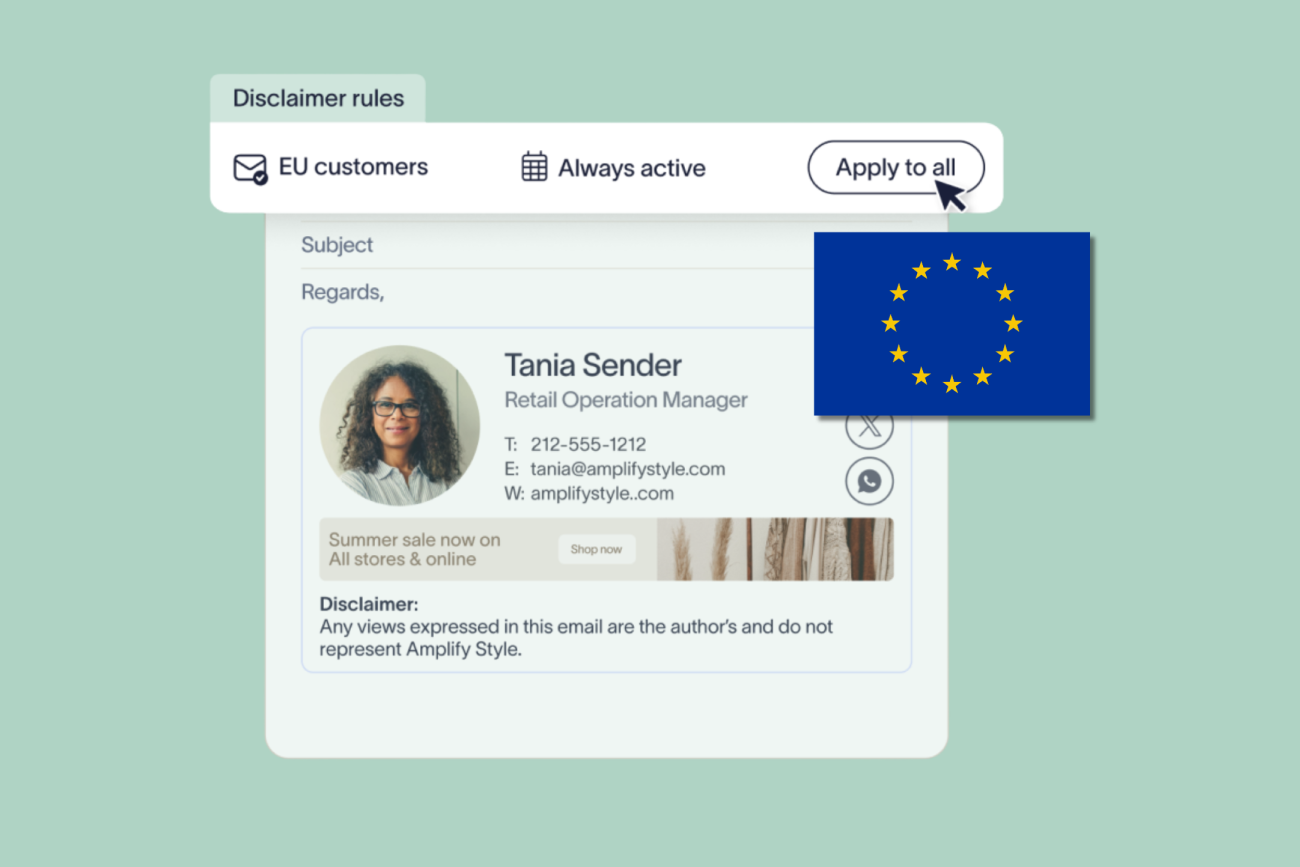
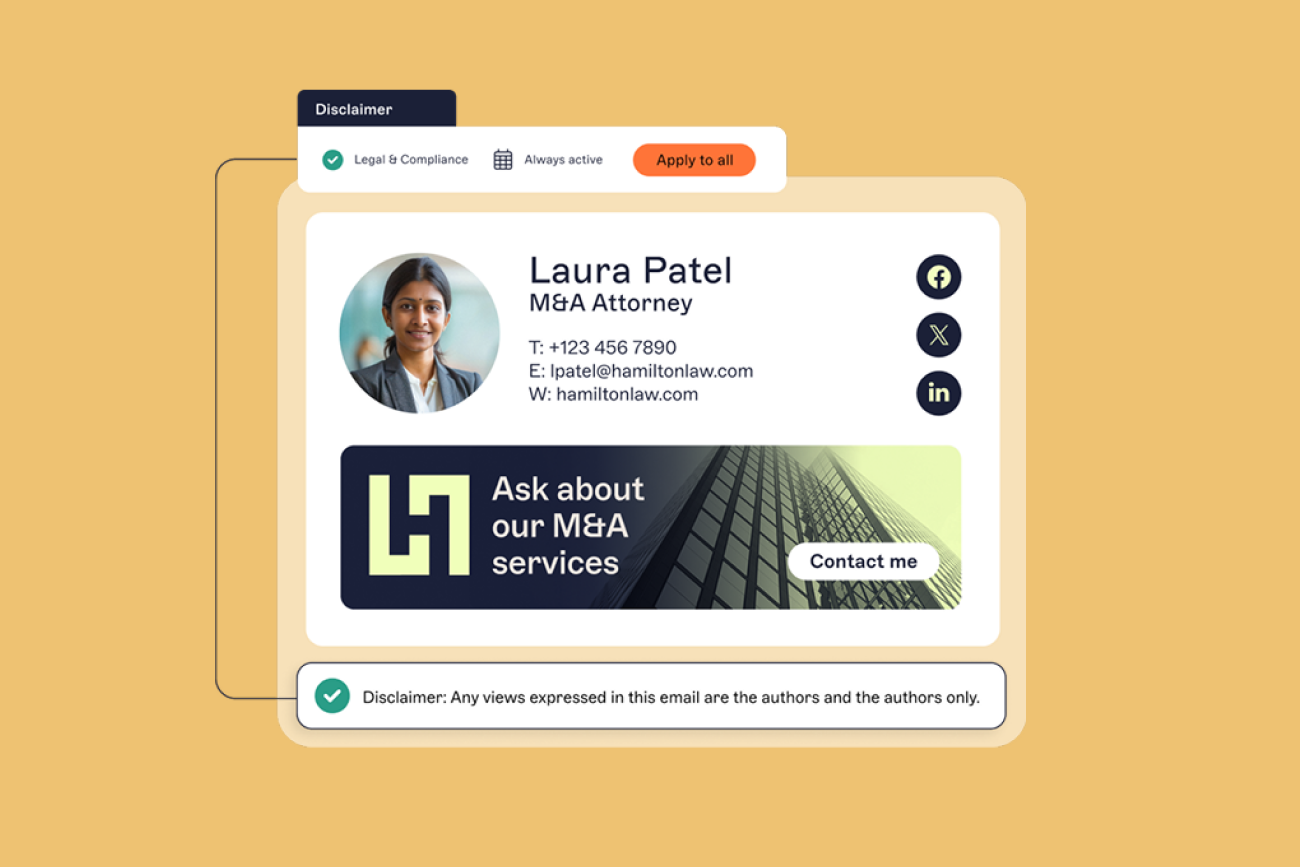
You can manage, automate, and update all of these disclaimer types across your organization using Exclaimer's Disclaimers feature.
1. Breach of confidentiality disclaimers
Quick answer
A confidentiality disclaimer tells the recipient an email is meant only for them and says what to do if it landed in the wrong inbox.
Use when: The email contains proprietary business information, personal data, financial details, or legal documents the sender wouldn't want forwarded.
Legal note: A confidentiality notice shows the sender took care, which can support a claim if confidential material is misused. How far it holds depends on the jurisdiction and the information, and the notice can't stop anyone forwarding the email.
CONFIDENTIAL: This email and any files transmitted with it are confidential and intended solely for the use of the individual or entity to whom they are addressed. If you have received this email in error, please notify the system manager. This message contains confidential information and is intended only for the individual named. If you are not the named addressee you should not disseminate, distribute or copy this e-mail. Please notify the sender immediately by e-mail if you have received this e-mail by mistake and delete this e-mail from your system. If you are not the intended recipient you are notified that disclosing, copying, distributing or taking any action in reliance on the contents of this information is strictly prohibited.
This message has been sent as a part of discussion between [SENDER'S NAME] and the addressee whose name is specified above. Should you receive this message by mistake, we ask that you inform us at your earliest possible convenience. In this case, we also ask that you delete this message from your mailbox, and do not forward it or any part of it to anyone else. Thank you for your cooperation and understanding.
The content of this message is confidential. If you have received it by mistake, please inform us and then delete the message. It is forbidden to copy, forward, or in any way reveal the contents of this message to anyone. The integrity and security of this email cannot be guaranteed. Therefore, the sender will not be held liable for any damage caused by the message.
Create email disclaimers that fit your business
Produce email disclaimers tailored to your organization’s needs with Exclaimer's free generator.
2. Legal privilege disclaimer
Quick answer
A legal privilege disclaimer says an email may be protected by attorney-client privilege or work product protection, and asks anyone who received it by mistake not to read, copy, or share it.
Use when: An email is sent by or for in-house or outside counsel and contains legal advice, analysis, or strategy.
Legal note: A notice records that the sender meant the communication to be protected, and it can't create privilege on its own. Privilege rules differ between the U.S., the UK, and the EU, and in-house counsel communications can get narrower protection in some places. Have counsel approve the wording.
This email may contain information that is subject to attorney-client privilege or attorney work product protection. It is intended solely for the named recipient. If you have received it in error, please notify the sender immediately, delete all copies, and do not disclose, copy, or distribute its contents. Unauthorized use or disclosure may constitute a waiver of applicable legal privilege.
This communication originates from the legal department of [Company Name] and may be subject to attorney-client privilege. It is intended only for the individual or team to whom it is addressed. Please do not forward without prior authorization from the sender. If you received this email in error, please contact [email protected] immediately.
Which disclaimers limit liability or stop accidental contracts?
3. Virus liability disclaimers
Quick answer
A virus liability disclaimer tells recipients to scan attachments themselves and limits the sender's responsibility if a message carries malware.
Use when: Any outgoing email, especially one with attachments.
Legal note: It limits liability, and enforceability varies by jurisdiction.
Warning: Computer viruses can be transmitted via email. The recipient should check this email and any attachments for the presence of viruses. The company accepts no liability for any damage caused by any virus transmitted by this email. E-mail transmission cannot be guaranteed to be secure or error-free as information could be intercepted, corrupted, lost, destroyed, arrive late or incomplete, or contain viruses. The sender therefore does not accept liability for any errors or omissions in the contents of this message which arise as a result of e-mail transmission.
Warning: Although the company has taken reasonable precautions to ensure no viruses are present in this email, the company cannot accept responsibility for any loss or damage arising from the use of this email or attachments.
[YOUR COMPANY] puts your security first. We make every effort to keep this message free of viruses, but we cannot guarantee it, and data in an email can be infected or corrupted in transit. Please review this message and its attachments for threats, as we do not accept liability for damage caused by viewing the contents of this email.
4. No-contract disclaimers
Quick answer
A no-contract disclaimer says nothing in an email creates a binding agreement without written confirmation.
Use when: Sales, procurement, and negotiation emails discuss pricing, delivery timelines, service scope, or other terms a recipient could read as a commitment.
Legal note: Under many common law systems, an exchange of emails can form a contract if it contains an offer, acceptance, and consideration. Contract law varies, so have counsel adapt the wording to your jurisdiction.
No employee or agent is authorized to conclude any binding agreement on behalf of [YOUR COMPANY] with another party by email without express written confirmation by A. Director.
This quotation request is sent in order to compare available offers. It does not imply entering into a legally binding contract with [YOUR COMPANY].
5. Negligent misstatement disclaimers
Quick answer
A negligent misstatement disclaimer says information in an email is shared in good faith and may be incomplete or change, so the recipient shouldn't treat it as confirmed.
Use when: Emails share analysis, recommendations, projections, market information, or technical guidance a recipient might rely on for a financial, legal, or business decision.
Legal note: It can reduce exposure but doesn't remove it where the sender owed a duty of care. Negligent misstatement is a common law concept (see Hedley Byrne v Heller in English law).
Our company accepts no liability for the content of this email, or for the consequences of any actions taken on the basis of the information provided, unless that information is subsequently confirmed in writing. If you are not the intended recipient, you are notified that disclosing, copying, distributing, or taking any action in reliance on the contents of this information is strictly prohibited.
6. Errors and omissions disclaimers
Quick answer
An errors and omissions disclaimer admits mistakes can happen and limits liability for accidental inaccuracies, so no one expects every figure, date, or fact in the email to be guaranteed.
Use when: Emails contain data, statistics, financial figures, or technical specifications that can change between drafting and receipt.
Legal note: It doesn't cover deliberate misrepresentation or gross negligence, and regulated industries keep their own accuracy standards.
Every effort is made to ensure the accuracy of this email's content. However, [Your Company] does not accept liability for any errors, omissions, or inaccuracies that may occur during transmission or formatting.
7. No responsibility disclaimers
Quick answer
A no responsibility disclaimer says the sender isn't answerable for what recipients do with general information, third-party content, or advice.
Use when: Newsletters, research summaries, and advisory emails pass on content the sender didn't write.
Legal note: It limits liability, and courts still look at whether the sender took reasonable care.
The information contained in this email is provided for general purposes only. [Your Company] accepts no responsibility for any actions taken based on this communication or for any consequences resulting from its use.
8. No guarantee disclaimers
Quick answer
A no guarantee disclaimer says nothing in the email promises a particular outcome.
Use when: Emails discuss projected returns, estimates, timelines, or future performance.
Legal note: It fits the forward-looking statement rules in financial services, set by regulators such as the Financial Conduct Authority (FCA) and the Securities and Exchange Commission (SEC), though it doesn't cover statements made recklessly or without a reasonable basis.
[Your Company] makes no guarantees regarding the completeness, accuracy, or outcome of the information contained in this email. Recipients should verify all details before taking action.
9. Employer's liability and opinion disclaimers
Quick answer
An employer's liability disclaimer, also called a views expressed or opinion disclaimer, says an employee's opinions are their own and not the company's.
Use when: Personal views could be mistaken for company policy, such as in emails about public affairs or customer disputes.
Legal note: It can limit the organization's vicarious liability for an employee's opinions, but a false statement of fact can still support a defamation claim.
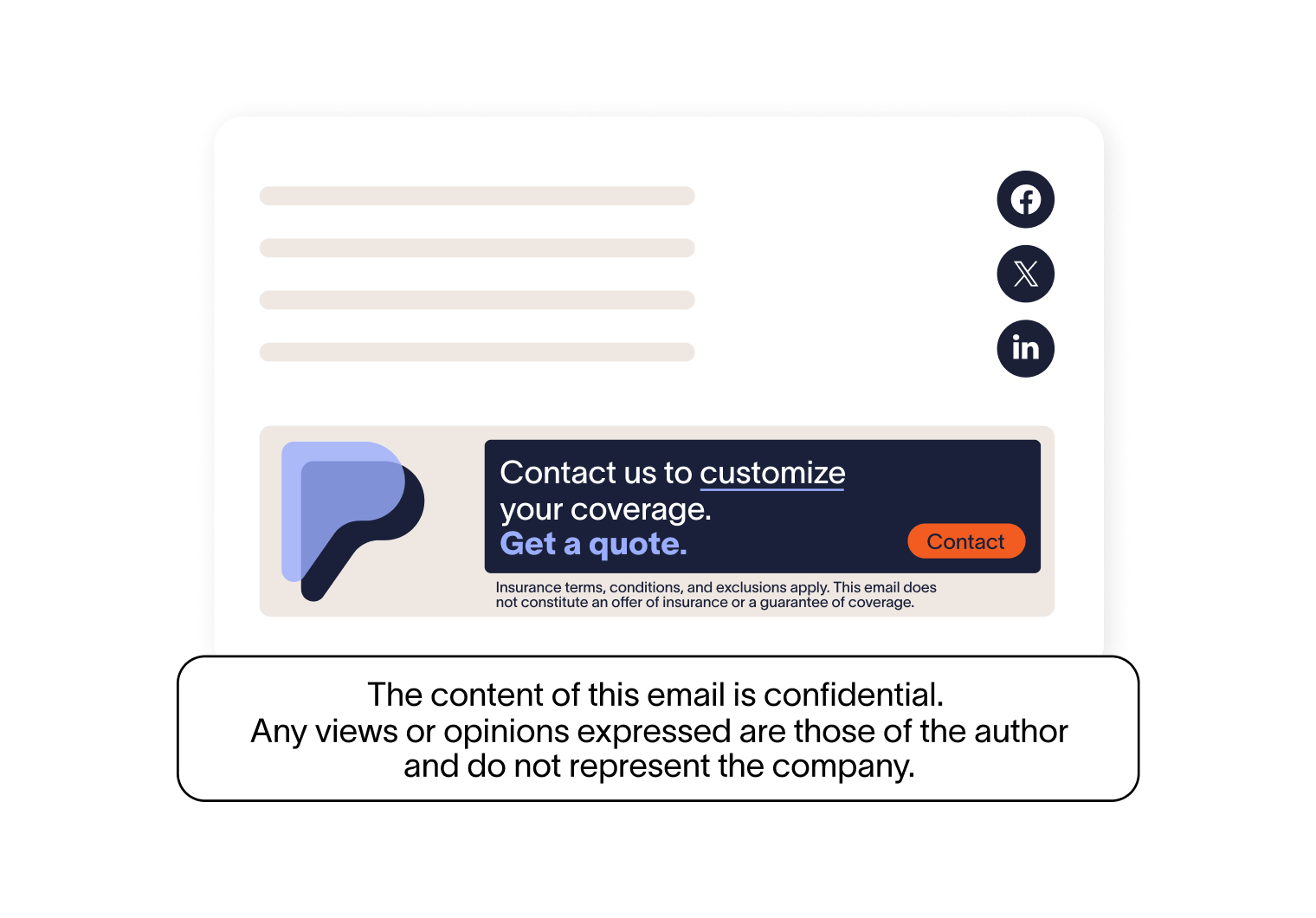
Any views or opinions presented in this email are solely those of the author and do not necessarily represent those of the company. Employees of the company are expressly required not to make defamatory statements and not to infringe or authorize any infringement of copyright or any other legal right by email communications. Any such communication is contrary to company policy and outside the scope of the employment of the individual concerned. The company will not accept any liability in respect of such communication, and the employee responsible will be personally liable for any damages or other liability arising.
The views expressed in this email are the sender's own and don't necessarily reflect those of [Company Name].
10. Professional services and advice disclaimers
Quick answer
A professional services disclaimer says an email is general information, not formal legal, financial, or medical advice.
Use when: Law firms, accounting firms, financial advisors, consultants, and healthcare providers send email whose informal content could be read as a formal opinion.
Legal note: Required wording varies by regulator (the FCA, the Solicitors Regulation Authority, the General Medical Council, and the American Institute of CPAs, among others), and a disclaimer doesn't replace an engagement letter. Review it with a qualified professional in your field.
This email is for general information only and does not constitute legal advice or establish an attorney-client relationship. For advice on your specific circumstances, please contact us directly to arrange a formal consultation. [Firm name] is regulated by [regulator].
The content of this email is provided for informational purposes only and does not constitute financial, investment, or professional advice. [Company Name] accepts no liability for decisions made on the basis of this communication. Please consult a qualified professional before taking action.
Tip
End any liability limit with a carve-out such as "except where excluded by law" or "except where prohibited by applicable law".
Which email disclaimers do laws and regulators cover?
A few rules dictate what business email has to carry. UK-registered companies must show company details, and commercial email to a list needs sender details and a way to opt out in the U.S., Canada, and the EU.
11. Regional legal and regulatory disclaimers
Quick answer
A regional disclaimer carries the company details the law requires on business correspondence, such as the registered name, number, and office address.
Use when: Your jurisdiction requires company identification on business email. UK-registered companies are the standard example.
Legal note: UK-registered companies have to show their registered name, registered number, and registered office address on business emails. The requirement comes from regulations under the Companies Act 2006, and the ICAS summary lists the details.
For more detail, see email disclaimers in the UK, in the EU, and in the U.S..
Big Company Ltd. is a limited company registered in England and Wales. Registered number: 1234567. Registered office: 123 Some Street, Somewhere, Someshire.
12. GDPR email disclaimers
Quick answer
A GDPR email disclaimer points recipients to your privacy policy and says who to contact about their personal data.
Use when: An email goes to or concerns people in the EU or EEA and involves their personal data, including client communications, HR correspondence, marketing, and automated messages from web forms or a customer relationship management (CRM) system.
Legal note: GDPR Article 13 requires you to give people privacy information when you collect their data. A footer line can point to that information, but it doesn't replace it. Fines under Article 83 can reach EUR 20 million or 4% of global annual turnover, whichever is higher.
For more wording, see the top GDPR email disclaimer examples.
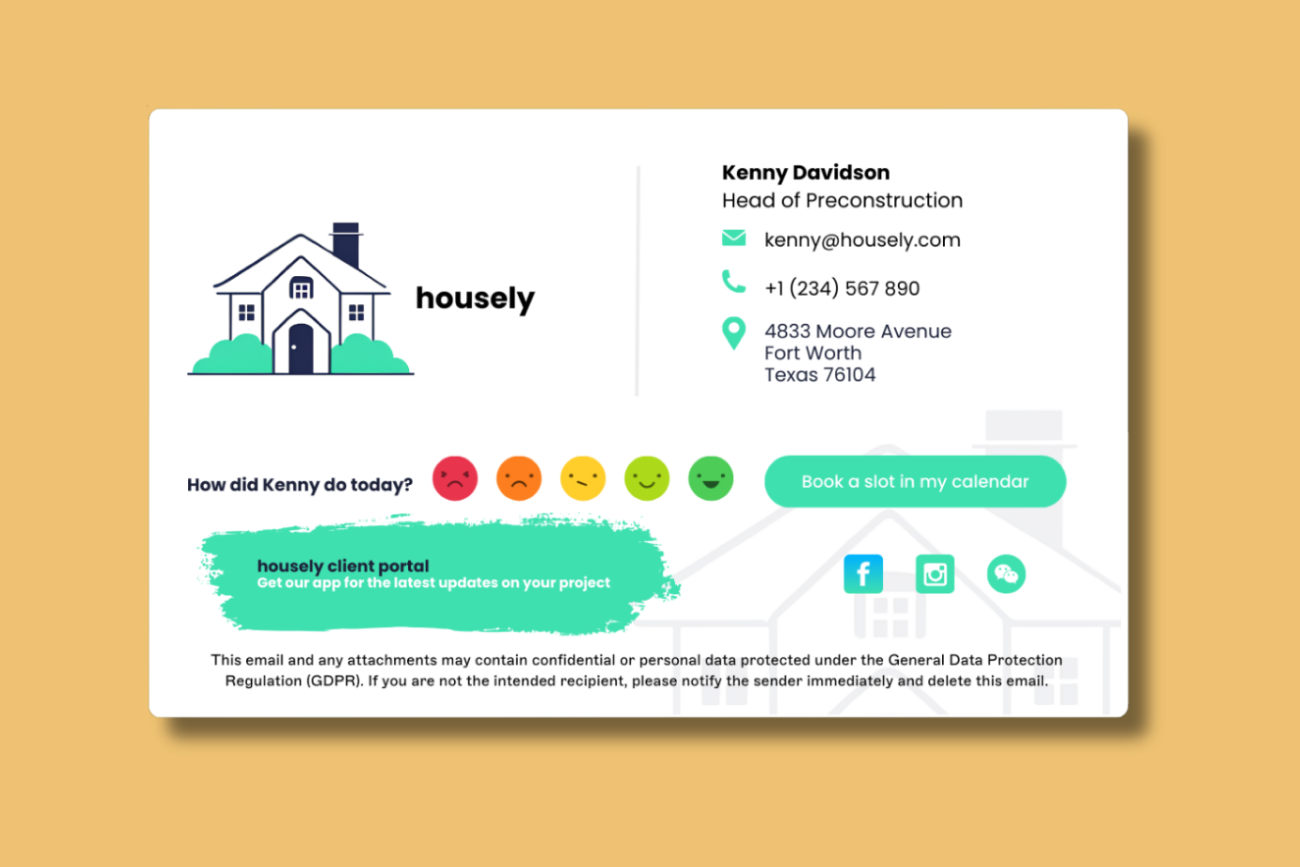
[COMPANY] is committed to ensuring the security and protection of the personal information that we process, and to providing a compliant and consistent approach to data protection. If you have any questions related to our GDPR compliance, please contact our Data Protection Officer or make a Data Subject Access Request.
This email may contain personal data processed under GDPR. For privacy queries, see our Privacy Policy at [URL] or write to [email protected].
13. HIPAA email disclaimers
Quick answer
A HIPAA email disclaimer warns recipients that a message may contain protected health information (PHI) and tells them what to do if it reaches the wrong person.
Use when: A HIPAA covered entity or business associate sends email that contains, references, or relates to a patient's PHI, including appointment confirmations, test results, billing details, and care coordination.
Legal note: HIPAA doesn't prescribe wording for an email disclaimer, and a disclaimer doesn't make an organization compliant. Encryption, access controls, staff training, and breach procedures do that work, as described by the Office for Civil Rights at the U.S. Department of Health and Human Services (HHS).
For more wording, see the top HIPAA email disclaimer examples.
Please note that this email may contain protected health information (PHI). Any unauthorized use or disclosure of this PHI is strictly prohibited. If you have received this message in error, please notify the sender immediately and delete this email from your system.
14. Financial services disclaimers
Quick answer
A financial services disclaimer identifies the firm, states its regulatory status, and says the email isn't investment advice or an offer to trade.
Use when: A regulated firm sends client-facing email about securities, investment products, portfolio commentary, or market analysis that could be read as a recommendation.
Legal note: FINRA Rule 2210 sets standards for communications with the public in the U.S., and FCA rules apply in the UK. Required wording depends on the regime, the instrument, and whether the client is retail or professional, so a compliance officer needs to approve it before use.
This email is a communication from [Firm Name], [a registered investment adviser / broker-dealer] regulated by [FINRA / the FCA / relevant regulator]. It is intended solely for the named recipient and may not be redistributed without written consent. Nothing in this message constitutes investment advice, a personal recommendation, or a solicitation to buy or sell any security or financial instrument. The value of investments can fall as well as rise, and past performance is not a reliable indicator of future results. Please refer to your client agreement and our [Form ADV Part 2 / Key Information Document] for full disclosures.
15. Newsletter and unsubscribe disclaimer
Quick answer
A newsletter disclaimer identifies the sender and gives a working way to unsubscribe, which commercial email to a list needs under CAN-SPAM in the U.S., CASL in Canada, and GDPR in the EU.
Use when: Any commercial email goes to a mailing list, including newsletters, product announcements, event invitations, and promotional offers, whether or not recipients opted in.
Legal note: CAN-SPAM requires a working unsubscribe method and a physical postal address in every commercial message. Civil penalties reach $53,088 per email under the Federal Trade Commission's (FTC) 2025 inflation adjustment, which still applies in 2026 because the FTC made no adjustment for 2026. CASL adds explicit consent requirements, and GDPR requires an opt-out in marketing email to EU recipients.
You're receiving this email because you opted in to communications from [Company Name]. To stop receiving emails like this, unsubscribe here [link]. [Company Name] | [Registered address].
This message was sent to [recipient email] as part of [Company Name]'s [newsletter name / mailing list]. We send [frequency] emails covering [topic]. To unsubscribe at any time, click [link] or reply with "unsubscribe" in the subject line. [Company Name], [Address], [City, State/Country, ZIP/Postal Code].
16. Affiliate disclaimers
Quick answer
An affiliate disclaimer tells readers you may earn a commission on links or recommendations in an email.
Use when: An email carries referral links, partner promotions, or sponsored content from which the sender earns a commission, fee, or other benefit.
Legal note: In the U.S., the FTC's Endorsement Guides (16 CFR Part 255) call for disclosure of material connections, as the FTC's guidance on digital advertising disclosures explains. In the UK, the Advertising Standards Authority (ASA) and the CAP Code apply. The disclosure has to be clear and prominent, so a buried footnote won't meet the standard.
Some links or references in this email may be affiliated with [Your Company] partners. This means we may receive a commission if you choose to make a purchase through those links. All opinions remain our own.
Which disclaimers build trust or set expectations?
17. Phishing and impersonation warnings
Quick answer
A phishing warning tells recipients what your organization will never ask for by email and where to send suspicious messages, so they have a reference point when judging a message.
Use when: Customer-facing email comes from an organization that handles payments or credentials or gets impersonated by fraudsters, such as banks and online retailers.
Legal note: It isn't a general legal requirement, though sector rules can differ. Update the wording whenever your official sender domain or security contact address changes.
[Company Name] will never ask you to share passwords, payment details, or personal credentials by email. If you receive a message claiming to be from us that requests this information, do not respond. Forward it to [email protected] and delete it immediately.
Genuine emails from [Company Name] are always sent from addresses ending in @example.com. If you're unsure whether an email is from us, don't click any links or open attachments. Contact us directly at [phone number] or [verified email address] to check.
18. Environmental disclaimers
Quick answer
An environmental disclaimer asks recipients to think before printing an email. A small green icon sometimes goes with it. For more wording, see environmental email footers.
Use when: Any business email comes from an organization with a stated sustainability policy or environmental commitments.
Legal note: It isn't a general legal requirement. It's a statement of values, and sector rules can differ.
Please consider the environment before printing this email. Every unprinted email helps protect the environment.
Please consider your environmental responsibility. Before printing this email message, ask yourself whether you really need a hard copy.
19. AI disclaimers
Quick answer
An AI disclaimer says an email was drafted, summarized, or reviewed with artificial intelligence tools. An email an AI tool wrote carries a different risk than one it only proofread, so the wording should match which of the two happened.
Use when: An AI tool generated, drafted, or materially edited the message, particularly in financial services, healthcare, and legal work, where accuracy carries professional or regulatory weight.
Legal note: Article 50 of the EU AI Act sets transparency rules and applies from August 2, 2026, as the Cloud Security Alliance summarizes. It covers chatbots and virtual assistants that interact with people. It also covers the marking of AI-generated output by providers, and the labeling of deepfakes and of AI-generated text published to inform the public on matters of public interest. That last duty falls away where a person reviews the text and takes editorial responsibility.
Whether a given AI-assisted business email falls inside any of these is a question for your legal team. They should review the wording before you apply one disclaimer across the organization.
This message may contain content created or reviewed using artificial intelligence tools. While every effort has been made to ensure accuracy, [Your Company] advises verifying important details before relying on the information provided.
Parts of this email may have been drafted or reviewed with the assistance of AI tools. This content has been checked by a qualified member of our team, but it should not be relied on as legal, financial, or medical advice. If you have questions about the accuracy of anything in this message, please contact us directly.
20. Estimated response time disclaimer
Quick answer
A response time disclaimer tells people how long to expect to wait for a reply from a shared or high-volume inbox.
Use when: Email comes from or relates to an address such as support@, billing@, info@, or hello@, where reply times vary and people are likely to follow up if they hear nothing.
Legal note: It isn't a general legal requirement. Specific commitments can read like service level promises, so avoid wording that mirrors contractual service level agreement (SLA) terms. Check with legal if customers have response-time obligations in their contracts.
This inbox is monitored Monday to Friday, 9 a.m. to 5 p.m. [time zone]. Our team typically responds within two business days. For urgent matters, please call [phone number].
Thank you for contacting [Company Name]. Due to high message volume, our current response time is up to [X] business days. If your matter is time-sensitive, please reference your case number in any follow-up or call us directly at [phone number].
Are email disclaimers legally binding?
Only to a limited degree. A disclaimer can show the sender took reasonable care, and it can support a legal claim if confidential material is misused. It can't stop a recipient from forwarding an email or acting on what it says, and courts treat it as evidence of intent. How much weight it carries depends on the jurisdiction, the type of disclaimer, and how the information was used.
"Email signatures and disclaimers can be an underrated area. They look small, and we're all so used to seeing them at the bottom of a message, but they carry mandated information in a number of jurisdictions and industries, and that information is often determined by regulatory requirements. Not having them, or not being able to show you had them on particular communications, can cause you an evidence problem."

In regulated sectors such as healthcare, financial services, and legal work, a disclaimer sits inside a wider compliance program, and the regulator's own requirements come first.
Disclaimers also rank behind a branded email signature as a trust signal. In the U.S. results of Exclaimer's 2026 When it Matters research, run with OnePoll (1,000 adults), 17% said legal disclaimers make a company email feel more trustworthy, against 23% for a professional, branded email signature.
What makes an email disclaimer fail?
A disclaimer that runs past 150 words buries the one or two protections you need, and multi-language blocks make it worse.
Threats and all-caps warnings read as defensive, and a polite request to notify the sender and delete the message does the same job.
Disclaimers repeat down a thread, because each reply quotes the earlier messages, footers included, and each sender's own disclaimer can be added on top. Microsoft's Exchange Server documentation describes adding an exception to a mail flow rule so it skips messages that already contain the disclaimer (organization-wide disclaimers in Exchange Server).
Disclaimers drift out of date when departments copy and adapt their own versions. Exclaimer COO Jim Turner has written about how it plays out in manufacturing: "Procurement may use one version, finance another, and operations something slightly different again. Over time, language drifts away from current policy, updates are missed, and variations multiply."
Laws, company details, and data practices change, so review the wording at least once a year, and sooner when legislation, jurisdiction, corporate structure, or data processing changes.
Compliance rests on encryption, access controls, a published privacy notice, and staff training, with the disclaimer alongside them.
How to write an effective email disclaimer
An effective email disclaimer should be concise (under 150 words), written in plain language, and include only the legal protections your organization actually needs.
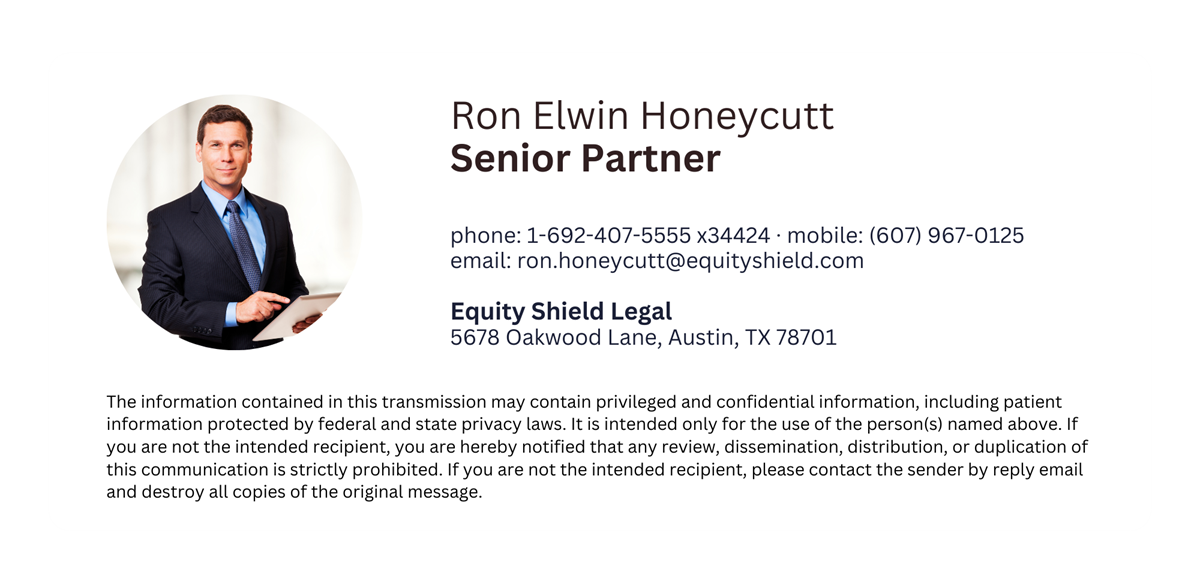 Follow these best practices to ensure your disclaimers are accurate, clear, and compliant:
Start with what your jurisdiction or regulator requires, then add the protections your business needs, such as confidentiality or liability limits.
Use plain language, short sentences, and normal capitalization. Avoid legal jargon and all caps.
Keep the tone professional and neutral. "We accept no responsibility for anything whatsoever" sounds defensive.
Separate the disclaimer from the message and the email signature with a divider line or a smaller font.
If you send email from several countries, use versions that follow each region's rules and language. One text won't fit every jurisdiction.
Have your legal or compliance team review the wording.
How to add an email disclaimer in Microsoft 365 and Google Workspace
Microsoft 365 and Google Workspace both include native options for appending text to outgoing email, but both have limitations that make them difficult to manage at scale.
Microsoft 365
An Exchange admin creates a mail flow rule in the Exchange admin center (Mail flow > Rules) that adds the text to messages. By default a rule applies to incoming and outgoing messages, so you add a condition, such as recipients outside the organization, to limit it to outgoing mail. Different disclaimers for different groups mean separate rules with their own conditions.
For a step-by-step guide: How to add an email disclaimer in Microsoft 365
Google Workspace
A Google Workspace admin sets the footer in the Admin console under Apps > Google Workspace > Gmail > Compliance > Append footer. It applies to everyone in the organizational unit you select, and child organizations inherit it. The footer editor doesn't support HTML, and images have to come from a public web address.
For a step-by-step guide: How to add an email disclaimer in Google Workspace
Managing disclaimers across both platforms
For organizations running both Microsoft 365 and Google Workspace, or those that need different disclaimers for different teams, regions, or message types, native tools require separate rule sets with no shared management layer.
Exclaimer's Disclaimers feature covers both platforms from one interface, with full HTML formatting, rules-based targeting, and a single update mechanism. See the management section below for more on how that works in practice.
How to manage email disclaimer templates in your company
Getting disclaimer text right is one thing. Making sure every employee is running the right version consistently, across every team, region, and hire is the harder problem. When legal updates a requirement, how quickly does that change reach every outgoing email? When a regulation applies to one department and not another, is there a way to target it precisely? Manual management doesn't scale for either scenario.
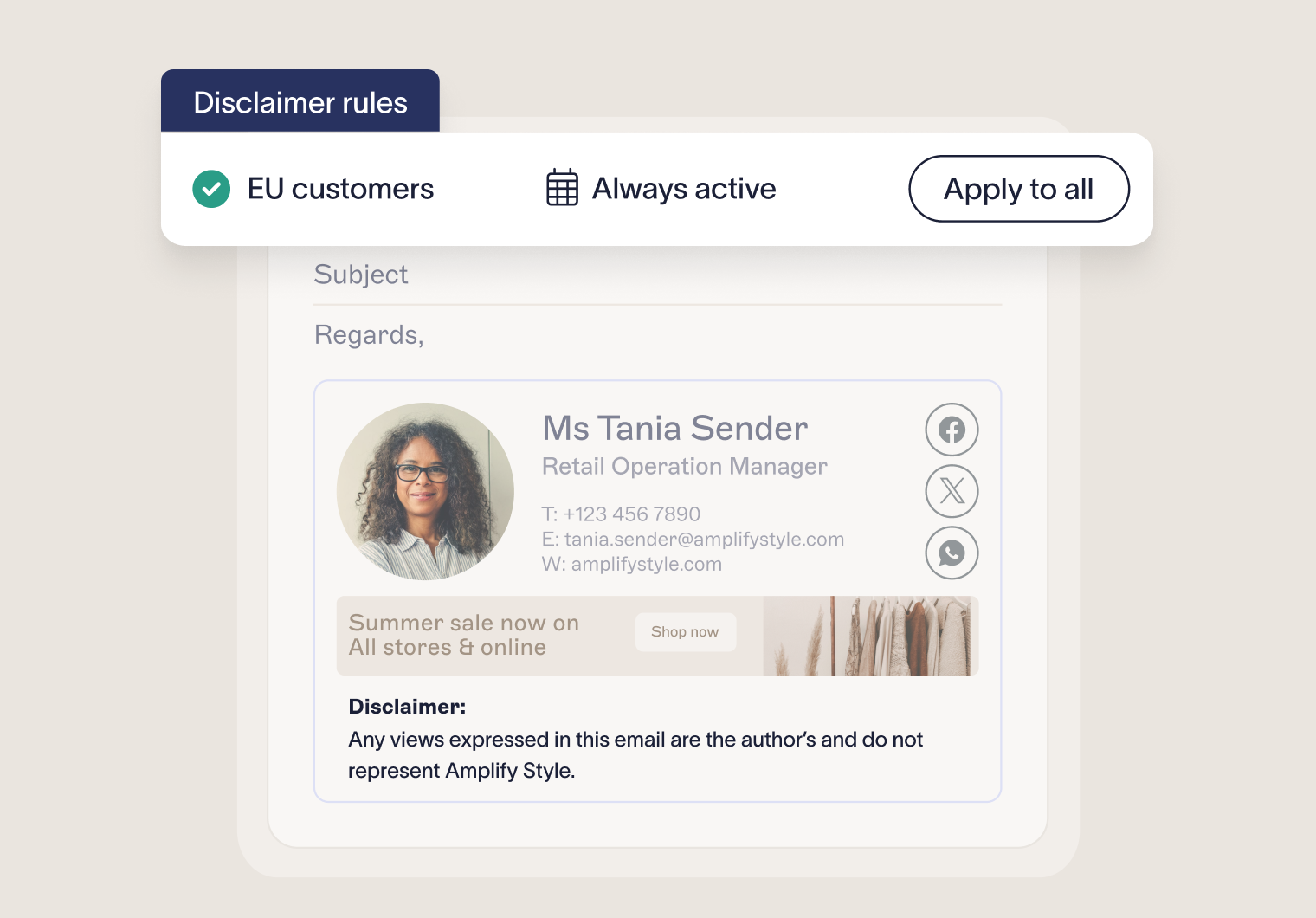
Most organizations start by managing disclaimers manually or through native platform tools: Exchange transport rules in Microsoft 365 or the footer settings in Google Workspace. Both work for a simple, static disclaimer applied to everyone. For compliance requirements that need conditional targeting by team, region, or role — or for organizations running both platforms — native tools require separate rule sets with no shared management layer.
Exclaimer manages disclaimers for 80,000+ organizations, processing over 20 billion email signatures every year according to Exclaimer platform data. With the Disclaimers feature, a single update automatically propagates to every employee. No relying on users to update their own email signature templates, no risk of different teams running different versions of legally required wording, and no separate rule sets to maintain across platforms.
Create a standard template: Develop an email disclaimer template that covers all necessary information and ensure it's used by all employees in the organization. This will help maintain consistency across communications from different departments or individuals.
Train employees: Educate employees on the importance of using email disclaimers and how to properly use them in their communications. This can help prevent errors, such as forgetting to include the disclaimer or using incorrect language.
Regularly review and update: It's crucial to regularly review and update your email disclaimer to ensure compliance with any legal or regulatory changes. Be sure to communicate these updates to all employees and make the necessary changes in their email signatures.
Enforce compliance: Monitor employee communications to ensure they are consistently using the required email disclaimer. This can help prevent potential legal issues and maintain brand consistency.
Use Exclaimer's Disclaimers feature: Exclaimer lets IT admins centrally assign and update legal text across every employee's email signature — no individual template edits needed. Rules-based targeting means different disclaimer text for different teams, regions, or user groups, applied automatically. When a compliance requirement changes, one update in the platform reaches everyone.
“Managing legal disclaimers shouldn’t be such a manual process. Our Disclaimers feature gives organizations the control and flexibility they need to remain compliant, save time, and reduce risk by not relying on end users to get it right. By centralizing disclaimer management, legal messaging is always accurate and up to date, no matter how large or complex the organization is.”