Naimh is a seasoned marketer of 12 years, including in SaaS and tech. She’s an expert at simplifying complex technology concepts, bridging the gap between IT and marketing. Naimh specializes in turning tech speak into actionable insights, helping marketers get the most out of their tools and technology.
The use of email signature quotes (40 examples)
TL;DR
A quote earns its place in a business email signature only when it's chosen for the brand, not by whoever happens to be sending the email.
Personal, motivational, or humorous quotes belong in personal email, not business correspondence.
Centrally managed email signature software fixes what represents the brand and leaves a smaller, defined set of fields, like pronouns or working hours, open to the individual.
When a quote earns its place in a signature
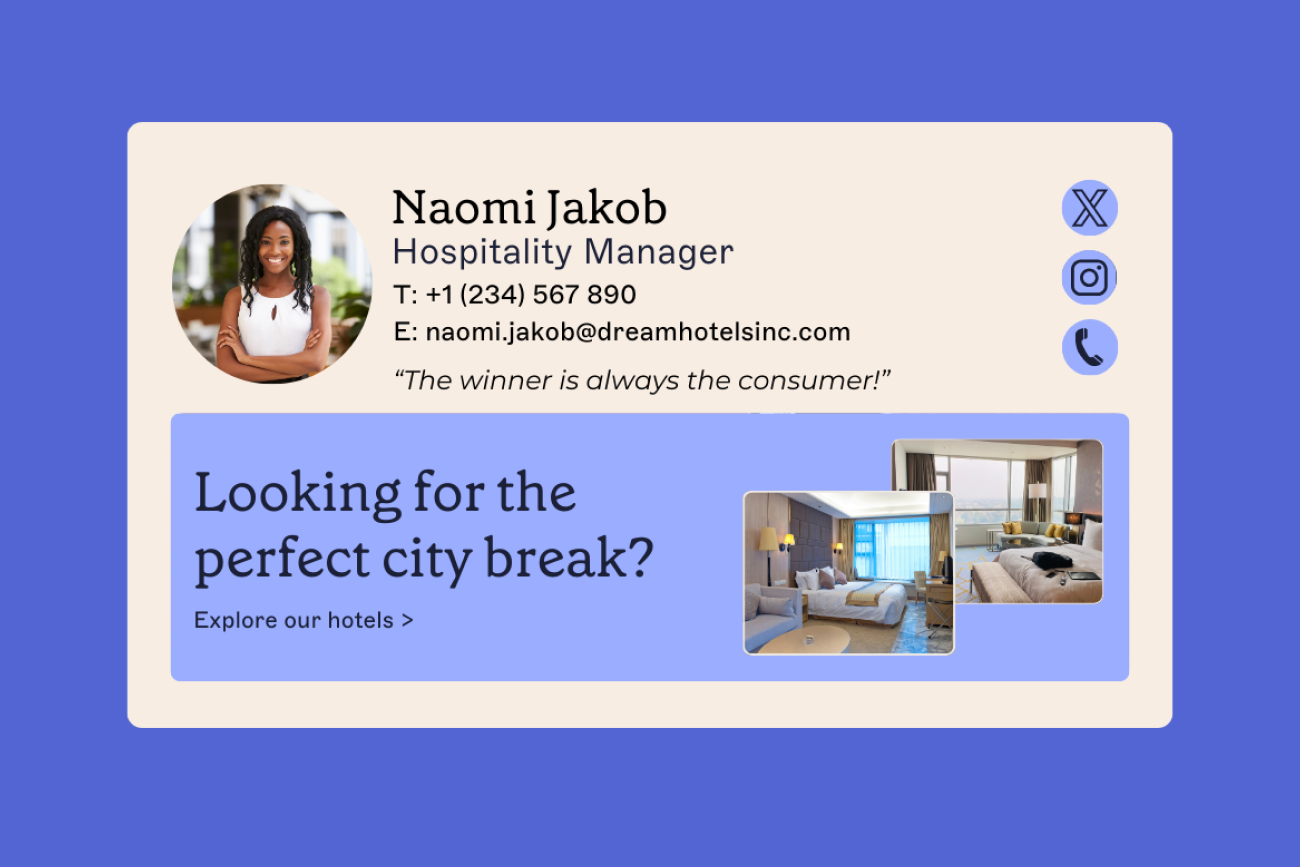
Nike's "Just Do It" and McDonald's "I'm Lovin' It" make good email signature quotes because nobody picked them off the cuff. Both are brand assets, decided once by the company and used everywhere the brand appears, including the bottom of every email:
Nike: "Just Do It"
McDonald's: "I'm Lovin' It"
L'Oréal: "Because You're Worth It"
BMW: "The Ultimate Driving Machine"
Tesco: "Every Little Helps"
KitKat: "Have a Break, Have a KitKat"
A tagline works in a signature for the same reason it works on a billboard: someone decided, once, exactly what it should say, and it doesn't change depending on who happens to be typing. That's also what makes it different from a quote an employee picks for themselves, however well-intentioned.
What letting employees choose actually risks
Most of what goes wrong when an email signature is left to individual choice is closer to embarrassing than dangerous. In fact, a quote that clashes with the brand voice, or a tagline nobody in Marketing approved, can create real pushback.
Brigham Young University's Marriott School tells staff to avoid quotes in email signatures outright, because "anything you include in it will communicate on behalf of BYU." Texas A&M's College of Engineering goes further and bans personal quotes from email signatures entirely. Occasionally, the stakes are much higher than a style guideline.
"Take the example of political statements being put in an email signature by one business unit somewhere in a global company. Someone is taking a side and appearing to stand for the entire company, and that goes on social media and spreads, and suddenly the company's stock price dips. All because one person put something in their own email signature."
Source: Reduce risk & reclaim IT time with modern email management
No one in Legal or Marketing reviewed that message before it went out. One person added a line to their own signature, and it left the building thousands of times before anyone noticed. Whatever a signature contains goes out under the company's name the moment someone hits send, whether that's a stray political opinion or an unapproved tagline.
Pull up ten employee signatures at random and read what's actually in them. It costs nothing, and it's a useful first step.
Quotes and personality still have a place in a signature. The point is that someone other than the sender, typically IT and Marketing working from the same approved list, should decide what's fixed and what's flexible, checked once rather than left to individual judgment in the moment.
What to centralize, and what to leave personal
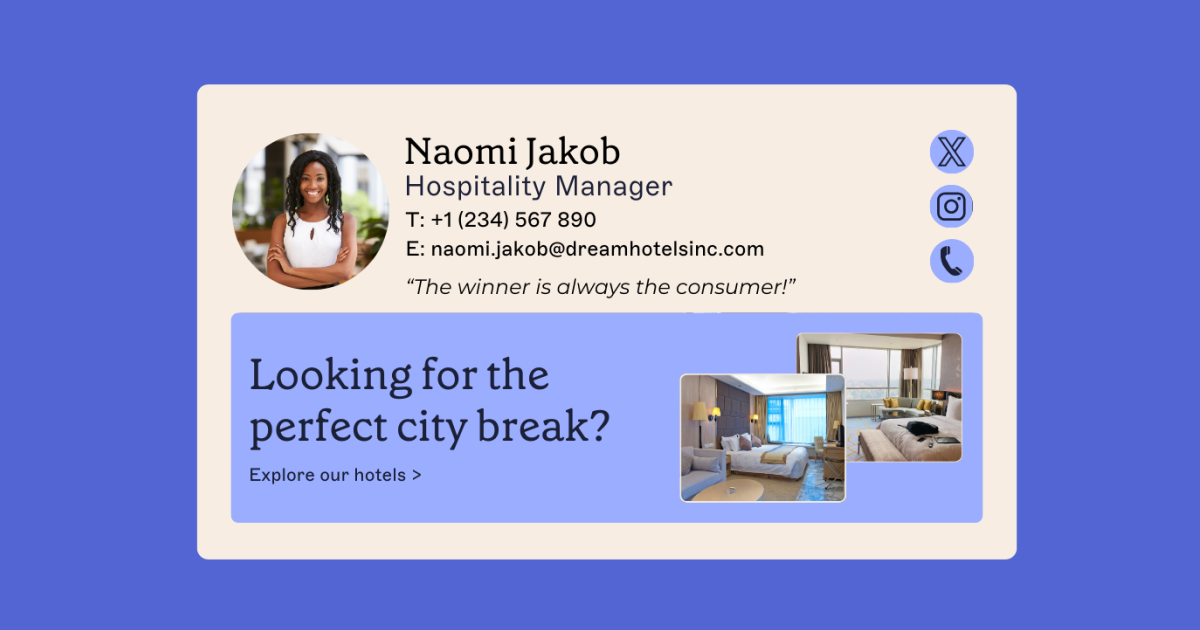
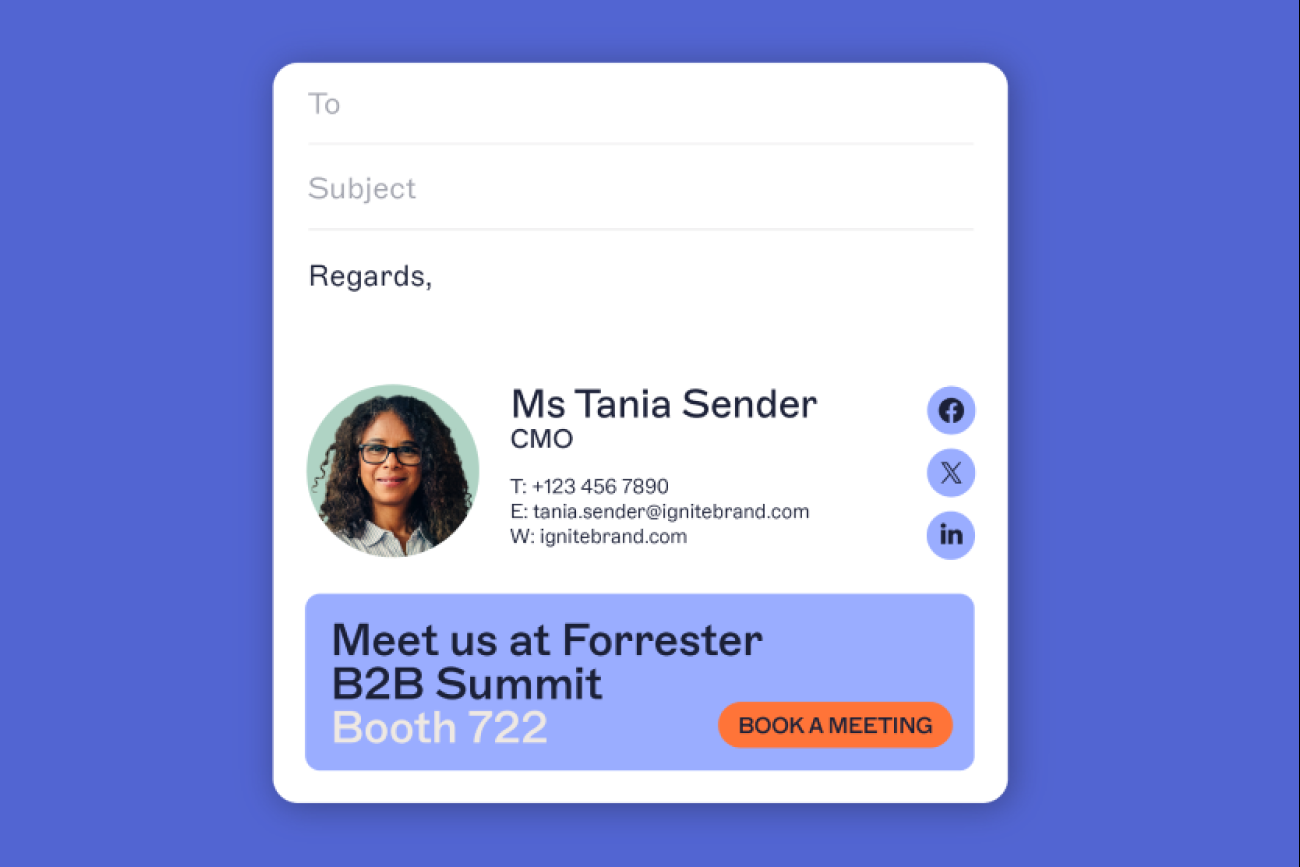
Splitting control between company and individual is how most email signature software handles this. The tagline, the logo, the legal disclaimer, and the layout stay fixed across the company, decided once and left alone. Pronouns, working hours, a phone number, and a professional certification stay open to the individual, because that information genuinely belongs to them.
Exclaimer's User Details Editor handles that second set. Employees update their own details without opening a ticket with IT, and without touching anything that represents the company rather than the person.
Role-Based Access Control (RBAC) extends the same logic to the tagline itself. Marketing can update the approved line every signature uses when the brand refreshes it, without filing an IT ticket, while individual employees still can't swap it out for something of their own choosing. For the fuller version of setting this up, Exclaimer's guide to building a company email signature policy walks through how to set the rules once and apply them everywhere.
If you want a quote for personal email
Personal email is where a favorite quote belongs. Nothing about a personal message represents the company, so the earlier risk doesn't apply, and a well-chosen quote adds warmth rather than confusion.
From historical figures
“Strive not to be a success, but rather to be of value.” Albert Einstein
“Remember that not getting what you want is sometimes a wonderful stroke of luck.” Dalai Lama
“Take the first step in faith. You don’t have to see the whole staircase, just take the first step.” Dr Martin Luther King Jr.
“If you want to lift yourself up, lift up someone else.” Booker T. Washington
“Success is not final; failure is not fatal: It is the courage to continue that counts.” Winston Churchill
“I’m a greater believer in luck, and I find the harder I work the more I have of it.” Thomas Jefferson
“Time is money.” Benjamin Franklin
“The secret of change is to focus all your energy not on fighting the old but on building the new.” Socrates
“Nurture your mind with great thoughts. To believe in the heroic makes heroes.” Benjamin Disraeli
“Concentrate all your thoughts upon the work in hand. The sun’s rays do not burn until brought to a focus.” Alexander Graham Bell
“Only those who will risk going too far can possibly find out how far one can go.” T.S. Elliot
“Don’t judge each day by the harvest you reap but by the seeds that you plant.” Robert Louis Stevenson
“You can’t use up creativity. The more you use, the more you have.” Maya Angelou
“We can’t help everyone, but everyone can help someone.” Ronald Reagan
“However difficult life may seem, there is always something you can do and succeed at.” Stephen Hawking
“Life isn’t about finding yourself. Life is about creating yourself.” George Bernard Shaw
“Yesterday is not ours to recover, but tomorrow is ours to win or lose.” Lyndon B. Johnson
“Action is the foundational key to all success.” Pablo Picasso
“We are what we repeatedly do. Excellence then is not an act but a habit.” Aristotle
“Believe you can and you’re halfway there.” Theodore Roosevelt
From business leaders
“I never dreamed about success. I worked for it.” Estée Lauder
“Always deliver more than expected.” Larry Page
“When everything seems to be going against you, remember that the airplane takes off against the wind, not with it.” Henry Ford
“Be undeniably good. No marketing effort or social media buzzword can be a substitute for that.” Anthony Volodkin
“Your most unhappy customers are your greatest source of learning.” Bill Gates
“When we strive to become better than we are, everything around us becomes better too.” Paulo Coelho
“When you find an idea that you just can’t stop thinking about, that’s probably a good one to pursue.” Josh James
“The fastest way to change yourself is to hang out with people who are already the way you want to be.” Reid Hoffman
“Don’t try to be original, just try to be good.” Paul Rand
“If you are working on something that you really care about, you don’t have to be pushed. The vision pulls you.” Steve Jobs
“Every day that we spent not improving our products was a wasted day.” Joel Spolsky
“Anything that is measured and watched, improves.” Bob Parsons
“It’s more effective to do something valuable than to hope a logo or name will say it for you.” Jason Cohen
“Whenever you see a successful business, someone once made a courageous decision.” Peter Drucker
“The first one gets the oyster, the second gets the shell.” Andrew Carnegie
“A satisfied customer is the best business strategy of all.” Michael LeBoeuf
“Failure defeats losers, failure inspires winners.” Robert T. Kiyosaki
“If you don’t drive your business, you will be driven out of business.” B. C. Forbes
“If you don’t understand the details of your business you are going to fail.” Jeff Bezos
“Great companies are built on great products.” Elon Musk
No off-piste quotes. Full signature conformity
With Exclaimer, you ensure that end users can’t add their own email signature quotes to business messages. In fact, they won’t be able to update their signatures at all.
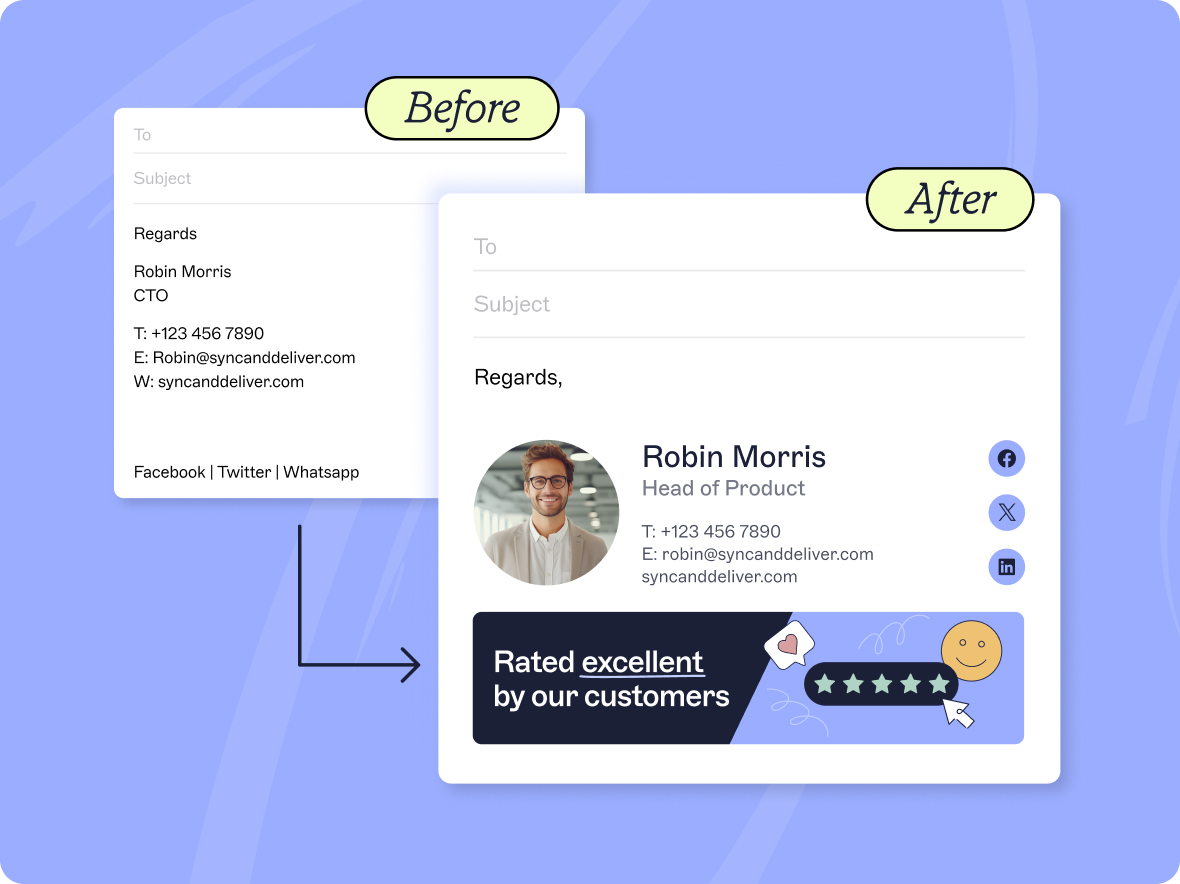
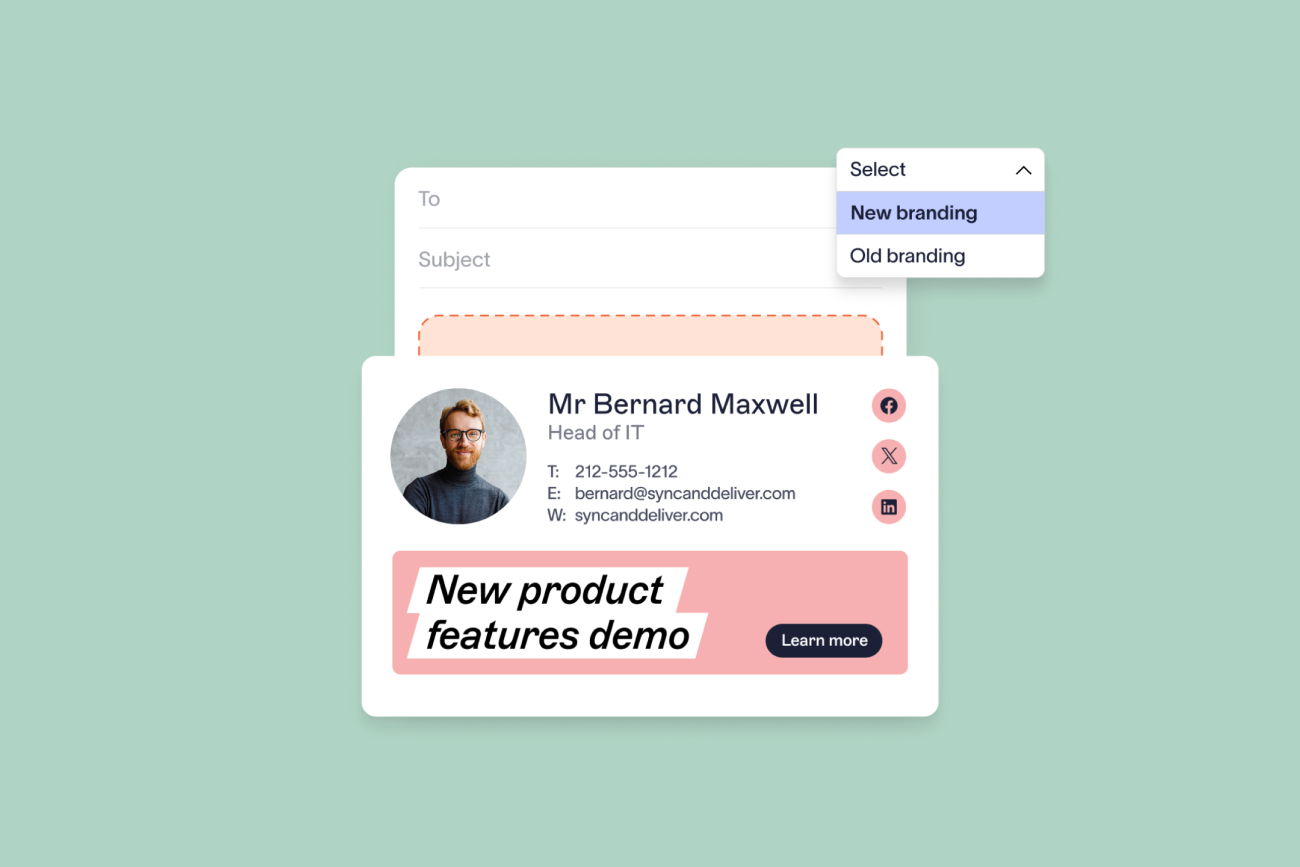
All templates are controlled from one central location, giving you full control of what appears in every message.
Learn more about using Exclaimer for email signature management.