Dave is a marketing expert with 15 years experience in the tech and SaaS world. He specializes in educating IT and channel audiences, with a focus on security, privacy, compliance, and marketing technology. With a talent for storytelling and a deep understanding of the industry, Dave transforms complex IT topics into clear, engaging, and impactful narratives.
The top 5 HIPAA email disclaimer examples
TL;DR
A HIPAA email disclaimer is a statement added at the end of an email that contains PHI (Protected Health Information)
An effective HIPAA disclaimer should clearly state that the email contains PHI, include instructions for handling the information properly, and be clearly visible
Short HIPAA email disclaimer: "This email may contain Protected Health Information (PHI) intended only for the named recipient. If you received this message in error, please notify the sender immediately, delete all copies, and do not use, disclose, or distribute the information."
Standard HIPAA email disclaimer: "This message and any attachments may contain Protected Health Information (PHI) protected under HIPAA, 45 CFR Parts 160 and 164. It is intended only for the individual named above. If you are not the intended recipient, any review, use, disclosure, copying, or distribution is prohibited. Please notify the sender immediately and permanently delete this message and all attachments."
HIPAA compliance extends to every email your organization sends that contains patient data. This guide covers what a HIPAA email disclaimer is, when you need one, and how to apply it consistently across your organization.
What is HIPAA?
Enacted by the U.S. Congress in August 1996, the Health Insurance Portability and Accountability Act (HIPAA) offers protection for millions of American workers by improving the portability and continuity of health insurance coverage.
It requires U.S. healthcare providers and covered entities to have technical safeguards in place to protect personal health records. These include audit controls, integrity controls, and transmission security.
What's the penalty for a HIPAA violation?
HIPAA violations are strictly prohibited and carry both civil and criminal penalties.
Civil penalties are set in tiers based on how much the organization knew about the violation and how it responded, and the amounts are adjusted for inflation every year. Following the most recent adjustment, effective January 28, 2026, they range from $145 per violation at the lowest tier up to a statutory maximum of $2,190,294 per violation category, per year, at the highest. Criminal violations are prosecuted separately by the Department of Justice and can carry fines alongside prison time of up to 10 years for the most serious cases, such as selling PHI for personal gain.
Healthcare providers continue to be cited for HIPAA violations on a regular basis.
Sources: U.S. Department of Health and Human Services (HHS) Office for Civil Rights, enforcement data; penalty figures per HIPAA Journal's coverage of the January 2026 inflation adjustment
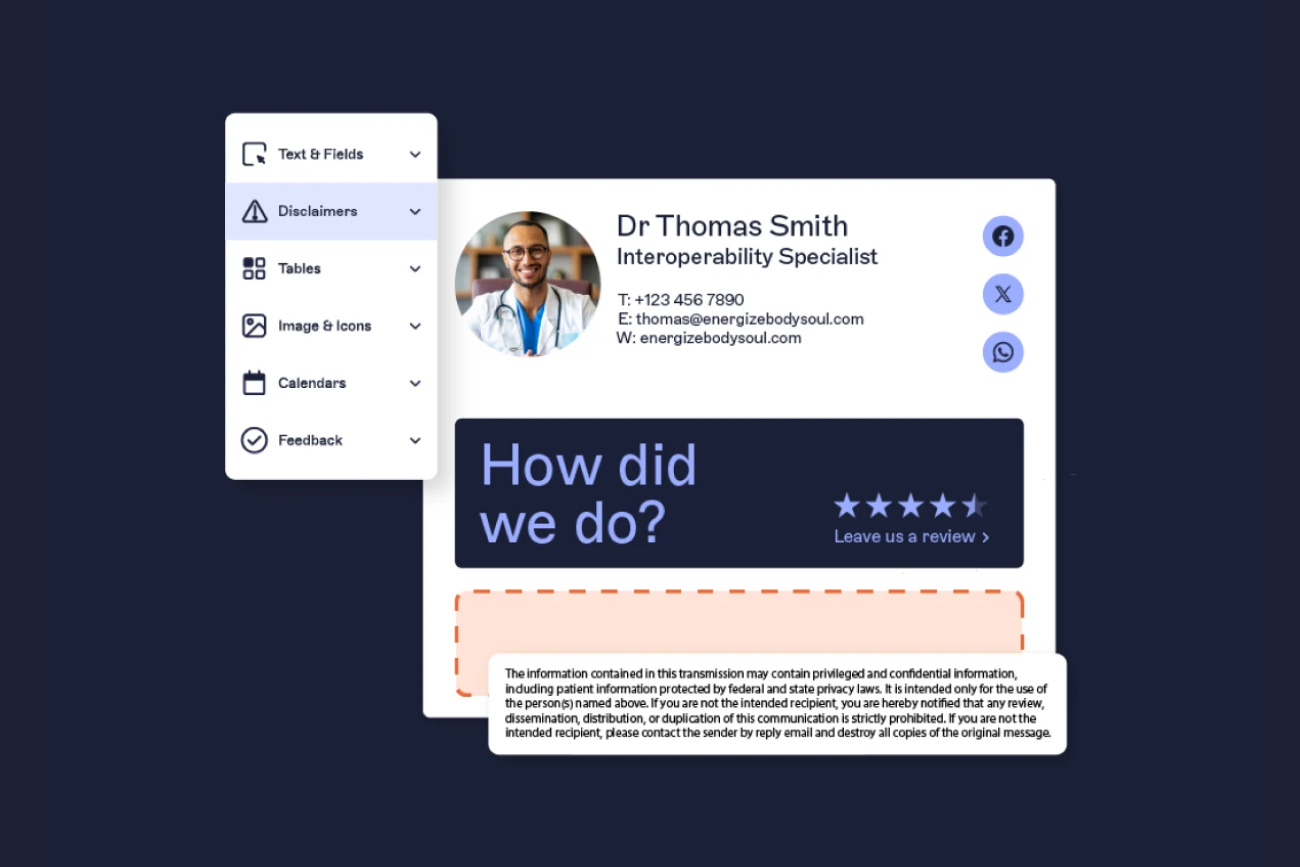
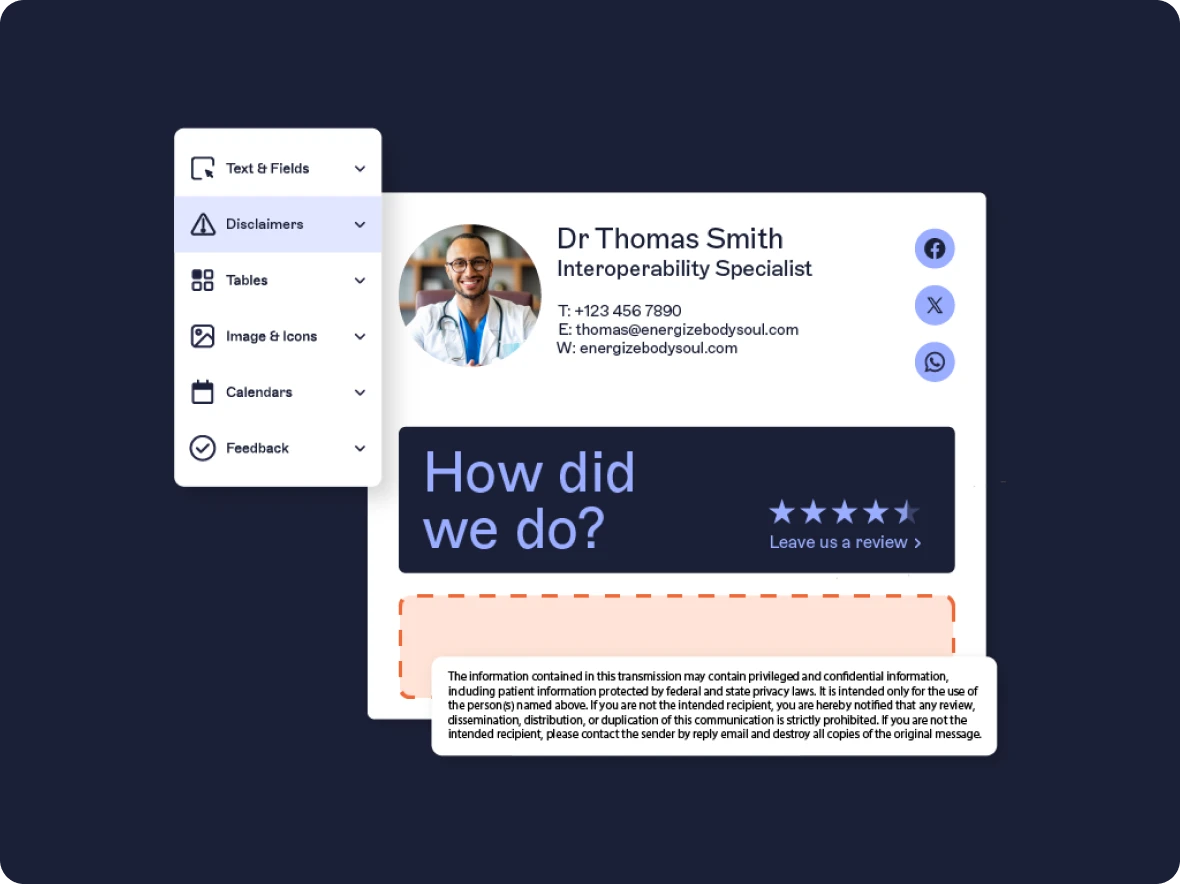
Our Disclaimers feature gives you a single place to control, assign, and update legal messaging without relying on manual edits or user intervention. Manage your disclaimers and email signatures at scale with our email signature solution.
What is a HIPAA email disclaimer?
A HIPAA email disclaimer is a statement added at the end of an email that contains PHI (Protected Health Information). Its purpose is to inform the recipient that the email contains confidential and protected health information and that any unauthorized disclosure or use of this information is strictly prohibited.
 The disclaimer also typically includes a reminder for the recipient to notify the sender immediately if they received the email by mistake, as well as instructions on how to handle the information properly.
Why a HIPAA email disclaimer is needed
HIPAA explicitly permits email communication between healthcare organizations and patients.
The problem is that email as a channel is inherently insecure. Data isn't encrypted by default, especially by popular email clients like Outlook and Gmail. This means there's no way of telling if a receiver is actually the intended recipient.
Email communications are permitted under HIPAA regulations, but specific precautions must be taken. HIPAA requires that any electronic data be encrypted and patient consent obtained in order to use their information. At the same time, every email that you send must come with a HIPAA email disclaimer to assist with full HIPAA compliance.
How does a HIPAA disclaimer keep you compliant?
A HIPAA email disclaimer keeps an organization compliant in several ways:
It's used to inform patients and recipients that information contained within an email may be PHI and isn’t 100% secure. This means any recipient who chooses to reply with confidential information does so at their own risk.
It also encourages people who shouldn't be reading the message to forward it to the correct party.
A HIPAA email disclaimer can also tell patients not to disclose personal information. Examples include their date of birth or medical information.
The disclaimer is designed to reduce your liability if patient data is intercepted by unknown parties and used for unlawful purposes.
It’s worth remembering that a compliant HIPAA email disclaimer is designed only to inform. It won’t make your organization 100% compliant. HIPAA is designed to put patients first. This means your disclaimer needs to inform recipients of the risks related to their correspondence.
HIPAA isn't the only framework email disclaimers answer to, either, which is worth knowing before treating a disclaimer as a one-off legal task.
"Most regions don't legally mandate a disclaimer word-for-word, but they're expected: HIPAA and GLBA in US healthcare and banking, FISMA for federal information systems, CCPA in California, PIPEDA in Canada, the UK Companies Act, GDPR and the EU company law directives, plus LGPD in Brazil, PDPA in Singapore and Australia's Privacy Act."
For a healthcare organization operating across state lines or with an international patient base, that means a HIPAA disclaimer usually isn't the only one a compliance officer needs to think through.
Five ready-to-use HIPAA email disclaimer examples
The following five examples cover the most common HIPAA compliance scenarios. Copy the one that fits your organization and adapt it as needed.
Use this table to find the right example for your situation:
Example | Best used for |
|---|---|
1. Basic HIPAA disclaimer | General outbound healthcare email |
2. Comprehensive disclaimer | Clinical, billing, and referral teams |
3. Confidentiality notice | All outbound email from covered entities |
4. Patient-facing warning | Patient-initiated email communication |
5. Practice email policy | Healthcare practices managing unencrypted email |
1. Basic HIPAA email disclaimer
This email may contain Protected Health Information (PHI) protected under HIPAA, 45 CFR Parts 160 and 164. It is intended only for the named recipient. If you received this message in error, please notify the sender immediately at [email/phone], permanently delete all copies, and do not use, disclose, copy, or distribute the information.
2. Comprehensive HIPAA email disclaimer
This transmission may contain privileged and confidential information, including Protected Health Information (PHI) protected by the Health Insurance Portability and Accountability Act of 1996, 45 CFR Parts 160 and 164, and applicable state privacy laws. It is intended only for the named recipient or authorized representative. If you are not the intended recipient, any review, use, disclosure, copying, forwarding, or distribution is strictly prohibited. If you received this message in error, please notify the sender immediately by reply email or at [phone], then permanently delete this message and all attachments.
3. Confidentiality statement
WARNING: CONFIDENTIALITY NOTICE — This transmission may contain Protected Health Information (PHI) protected under HIPAA and applicable state privacy laws. It is privileged communication intended solely for the named recipient. If you are not the intended recipient, any review, disclosure, copying, distribution, or use of this information is strictly prohibited. If you received this transmission in error, please notify the sender immediately at (xxx) xxx-xxxx or [[email protected]] and permanently delete all copies.
4. Patient-facing HIPAA email disclaimer
Email may not be a secure method for transmitting Protected Health Information (PHI). Please do not include medical record numbers, dates of birth, diagnoses, treatment details, insurance information, Social Security numbers, or other sensitive health information in emails to us. To send PHI securely, use our patient portal at [link] or call us at [phone]. Email communication does not replace diagnosis, treatment, or evaluation by a licensed healthcare provider. For emergencies, call 911 or go to the nearest emergency room.
5. Healthcare practice email policy
[Practice Name] protects Protected Health Information (PHI) using safeguards required under HIPAA's Security Rule, 45 CFR §164.312. Because standard email and text messaging may not provide adequate protection for PHI, it is the policy of [Practice Name] not to send PHI through unencrypted email or SMS. To receive health information electronically, use our secure patient portal at [link] or call us at [phone] to discuss your communication options.
What a HIPAA email disclaimer can and can't do
HIPAA does not prescribe specific email disclaimer wording. Under the HIPAA Privacy and Security Rules (45 CFR Part 164), covered entities and business associates must protect PHI through appropriate administrative, physical, and technical safeguards. A disclaimer supports these obligations by warning recipients that an email may contain PHI, providing instructions for misdirected messages, and documenting that your organization takes privacy seriously.
It's not a substitute for encryption of electronic PHI, access controls, staff training, risk analysis, or breach-response procedures. Review any disclaimer wording with your HIPAA privacy officer or legal counsel before deploying it organization-wide.
Source: HHS Office for Civil Rights, HIPAA for Professionals
How to create a HIPAA email disclaimer
A HIPAA email disclaimer needs the following elements:
A statement that the email may contain Protected Health Information (PHI)
Instructions for handling the information properly, such as deleting the email if received by mistake or forwarding it to the appropriate party
A reminder that recipients should not disclose any personal information in response to the email
Make sure the disclaimer is easily visible and not hidden in the email text
Update the disclaimer regularly to reflect any changes in regulations or policies
A minimal starting point: "This message may contain Protected Health Information (PHI) intended only for the named recipient. If you received it in error, notify [contact], delete all copies, and do not use, disclose, or distribute the information."
Create a HIPAA-compliant email disclaimer
Use Exclaimer’s email disclaimer generator to produce wording you can adapt to your organization quickly.

How to add a HIPAA email disclaimer to your emails
If you run a small healthcare practice, your email needs will most likely be relatively simple. This means you can probably add a disclaimer directly to your email client. You can do this on an individual basis with little IT support.
Below are a couple of guides to get you started:
For larger practices, your IT team will be responsible for ensuring all messages have an appropriate HIPAA email disclaimer. However, this is often where issues arise.
Disclaimers are notoriously difficult to manage at scale. Employees can still tamper with the messaging, important wording can be missed out, IT updates will take a considerable amount of time, and there’s the risk of legal action for noncompliance.
How to enforce HIPAA email disclaimers organization-wide
Knowing what to put in a HIPAA email disclaimer is one thing. Applying it consistently across the whole organization is another. For IT teams and compliance officers in healthcare, that's where the real challenge starts.

Managing disclaimers through native Microsoft 365, Google Workspace, or Exchange settings has real limitations for IT and compliance teams:
Users can edit or delete disclaimer text directly from their email client
Updating the wording means making the change separately across each admin area
There's no centralized point of control for tracking or auditing disclaimer consistency
Exclaimer's email signature management solution addresses each of these gaps. With Signature Rules and the Disclaimers feature, IT admins and compliance officers can:
Apply a consistent HIPAA email disclaimer to every outgoing email, regardless of which client or device the sender uses
Lock the disclaimer text so users can't edit or remove it
Manage all legal disclaimer templates from one admin console, with updates rolling out across the whole organization at once
"Healthcare IT and compliance teams ask us two things before they're comfortable putting Exclaimer in their mail flow: can users remove the disclaimer, and what do we do with the email content. The disclaimer is applied centrally, so users can't touch it. On the content side, emails pass through our platform in transit only. Nothing is stored, and there's no way for anyone at Exclaimer to access what's in those messages."