Naimh is a seasoned marketer of 12 years, including in SaaS and tech. She’s an expert at simplifying complex technology concepts, bridging the gap between IT and marketing. Naimh specializes in turning tech speak into actionable insights, helping marketers get the most out of their tools and technology.
Teacher email signature examples and best practices for schools

TL;DR
A teacher email signature should show your name, role, school, and official contact details in a consistent, structured format.
Keep the main signature block to five to eight lines so it stays readable, especially on mobile.
Follow school or district guidelines for formatting, branding, and any required disclaimer language.
Skip decorative fonts, long quotes, and personal social media links unless your school specifically permits them.
If more than a handful of staff need the same signature, standardizing it centrally beats asking every teacher to copy a template by hand.
A teacher email signature is the standardized block of information that appears at the end of every message an educator sends. It identifies the teacher, presents the school professionally, and gives parents and students clear, reliable contact information.
In school environments, consistency matters. Parents often rely on email as a primary communication channel, and every message reflects on the teacher and the institution sending it. A professional teacher email signature keeps communication clear, reduces confusion, and supports district branding standards.
A well-structured email signature for teachers typically includes a full name, role, school name, official contact details, and any required legal disclaimer. This guide covers real examples, formatting recommendations, and what to do once it's not one signature but every teacher on staff.
What is a teacher email signature?
A teacher email signature is the standardized identification block that appears at the end of every school-related email. It confirms the sender’s identity, clarifies their role within the school, and provides official contact information in a consistent format.

In educational settings, email is a primary channel between teachers, parents, administrators, and students. Where a school has set formatting or branding guidelines for staff communication, a teacher email signature should follow them rather than personal preference. Plenty of schools have no such policy at all, which is part of why signatures vary so widely from one teacher to the next.
Standardization prevents inconsistent formatting, outdated contact details, and off-brand messaging. Applied consistently across staff, a structured email signature for teachers supports clarity, accountability, and institutional credibility.
Examples of teacher email signatures
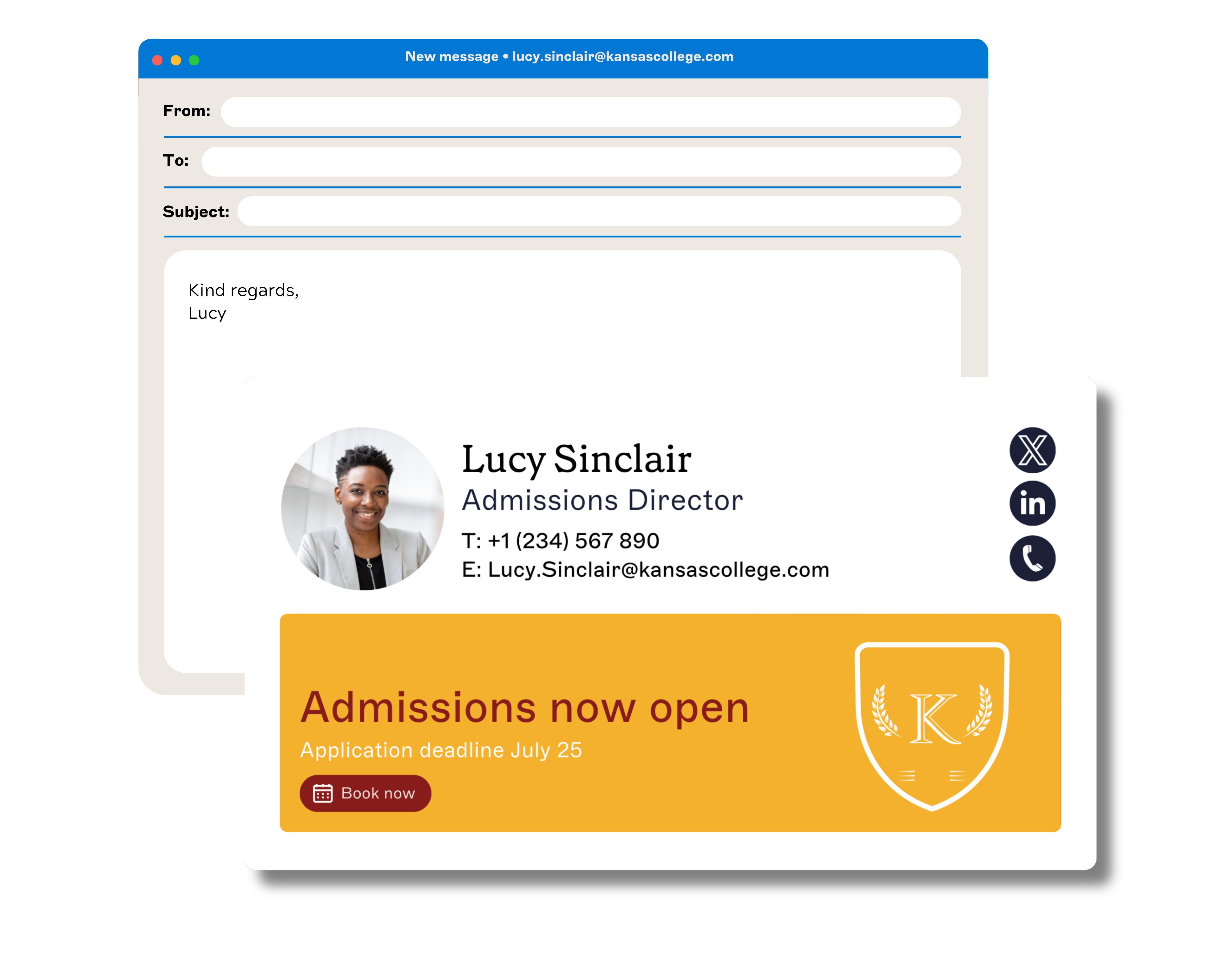
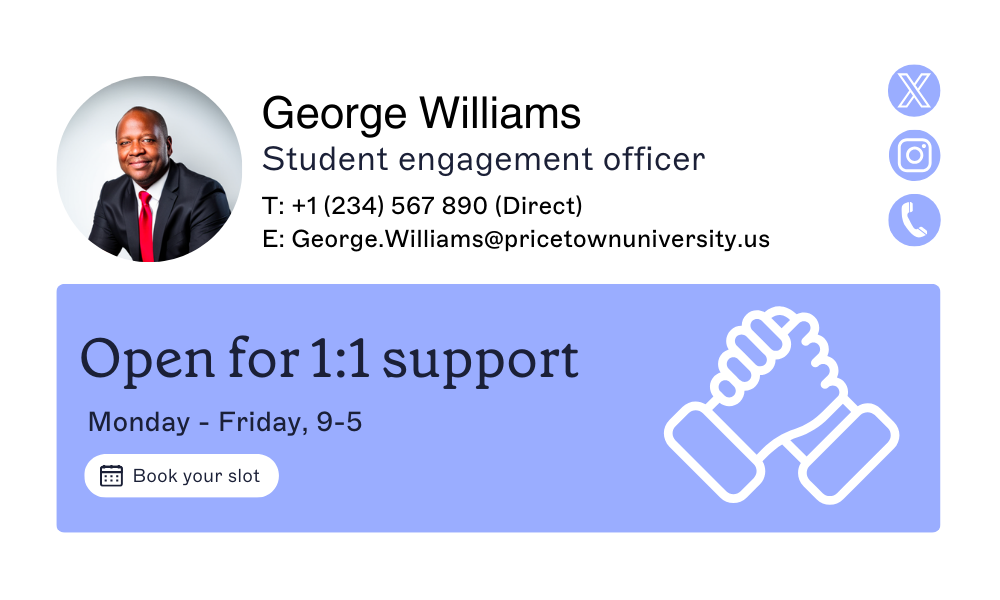
Please take a look at some teacher email signature templates we’ve designed below. These should provide inspiration you can use when creating your email signature designs.




Formatting best practices shown in these examples
Across all teacher email signature examples above:
Use consistent font size and spacing
Avoid excessive colors or design elements
Keep the signature between five and eight lines when possible
Skip long motivational quotes unless district policy allows them
Test on desktop and mobile before finalizing
What should a teacher email signature include?
A teacher email signature should contain structured, official information that lets recipients quickly identify the sender and respond appropriately. In school environments, clarity and consistency matter more than visual styling.
Required elements
A professional teacher email signature should include:
Full name – displayed clearly on the first line
Official job title or subject area – such as "3rd Grade Teacher" or "Math Department Chair"
School name – written in full, not abbreviated
School-issued email address
Direct phone number or main office line
These elements confirm identity and reduce confusion for parents and guardians.
Optional elements (based on school policy)
Some districts also require or permit:
Office hours
Department name
School website link
Legal disclaimers — check district policy before adding one, since the exact wording may need sign-off from whoever handles legal or compliance matters for the district
Confidentiality notices
- Accessibility statements
What to avoid in your teacher email signature
To keep a teacher email signature professional:
Avoid decorative fonts
Skip long motivational quotes unless your district specifically permits them
Avoid excessive colors or image-heavy formatting
Leave out personal social media links
An effective teacher email signature is structured, readable, and consistent across devices. It supports professional communication rather than drawing attention to design.
How to create a professional teacher email signature
Creating a professional teacher email signature takes structure, consistency, and alignment with school guidelines. Follow the steps below to build a signature that communicates clearly and reflects institutional standards.
Step 1: Establish identity first
Start with your full name on the first line, then list your official role or subject area immediately below. This order lets parents and administrators identify the sender within seconds.
Step 2: Add institutional context
List the full name of your school beneath your role, followed by your school-issued email address and phone number. Keeping this order consistent improves readability and reduces confusion.
Step 3: Include required compliance elements
If your district mandates legal disclaimers, confidentiality statements, or accessibility notices, check district policy before wording them, since whoever handles legal or compliance matters for the district may need to sign off on the exact language. Place them below the main signature block, separated with a line break or smaller font size to avoid visual clutter.
Step 4: Maintain clean formatting
To create a professional teacher email signature:
Use a standard, readable font
Avoid decorative script fonts
Limit color usage
Avoid image-heavy designs
Keep the signature between five and eight lines when possible
Overly complex formatting can break on mobile devices or external email platforms.
Step 5: Test before finalizing
Send yourself a test email and review it on:
Desktop
- Mobile phone
Web-based email client
Confirm the contact details are correct, links work, spacing holds up, and the signature looks the same everywhere it's read.
How long should a teacher email signature be?
A teacher email signature should be brief and structured. In most school environments, the primary signature block should stay between five and eight lines.
Longer signatures can reduce readability, particularly on mobile devices where space is limited. If the signature pushes the main message too far down the screen, it weakens communication clarity.
Required legal disclaimers may extend the total length. These should appear below the main signature block and stay visually separate to preserve structure.
Should teachers include quotes in their email signature?
Including a quote in a teacher email signature is a personal choice, and it's worth checking against school or district policy before adding one.
If quotes are allowed, consider the following guidelines:
Keep it short, ideally one sentence
Avoid political or controversial topics
Avoid religious references unless aligned with school policy
Make sure it doesn't overshadow essential contact information
Making your teacher email signature mobile-friendly
Some of the email a teacher sends gets opened on a phone rather than a desktop. If a teacher email signature isn't optimized for smaller screens, essential contact details can appear compressed, misaligned, or hard to locate.
To maintain readability across devices:
Use standard system fonts such as Arial or Calibri
Keep the main signature block between five and eight lines
Avoid oversized logos or image-heavy layouts
Limit the use of multiple columns
Maintain consistent spacing between lines
Images can scale unpredictably depending on the email client. Large logos can push text below the visible screen area, especially in reply threads.
If your district requires legal disclaimers, place them below the main signature block and avoid excessive formatting. On mobile screens, long disclaimers can dominate the display and obscure contact details.
Before finalizing a professional teacher email signature:
Send a test email
Open it on desktop and mobile
Check reply chains to confirm spacing remains intact
Confirm that links remain clickable
Accessibility considerations for teacher email signatures
A teacher email signature should be readable by screen readers and assistive technologies, and clear for recipients with visual impairments, whatever a specific school's accessibility obligations require.
Where a school sits determines which accessibility rules actually apply, and none of them name an email signature directly.
United States: Section 504 of the Rehabilitation Act requires effective communication with people who have disabilities at any school that receives federal funding, which covers virtually every public school and many private ones too. The Department of Justice's 2024 rule under Title II of the ADA adds a specific technical standard, WCAG 2.1 Level AA, but only for the websites and mobile apps that public school districts provide, with compliance deadlines running through 2027 and 2028 depending on district size.
European Union: The Web Accessibility Directive sets the same WCAG 2.1 AA standard for public sector websites and apps. Member states can choose to exempt schools and nurseries from it, except for content tied to essential online administrative functions.
United Kingdom: The Public Sector Bodies Accessibility Regulations 2018 apply the same WCAG standard to public sector websites and carry an almost identical carve-out. Schools and nurseries are partially exempt, again except for content relating to essential online administrative functions.
Treat accessible signature formatting as an application of the same effective-communication principle to another piece of official school correspondence, not a separately enforced signature rule in any of these jurisdictions.
To improve accessibility in an email signature for teachers:
Use standard, readable fonts such as Arial, Calibri, or Helvetica
Maintain high color contrast between text and background
Avoid placing essential contact details inside images
Add descriptive alt text to logos
Avoid decorative script fonts
Keep the layout linear rather than multi-column
Contact details should always appear as text. Screen readers can't reliably interpret information embedded in graphics.
If your school follows Web Content Accessibility Guidelines (WCAG), apply similar principles to email signatures. Clear structure, readable text size, and contrast improve usability for all recipients.
Who's responsible for keeping every teacher's signature consistent?
One teacher's email signature takes a few minutes to build. However, keeping every teacher's email signature accurate, on brand, and carrying the right disclaimer language across a whole school year is a different job. And it's not something that's actually in anyone's job description.
Google Workspace for Education and Microsoft 365 for Education both offer a native way to push a signature or disclaimer centrally, and neither goes very far.
Google Workspace for Education: Google's Admin Console applies one Append Footer template per organizational unit, with no directory sync and no personalization by name or role.
Microsoft 365 for Education: Transport rules run at the server and reach every client, but the signature often lands below quoted reply text instead of above it, and formatting stays basic.
Both work for a single, uniform disclaimer, but aren't built for keeping dozens or hundreds of individual, accurate, on-brand signatures in sync.
Why this shows up every school year
Exclaimer's State of Business Email 2025 research draws on more than 4,000 IT leaders across the UK, US, Germany, and Australia. It found that IT teams broadly rank email signature management among their most time-consuming administrative tasks. In the U.S. cut of that data specifically, legal, finance, and education came out as the sectors that felt this hardest. That tracks with what a school's IT or communications office deals with every new school year: new hires, role changes, and building transfers, each needing an accurate, on-policy signature applied before the first day back.
Someone has to make sure every teacher's email carries the same accurate information and the same approved disclaimer language, without checking hundreds of mailboxes by hand every time something changes. That's the governance question a school or district actually has to answer.
What student-data rules actually require
Where a school sits determines which student-data law applies, and none of them set a specific email signature format.
United States: FERPA, the federal regulation at 34 CFR Part 99, governs how schools handle and disclose student education records. It covers consent for disclosure, recordkeeping of disclosures, and directory information, not signature wording.
European Union: The GDPR governs how any school processes personal data, including a student's or staff member's name and contact details in a signature. It doesn't prescribe signature content, requiring only that whatever personal data appears is limited to what's needed and processed on a lawful basis.
United Kingdom: UK GDPR and the Data Protection Act 2018 apply the same principles domestically. LegalVision UK confirms that disclaimers aren't compulsory under the regime, even though many organizations add one anyway.
Some schools add confidentiality language to staff signatures partly because of these broader data-protection rules, but that's a policy choice in every jurisdiction here, not a line-by-line legal mandate. Confirm with local policy what your specific wording should say.
Final thoughts on creating a professional teacher email signature
A teacher email signature is a formal extension of school communication. It identifies the educator, represents the institution, and provides parents and students with reliable contact information in every message sent.

Structured properly, a professional teacher email signature supports clarity, accessibility, and institutional consistency for one teacher. Getting the same result across a whole school or district, without checking every mailbox by hand, is a different job. And it's the one that tends to land on whoever manages IT or communications once the school year starts.
If managing email signatures for every teacher on staff manually has become a burden, there's a more direct way to handle it. Exclaimer centralizes control and applies updates automatically, keeping every signature consistent and compliant across a district.
Learn more or start a free trial to see how email signature management works in practice.