



How to write cold email subject lines that get opened
8 December 2025
0 min read
TL;DR
Cold email subject lines work when they stay short, direct, and relevant to the reader.
Personalize only when the detail is accurate and meaningful, not forced or decorative.
Avoid vague, promotional, or clever wording that slows the reader down or hurts trust.
Use clear patterns that highlight value, point to a gap, or reference something specific to their work.
Test small changes through simple A/B tests to see what improves open and reply rates.
Build on the patterns that perform well and keep subject lines simple enough to scan fast.
Cold emails fail when the subject line misses. People open messages that feel relevant and ignore everything else.
This guide shows you how to write cold email subject lines that get noticed. You’ll learn simple methods that work for sales and outreach teams, common mistakes to avoid, and examples you can use right away.
Why send cold emails?
There are various reasons why you might send cold emails. Common reasons include:
Building brand awareness
Fostering new connections
Promoting company products
Generating new leads
The most obvious reason for cold emailing is to look for new customers. However, you can also use cold emails to:
Build relationships with thought experts and influencers
Arrange product testing
Explore new business opportunities
Why cold email subject lines matter
Cold email only works when someone opens the message. Most people scan their inbox fast, so the subject line carries the entire chance to get noticed.
If it looks relevant, the email earns a moment of attention. If it feels generic, it gets ignored. Strong subject lines help your outreach reach the right people and start conversations.
What makes a cold email subject line effective
Cold email subject lines work when they are short, clear, and relevant. Most people read them in a single glance, so every word must earn its place.
A strong line tells the reader why the email matters. It avoids vague claims, heavy wording, and anything that looks promotional. The best subject lines feel timely and specific to the person receiving them.
Best practices for writing cold email subject lines
Writing strong cold email subject lines comes down to a few practical habits.
Write from the reader’s point of view.
Use simple language and cut anything that adds weight.
Keep the line short so it’s easy to scan.
Avoid jargon or promotional wording.
Test small changes to see what improves open rates.
Keep the subject line aligned with the message so it sets an honest expectation.
Cold email subject line examples
Below are examples of cold email subject lines you can use across different outreach scenarios. Each line is short, direct, and written to feel relevant to the recipient. You can adapt them for sales, marketing, or general outreach depending on your audience.
B2B cold email subject lines
| Subject line | Why it works |
|---|---|
| Quick question about your process | Low friction and relevant to operational roles. |
| A way to cut time on this task | Offers a clear, practical benefit. |
| Thought this might be relevant to your team | Signals context and audience awareness. |
| Noticed something in your current setup | Invites curiosity without being vague. |
| A simple idea to improve your workflow | Prioritizes value and keeps expectations grounded. |
Sales email subject lines
| Subject line | Why it works |
|---|---|
| A way to save your team time | Focuses on a universal performance metric. |
| Noticed a gap we can help with | Specific and accountable without over-promising. |
| A quick idea based on what you shared | Builds continuity with past interactions. |
| Something that could remove friction | Addresses process pain points directly. |
| A clearer way to do this | Suggests improvement without pressure. |
Personalized cold email subject lines
| Subject line | Why it works |
|---|---|
| About your recent update on [topic] | Uses direct personalization based on real activity. |
| Saw your note about [specific detail] | Shows genuine attention to their work. |
| Thought of you when I read this | Human, conversational, and context-driven. |
| Follow-up on your comment about [topic] | Anchors the message to something they shared. |
| Congrats on the recent milestone | Warm, relevant, and timely. |
Catchy subject lines for outreach
| Subject line | Why it works |
|---|---|
| A quick idea for you | Short, approachable, and purposeful. |
| A quick idea for you | Feels timely without pushing urgency. |
| Sharing a useful insight | Positions the email as informational. |
| Noticed a pattern worth flagging | Signals relevance and observation. |
| A simple improvement worth considering | Promises value without overselling. |
Follow-up subject lines
| Subject line | Why it works |
|---|---|
| Wanted to circle back | Clear and respectful. |
| Any thoughts on this? | Invites a simple reply. |
| A quick update for you | Sets the expectation for new information. |
| Still a good time for this? | Lets the recipient control timing. |
| Revisiting this idea | Direct and grounded, not pushy. |
How to write the best cold email subject lines for sales teams
Sales outreach relies on subject lines that sound direct, relevant, and human. The best lines help the reader understand why the email matters without feeling pressured or sold to. Sales teams benefit from using subject lines that reference the customer’s context, highlight a practical benefit, or point to something recent or timely
Do | Don't |
Write with the customer’s context in mind | Use promotional or salesy wording |
Keep the line short and direct | Add unnecessary detail or long explanations |
Focus on one clear idea | Try to be clever or vague |
Use simple, human language | Make claims you can’t support |
Point to a gap, change, or improvement | Use generic phrases that fit any recipient |
Reference something the customer shared when relevant | Hide the main point behind soft language |
How to personalize cold email subject lines at scale
Personalizing cold email subject lines at scale means using details that are specific enough to feel relevant but simple enough to automate. Good personalization reflects something real about the recipient, such as their role, industry, or recent activity. It avoids generic placeholders or details that feel forced.
Do | Don't |
Use details you can verify | Use placeholders that feel automated |
Keep personalization simple and accurate | Add personalization that has nothing to do with the message |
Reference role, industry, tools, or recent activity | Try to sound overly familiar |
Group recipients into segments with shared traits | Include details you can’t scale or maintain |
Personalize only when it adds clarity | Force customization that adds noise instead of context |
Make the subject line feel relevant to the reader’s work | Use generic lines disguised as “personal” |
Common cold email subject line mistakes to avoid
Cold email subject lines fail when they are vague, promotional, or too long to scan. Lines that try to create curiosity without context also perform poorly. Avoid wording that oversells or misleads. It damages trust and reduces replies. The subject line should match the message and make the email easier to open, not harder to understand.
| Mistake | Why it hurts |
|---|---|
| Vague subject lines | They fail to signal relevance and get ignored. |
| Overly promotional wording | Feels generic and reduces trust. |
| Trying to be clever | Confuses the reader and delays understanding. |
| Curiosity without context | Looks like clickbait, which lowers open rates. |
| Subject line mismatch | Misleading lines damage credibility and reduce replies. |
| Lines that are too long | Hard to scan on mobile and easy to skip. |
| Overpersonalization | Feels forced or automated when the detail isn’t meaningful. |
How to fix weak cold email subject lines
Weak subject lines fall into patterns. Here are real-world examples of what goes wrong and how to fix them with clear, simple improvements.
Bad → Better
1. The vague opener
Bad: “Quick question”
Why it fails: No context, no relevance.
Better: Quick question about your process
Why it works: Adds clarity and purpose.
2. The clickbait tease
Bad: “You won’t believe this…”
Why it fails: Looks like spam in a B2B inbox.
Better: Noticed something in your current setup
Why it works: Creates curiosity without gimmicks.
3. The overhyped promise
Bad: “This will change everything for your team!”
Why it fails: Overpromises and erodes trust.
Better: A way to save your team time
Why it works: Simple and believable.
4. The fake personal touch
Bad: “I loved your blog!”
Why it fails: Sounds automated without specifics.
Better: Saw your note about [specific detail]
Why it works: Uses real context, not flattery.
5. The bloated line
Bad: “Reaching out to introduce myself and share a few ideas…”
Why it fails: Too long and hard to scan.
Better: A quick idea for your team
Why it works: Tight and direct.
6. The mismatched subject line
Bad: “Following up on our call”
Why it fails: Misleading if no call happened.
Better: Thought this might be useful based on your role
Why it works: Honest and relevant.
7. The overpersonalized stretch
Bad: “How’s your dog?”
Why it fails: Unprofessional and invasive.
Better: About your recent update on [topic]
Why it works: Personalization that stays in-bounds.
8. The cute-but-wrong attempt
Bad: “Let’s taco 'bout your strategy”
Why it fails: Off-brand in a B2B setting.
Better: A clearer way to do this
Why it works: Professional and purposeful.
How to test and optimize cold email subject lines
Improving cold email subject lines takes steady testing, not guesswork. Real data shows what your audience pays attention to and reveals patterns you can use across sales and outreach. Small changes make it clear which lines stand out and which ones don’t.
Use the checklist below to run quick tests, review the results, and refine your approach over time.
Step-by-step checklist
1. Choose one variable to test
Pick a single element, such as length, tone, personalization, or clarity.
Testing more than one variable at a time makes results unclear.
2. Create two versions of the subject line
Keep the email body identical.
Only the subject line should change.
3. Split your audience into similar groups
Use groups with similar roles, industries, or behaviors.
This keeps the comparison fair.
4. Send each version to one group
Version A to one group.
Version B to the other.
No cross-pollination.
5. Track the right metrics
Start with open rate.
Then look at replies or any follow-up actions.
6. Review what changed
Identify which version performed better and why.
Look for patterns, not one-off spikes.
7. Repeat the test with one new variable
Run the next test with a different adjustment.
Steady, small iterations outperform big swings.
8. Build a library of what works
Document winning patterns so the team can reuse them.
Good testing turns subjective guesses into repeatable rules.
Bringing it all together
Strong cold email subject lines follow simple habits. The takeaways below highlight the core ideas that shape effective outreach and help your emails earn attention consistently.
Keep subject lines simple and direct: Short lines that focus on one idea are easier to scan and more likely to be opened.
Personalize only when it adds value: Use details that stay relevant to the recipient’s work. Avoid anything that feels forced or decorative.
Test small changes and build on what works: A/B testing one variable at a time reveals patterns your team can use across future outreach.
Craft compelling email signatures with Exclaimer
You’ve seen how strong subject lines help you earn attention. The close matters just as much. A well-built email signature gives every message a clear next step, adds context, and supports your wider outreach.
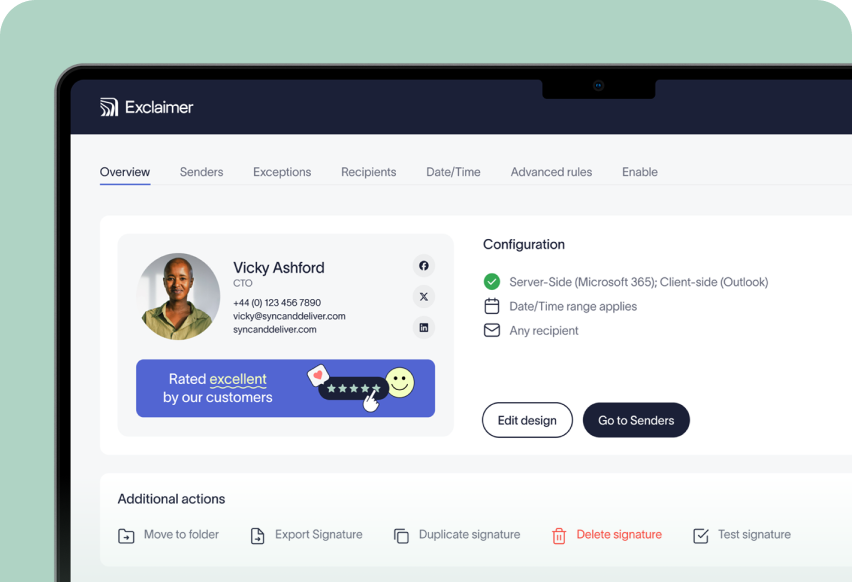
Exclaimer makes this easy. Our email signature management platform lets you create consistent, on-brand signatures that support any campaign. Add a personal touch, highlight key links, or give readers a simple way to connect—all without adding work for IT.
To learn more, contact us today or get yourself a free online demo.