




Digital communication governance: Closing the gap between policy and practice
1 April 2026
0 min read
Most organizations have the policies. The guidelines are documented. The frameworks are signed off.
Regulatory scrutiny has moved further into everyday communication governance. Auditors aren't just asking whether policies exist. They want evidence those policies are applied consistently, across every channel, on an ongoing basis. For most organizations, that's a harder question to answer than it should be.
Enforcement across email, Microsoft Teams, Slack, Zoom, mobile devices, and AI-assisted tools is often uneven, manual, and difficult to trace when examined. That gap is where legal and regulatory risk accumulates, and it typically surfaces during an audit or investigation, when the burden of proof is already on your organization.
Exclaimer's Alex Dennis, Information Security Manager, and Ed Bodey, General Counsel, explored exactly this in a recent webinar on regulatory pressure and digital communication governance. Here are the key takeaways.
Why having a policy isn't enough
The challenge most organizations face is that policies are applied inconsistently across platforms, updated manually at different times in different systems, and in some cases not applied at all in channels that have grown outside the original governance framework.
Email tends to be tightly controlled. Messaging tools like Slack or Teams operate with far less oversight, often because they're used more informally. As new tools are introduced, the gap between what policy says and what's actually happening across systems widens.
Regulators and auditors aren't evaluating each channel in isolation. They're looking at how communication is governed across the organization as a whole. Organizations are still expected to have policies in place, educate their staff, and show those policies are meaningful in practice. For example, the UK Information Commissioner's Office treats accountability as a core principle under UK GDPR, requiring organizations to demonstrate compliance actively rather than simply assert it. The complexity of a fragmented communication environment doesn't reduce that obligation.
Risk surfaces before anything goes visibly wrong
Ungoverned communication channels create exposure well before an incident occurs. The most common scenarios involve audits and investigations, where an inability to demonstrate consistent policy application becomes a formal finding with a direct business cost.
Data laws require organizations to show how personal data is handled within everyday communications, including what's disclosed to recipients about how their information is processed. Sender identification, legal disclaimers, and confidentiality notices carry the same obligations across every channel an organization uses, and those requirements don't vary based on how formally a channel is used.
Accessibility adds another layer of obligation that many organizations underestimate in the context of digital communications. Both the Equality Act 2010 in the UK and the Americans with Disabilities Act in the US carry implications for how information is presented to recipients, and those requirements apply regardless of which platform the message is sent from.
When communication happens in systems that aren't fully governed, retrieving it for an audit or legal request becomes difficult. Visibility gaps create a practical inability to respond when that information is called for. Financial services regulators have made this point through enforcement rather than guidance. The US Securities and Exchange Commission has pursued action against firms for off-channel communications that fell outside recordkeeping requirements, resulting in significant fines across multiple institutions.
What demonstrable governance actually requires
Regulators and auditors want policies that are lived by the organization, with documented standards, evidence of consistent application across systems, a traceable record of policy updates, and confirmation that staff understand their role in maintaining them.
Operationally, meeting those expectations is demanding. When policies are managed separately in each platform, systems drift. Manual update processes fall out of sync, and enforcement varies across channels. This isn't a theoretical risk. ISO 27001, the international standard for information security management, treats documented evidence of controls and their consistent application as a core requirement, an expectation increasingly shared by regulators across sectors and jurisdictions.
Centralization addresses the drift problem directly. Applying policies consistently across systems rather than platform by platform makes it significantly easier to demonstrate that standards are being met. Visibility is the other requirement: organizations need to be able to show how communication is being handled and produce that evidence when it's requested.
Closing the gap in practice
The practical starting point is a gap analysis across all communication systems: every approved platform, where policies are applied inconsistently, and where visibility is limited. The goal at this stage is clarity about where the differences exist and which carry the most risk.
From there, ownership needs to be explicit. Assigning clear accountability for which communication standards apply across which systems is a foundational step before technical controls can be made reliable. Managing communication standards in one place, rather than maintaining the same disclaimer language across multiple systems separately, removes the manual burden and reduces the surface area for error.
Staying ahead of regulatory change matters too. Organizations that introduced AI-assisted messaging without governance controls found themselves managing compliance gaps retroactively. Regulators are paying close attention to this area. The Federal Trade Commission has flagged AI-generated business communication as an active area of regulatory scrutiny, and proactive governance is considerably less costly than reactive remediation.
Built for the standard auditors expect
At scale, manual processes can't reliably deliver the centralization and demonstrable controls that governance requires.
Exclaimer is the global leader in email signature management for Microsoft 365 and Google Workspace, trusted by more than 75,000 organizations worldwide, including Sony, Bank of America, the BBC, and the Academy Awards. Its platform gives IT and compliance teams central control over email signatures and video meeting branding, applying them automatically across every user and device.
Signatures and disclaimers are applied server-side, consistent regardless of device or email client. Smart rules apply specific disclaimer language based on sender region, department, or communication type, directly supporting compliance across multiple jurisdictions. When a policy changes, that update applies instantly across the organization.
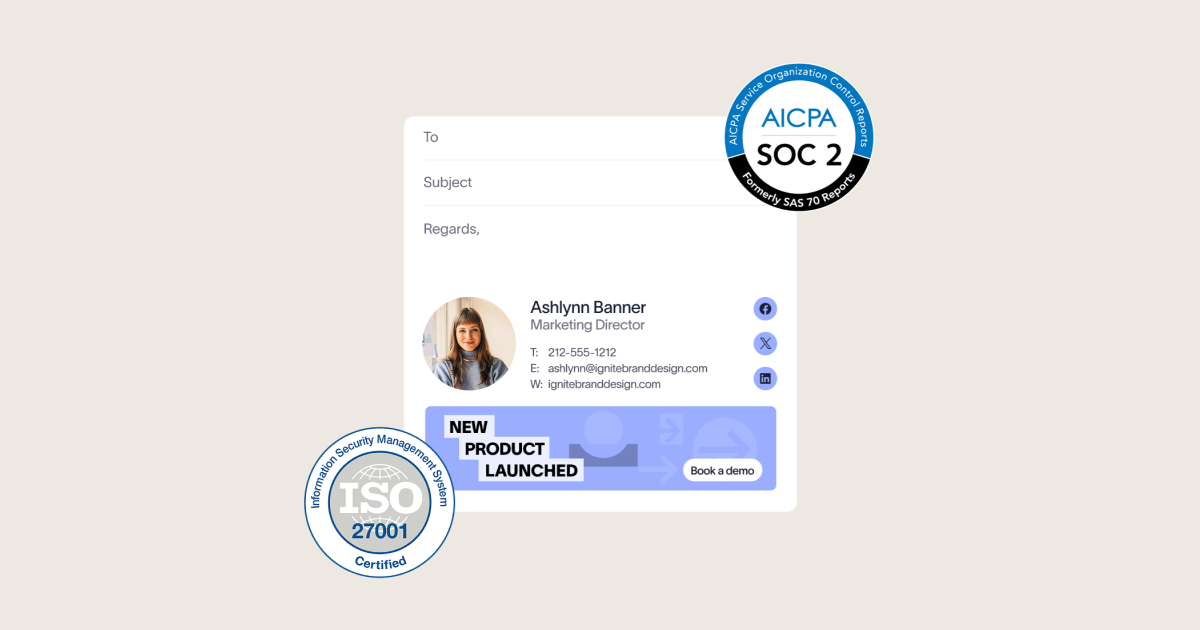
Exclaimer holds ISO 27001, ISO 27018, and SOC 2 Type II certifications, processes data within regional boundaries to support GDPR compliance, and maintains audit-ready logs that give compliance teams the evidence they need under scrutiny.
Watch the webinar on demand
The full session covers how to run a gap analysis across communication systems, how IT and legal can align on enforceable standards, and what audit readiness looks like in a complex communication environment.
Watch the webinar on demand or book a demo to see how Exclaimer helps organizations govern communications at scale.