




The real cost of email signature non-compliance in financial services—and how to fix it
9 January 2026
0 min read
TL;DR
Email is a regulated communication channel in financial services, and email signatures fall under the same disclosure and governance expectations.
Manual or inconsistent signature management creates compliance gaps that increase audit exposure and regulatory scrutiny.
Missing or outdated disclaimers, especially across mobile and hybrid environments, are common failure points during audits.
The cost of non-compliance shows up in remediation work, legal review cycles, IT overhead, and reputational trust, not just fines.
Centralized email signature governance helps financial institutions apply disclosures consistently, prove control during audits, and reduce operational risk.
Financial services organizations operate under intense regulatory scrutiny. Every outbound communication is subject to expectations around accuracy, disclosure, and consistency. Email is no exception.
Yet financial services email signatures are still commonly managed manually, left to individual employees, or enforced through fragile scripts and transport rules. In regulated environments, that lack of control introduces avoidable risk.
Missing or incorrect disclaimers, inconsistent sender details, and unmanaged mobile signatures can all create compliance gaps. Over time, those gaps increase audit exposure, slow regulatory responses, and place unnecessary pressure on IT and compliance teams.
In financial services, email signatures are part of communications governance. When they aren't controlled centrally, the cost shows up in audits, remediation work, legal review cycles, and reputational trust.
This article examines the real cost of email signature non-compliance in financial services, including:
Regulatory and audit risk
Legal and disclosure exposure
Operational overhead for IT teams
Brand and trust implications in regulated markets
Why this matters for financial services IT
In financial services, email is a regulated communication channel. Every message must include the right details, from legal disclaimers to up-to-date job titles.
Email signature non-compliance creates real regulatory, legal, and operational risk for financial services organizations. Inconsistent or outdated disclaimers can expose firms to audit findings, enforcement action, and reputational damage.
Centralized email signature governance reduces risk, improves compliance consistency, and removes manual enforcement from IT teams.
Email signature compliance requirements in financial services
Financial services regulators expect firms to maintain control over all outbound business communications. That includes email signatures, which often contain legal disclaimers, regulatory disclosures, and sender information relied on during audits and investigations.
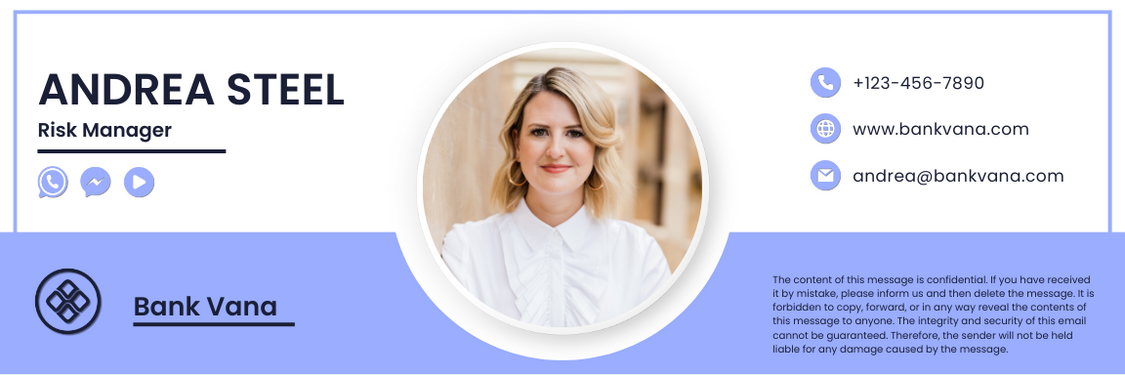
When signatures are inconsistent or unmanaged, firms can struggle to demonstrate that required disclosures were applied accurately and consistently at the time an email was sent.
That exposes your firm to unacceptable risk.
FINRA and SEC communication oversight
In the United States, regulators such as FINRA and the SEC treat business email as regulated communication. Firms are expected to supervise, retain, and produce communications that relate to financial activity.
Email signatures play a supporting role in that oversight. Missing or outdated disclaimers can raise questions during audits, especially when firms cannot prove what information was included in historical correspondence.
FCA expectations in the UK and EMEA
The Financial Conduct Authority (FCA) requires firms to communicate with clarity and accuracy. Disclosures must be fair, clear, and not misleading across all channels.
Email signatures that vary by department, device, or individual increase the risk of inconsistent disclosures. Over time, that inconsistency can undermine compliance controls and complicate regulatory reviews.
40% of financial firms now consider communication compliance a board-level issue.
GDPR and data protection considerations
Under GDPR and similar data protection frameworks, organizations are expected to handle personal data responsibly and transparently.
Email signatures often include personal identifiers such as names, job titles, phone numbers, and email addresses. When those details are unmanaged or outdated, firms risk breaching internal data accuracy policies and creating unnecessary compliance exposure.
Global regulatory consistency challenges
For multinational financial institutions, regulatory expectations rarely stop at one jurisdiction. Firms must balance regional disclosure requirements while maintaining consistent governance across their email environment.
Manual email signature management makes that balance difficult to sustain at scale.
| Regulation | What’s required | How email signatures help |
|---|---|---|
| SEC (U.S.) | Supervised, archivable communications | Adds disclaimers that indicate monitoring and retention policies |
| FINRA (U.S.) | Fair and accurate investor communication | Prevents missing or misleading disclosures in outbound messages |
| SOX (U.S.) | Traceable records and internal controls | Applies consistent role-specific legal language to support audits |
| FCA (UK) | Transparent and verifiable client communication | Standardizes information in outbound emails across teams and regions |
| GLBA (U.S.) | Safeguarding financial customer data | Warns users not to share sensitive account or personal details |
| GDPR (EU) | Transparent use of personal data | Includes legal identity, intent, and privacy access details in every message |
| CCPA (U.S.) | Clear consumer data handling rules | Embeds regulatory messaging and access options for recipients |
Real-world breakdown:
The SEC fined Robinhood $45 million for recordkeeping failures and weak internal controls. Among the issues: inconsistent signature content, missing disclosures, and no system in place to monitor outbound communication. These gaps raised red flags regulators couldn’t ignore.
The operational and financial cost of email signature non-compliance
Email signature non-compliance rarely shows up as a single, visible failure. More often, the cost is spread across day-to-day operations, audit preparation, and ongoing remediation work.
Over time, those costs add up.
| GDPR | CCPA | FINRA | FCA |
|---|---|---|---|
| Up to €20 million or 4 percent of global revenue | Between $100 and $750 per affected individual | Up to $1 million per violation, plus restitution | Formal actions for recordkeeping gaps and unclear communication |
Increased audit and remediation effort
When auditors ask how disclosures are applied and controlled, teams need clear answers. If signatures are managed manually or inconsistently, responding takes longer.
Compliance and IT teams may need to:
Reconstruct historical policies
Review scripts, transport rules, or user instructions
Manually confirm which disclaimers were in use during specific periods
That work diverts time from higher-value initiatives and increases the risk of follow-up findings.
Legal and disclosure risk
Email signatures often carry legal language that must remain accurate. When updates are delayed or partially applied, organizations may send communications with outdated disclosures.
That can trigger:
Additional legal review cycles
Internal policy exceptions
Remedial communications or corrective action
The cost is rarely limited to legal teams alone. IT and operations are often pulled in to support urgent changes.
The average data breach costs $4.88 million on average, but in the financial industry, that number climbs to $6.08 million. It only takes one unmanaged email to set it off.
Ongoing IT overhead
Without centralized control, IT teams become the default owners of email signature enforcement. Common tasks include:
Processing update requests
Troubleshooting inconsistent behavior across clients
Supporting exceptions for departments or regions
What starts as a small administrative task can quickly turn into recurring operational work.
Reputational impact in regulated markets
In financial services, consistency signals control. Emails with missing or inconsistent signatures can undermine confidence, particularly with regulators, partners, and institutional clients.
While reputational damage is harder to quantify, it often influences how closely organizations are scrutinized during reviews.
TIP: Exclaimer gives financial institutions a single platform to control every email signature.
Who is responsible for email signature compliance in financial services?
In financial services organizations, email signature compliance forms part of broader communications governance. Regulators expect firms to demonstrate control over how disclosures are defined, applied, and enforced across all business communications.

That responsibility is shared, but it must be clearly defined.
IT as the enforcement layer in regulated environments
IT teams are responsible for how email systems operate in practice. In financial services, that includes:
Ensuring required disclaimers are applied consistently
Covering all email clients and devices used by regulated staff
Maintaining reliable, repeatable enforcement mechanisms
During audits or supervisory reviews, IT teams are often asked to explain how disclosure controls are applied, even when they do not own the content itself.
Legal and compliance as disclosure owners
Legal and compliance teams define:
Which disclosures are required
When wording must change
How regulatory updates should be reflected in communications
In regulated environments, these teams are expected to demonstrate that approved language is not only defined, but consistently applied. Gaps between policy and execution are where audit findings tend to emerge.
Why clear ownership matters during audits
When regulators or auditors ask how disclosures were applied at a specific point in time, unclear ownership creates friction.
Common challenges include:
Delays in confirming who approved changes
Difficulty proving when updates went live
Uncertainty over which teams were responsible for enforcement
Clear ownership, supported by consistent technical controls, reduces audit risk and improves confidence across IT, legal, and compliance teams.
Financial firms waste an average of 83 working days per year (0.4 FTE) on manual email signature updates. That’s $28,000 in lost IT time.
*Based on 500 employee organization
Why email signature governance matters in financial services
In financial services, small inconsistencies can create outsized risk. Email signatures are a clear example.
When disclaimers, sender details, and disclosures are applied inconsistently, organizations face avoidable operational friction and regulatory exposure. Over time, those gaps increase audit effort, slow regulatory responses, and place unnecessary strain on IT, legal, and compliance teams.
Effective email signature governance supports:
Consistent application of required disclosures
Clear ownership across IT, legal, and compliance
Faster response during audits and supervisory reviews
Greater confidence in day-to-day communications
For regulated organizations, email signatures are part of how firms demonstrate control, consistency, and accountability in their communications.
How Exclaimer makes email compliance easier
Manual email signature management is slow, inconsistent, and creates unnecessary risk. Exclaimer replaces this with centralized control. That means no user edits, no scripts, no workarounds.

Built for financial services teams that can’t afford inconsistency
Exclaimer integrates with Microsoft 365, Google Workspace, and Exchange (Hybrid, SE, Online). It syncs with your user directory to keep signatures accurate across every role, team, and office.
Works across hybrid, mobile, and office-based roles.
Updates pushed instantly, with no ticketing.
Updates are pushed automatically—no tickets, no delays.
Everything is controlled from a central platform, so you can make changes quickly and know they’ve been applied.
Email disclaimers that follow policy every time
The Disclaimers feature lets IT apply legal text based on user attributes. You set the rules. The platform ensures compliance.
Apply disclaimers by team, location, or entity.
Set fallback messages when no attribute match is found.
Place disclaimers above or below banners or contact details.
Keep layout consistent with the rest of the signature.
Roll out updates instantly without touching templates.
This helps meet requirements for GDPR, GLBA, PCI DSS, and SEC 17a-4—without requiring user input.
 Why it matters
| When signatures are managed manually | When signatures are managed with Exclaimer |
|---|---|
| $28,000 in IT time lost annually | Fixed platform cost with minimal admin time |
| 83 days spent on manual updates | Under 10 hours per year |
| Risk of regulatory gaps and fines | Controlled content with version history |
| Delayed review cycles | Instant updates with audit-ready logs |
Audit-ready, by design
Every change is tracked. You get version history and full visibility for reviews, whether it’s internal, from the SEC, or from FINRA.
No last-minute fixes. No missing evidence.
Trusted by over 2,000 financial institutions worldwide
IT leaders in financial services already know email signatures are a weak point. What they need is control.
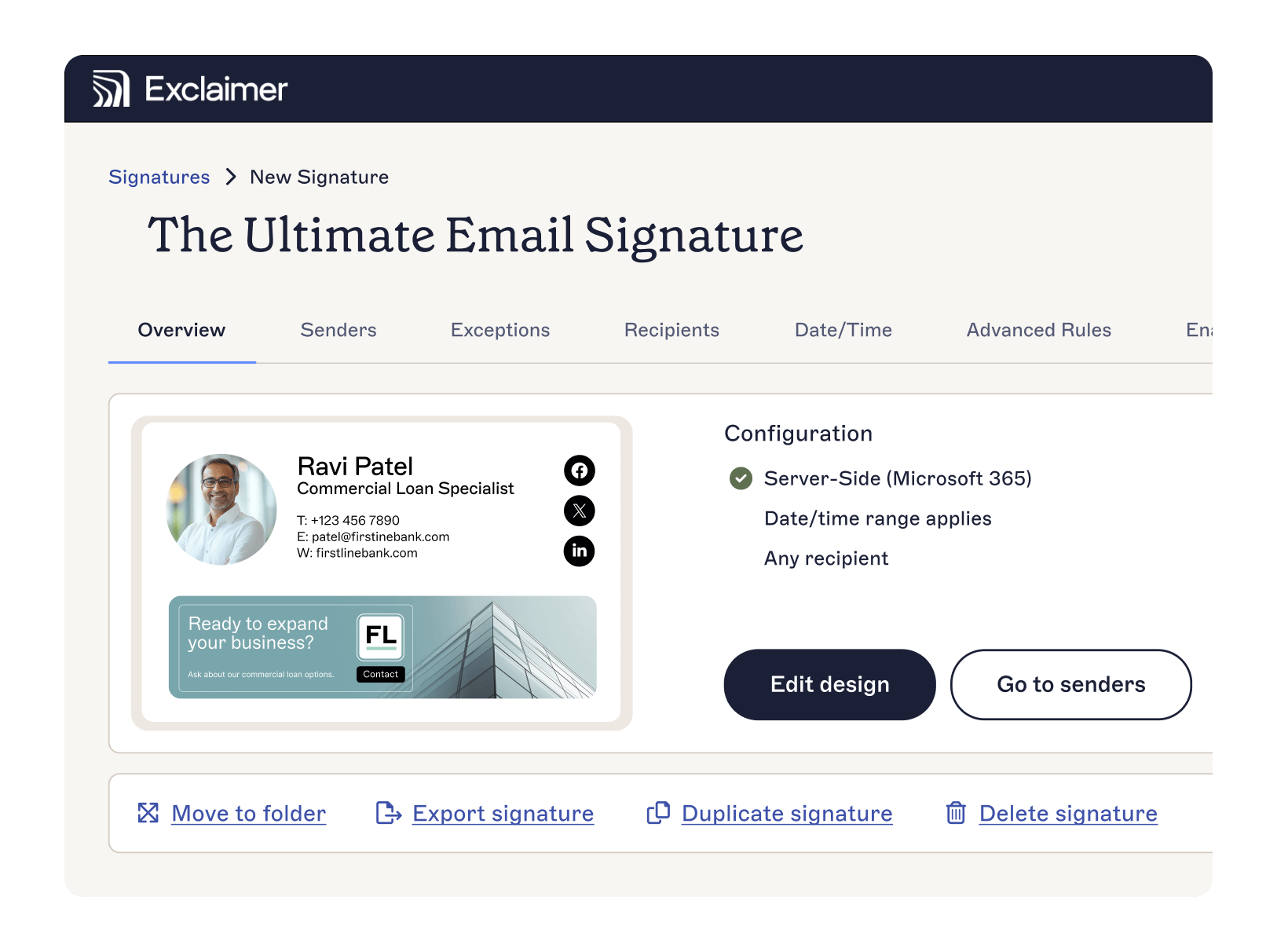 Exclaimer is trusted by over 2,000 financial institutions to manage every signature across branches, offices, and regulations—without adding to IT’s workload.
It works. Every message. Every user. Every time.
What financial services firms are saying
“Great way to standardize signatures for branding and compliance, and removes the need for employees to manage their own signatures, for Compliance to approve them, for Marketing to approve them, for Technology to teach people how to do it, and for our MSP to have to write scripts to handle our many disclosures. That's a lot of people who don't have to worry about signatures anymore.”
Caite Stevens
Chief Technology Officer
XML Financial Group
“As a tightly regulated business, we must ensure all required legal information is provided on all outbound emails we send. The disclaimer field in the signature does precisely that.”
Martin Andel
IT Support
Y3S Loans
“Creating a signature in their template design is very easy and pretty much builds itself. We were able to create signatures for our separate departments and have them up and running in no time. This makes compliance issues of people doing whatever they want completely go away.”
Kyle Wellcome
Help Desk Supervisor
Land Home Financial Services, Inc.
“I love how easy it is to add signatures for users. The implementation was great. It took about one week to figure everything out. We use it every day. It integrates with office 365 and works in the backend.”
Zakir Seyar
Director Of Information Technology
HRSS CPAs
Financial institutions worldwide use Exclaimer to reduce risk and cut down on repetitive IT tasks.
See how other financial firms like yours are improving compliance and gaining control.
Simplify email signature compliance without IT headaches
Email signature management shouldn’t eat up IT time or create risk. With Exclaimer, financial institutions get:
Compliance
Apply the right disclaimers by entity, region, or team—meeting regulations like SEC 17a-4, GDPR, and GLBA.
Consistency
Ensure every message includes approved legal content and accurate sender details—across all platforms and devices.
Control
Manage everything from one place, with no user edits and full version history for audits.
Efficiency
Sync with your directory and roll out updates in minutes—not days.
Exclaimer is already helping more than 2,000 financial institutions simplify email signature management. Now it’s ready for your environment.