Laura leads global demand generation and channel marketing at Exclaimer, where she is responsible for driving pipeline growth, partner engagement, and scalable marketing programs across regions. Her work focuses on connecting strategy with execution, ensuring marketing delivers measurable impact across both direct and partner channels.
AI-powered growth: Why brand structure has become a revenue conversation

Brand governance is moving into revenue conversations because AI is now generating more of the customer-facing communication that drives pipeline. The structure that keeps that communication consistent matters more than the AI tools themselves.
Across go-to-market teams, AI has accelerated the work. Outreach happens faster, campaign cycles compress, and the volume of customer-facing communication generated by AI keeps rising.
What's struggling to keep up is the structure around that output. Brand standards, tone of voice, positioning rules, and review processes are still managed in many organizations through manual steps and documents stored in places the AI never sees. The gap between documented governance and operational governance is where brand drift starts, and where the cost surfaces in the funnel before it surfaces anywhere else.
Exclaimer's Laura Wilkinson, VP of Global Demand Generation, Becky Dunne, Head of PLG, and Elisabeth Goossens, Director of Brand Communications, explored this in a recent webinar on AI-powered growth. Here are the key takeaways.
AI scales whatever structure already exists
AI accelerates everything around demand generation, but the strategy still has to come from people. Loose inputs produce loose output at scale.
Laura is straightforward about how AI sits inside demand generation now. Across BDR outreach, campaign execution, and content production, every part of pipeline at Exclaimer has AI in the mix. The strategy itself, she said, still has to come from people, and AI will scale whatever inputs you give it.
That's the part most AI productivity stories miss. Speed only translates to pipeline when the inputs are right, and the inputs are also where most teams haven't done the work yet.
The real speed gain is in learning cycles
The speed advantage AI has created shows up most clearly in internal learning cycles. Non-technical people can build, test, and ship their own tools without waiting on engineering, and that compounds across a quarter.
Becky's view from product-led growth was that the more interesting shift is what AI has done to learning cycles. Non-technical people in growth roles can now build, test, and ship their own internal tools without waiting on engineering. Exclaimer runs an internal "Vibe Coding Club" where people across the business build their own workflows and applications, with engineering and information security stepping in on the production side.
She was careful about where the speed advantage lives. The internal iteration cycle is faster, while governance still gates anything customer-facing. Becky described colleagues who had been hesitant about AI now shipping full applications themselves once they had a way in, and people thinking more boldly about how to solve problems now that "I can't get this built" has dropped out of internal conversations.
Volume creates a consistency problem
The volume of communication going through AI tools is creating a consistency problem. Without clear guardrails, teams interpret positioning differently, and brand drift starts before anyone notices.
Where Laura sees acceleration, and Becky sees learning velocity, Elisabeth sees volume. Output is up across every team using AI, and the risk that comes with volume is variation. Without clear guardrails, teams interpret positioning and brand permissions slightly differently, and that's where brand drift starts.
Elisabeth used Exclaimer's Gong rollout as her example. Before deploying it across sales, the team had to update terms and adjust sales disclaimers, coordinating across multiple functions before a single AI-generated conversation reached a customer. Skipping that step would have created compliance exposure across thousands of conversations. In her framing, the structural work is what determines whether AI helps or hurts.
A line she came back to was that AI's starting point is what teams teach it. If sales, marketing, and product haven't aligned on positioning before the AI runs, AI surfaces those inconsistencies faster, at scale, in the customer's inbox. One half-aligned email becomes hundreds.
The operational signs of governance breakdown show up early: review cycles getting longer, hours spent fixing tone and positioning that AI was meant to give back, and customer feedback flagging confusion. All of it traces back to AI deployed faster than the alignment around it.
Differentiation lives outside the tool
When competitors are using the same AI tools, the tool is the smallest part of the differentiation equation. The inputs, the brand guidelines, and the human judgment on the output are what shape the difference.
A question came up about differentiation in a same-tools world. Laura's answer was that the tool is the smallest part of the equation. If two companies run the same model for BDR outreach, the outputs will differ because the inputs differ: brand voice, positioning, tone, prompt structure, and the rules around what gets sent and when.
Elisabeth added the point that gets missed most often. There's still a person guiding the prompt or brief or vision; take that out and every brand starts to converge. Letting the machines decide everything is the fastest route to looking and sounding like every competitor in the category.
The practical implication is that brand guidelines only shape AI output when the AI is working from them directly. A document stored in a brand deck rarely changes anything until it's embedded in the prompt templates, the briefing structures, and the review steps. Most differentiation problems trace back to that gap between documented governance and operational governance.
Customer experience is the only honest test
Internal efficiency is easy to measure and easy to claim. The harder question is whether AI is improving the customer experience, and the answer lives in customer behavior rather than internal dashboards.
The closing question of the session was whether AI is improving the customer experience or only making the team more efficient.
Each speaker had a different angle. Laura tracks funnel metrics: engagement, conversion, pipeline impact. Becky watches whether the AI is solving the customer's issue first time, alongside activation rates, time-to-value, and qualitative feedback on whether the experience feels clearer to the customer or has been optimized for internal convenience. Elisabeth tracks output volume and brand perception, including how Exclaimer is appearing in LLM-generated answers as buyers move more of their early research into AI search.
That LLM visibility point is forward-looking. As more buyers start their research inside AI chat tools rather than search engines, brand presence in those answers becomes a new measurable surface. Companies missing from LLM responses for their own category lose visibility at the top of the funnel, and the loss won't show up in the analytics dashboards most marketing teams currently watch.
The thread across all three answers was the discipline of measuring outside the company first. Internal efficiency gains are easy to claim and cheap as evidence; efficiency that doesn't change customer outcomes is mostly noise.
How Exclaimer keeps brand consistent at scale
At scale, manual brand controls cannot keep pace with the speed at which AI is producing customer-facing communication. Centralizing the controls is what makes consistency possible across every email, every disclaimer, and every video meeting branded with company identity.
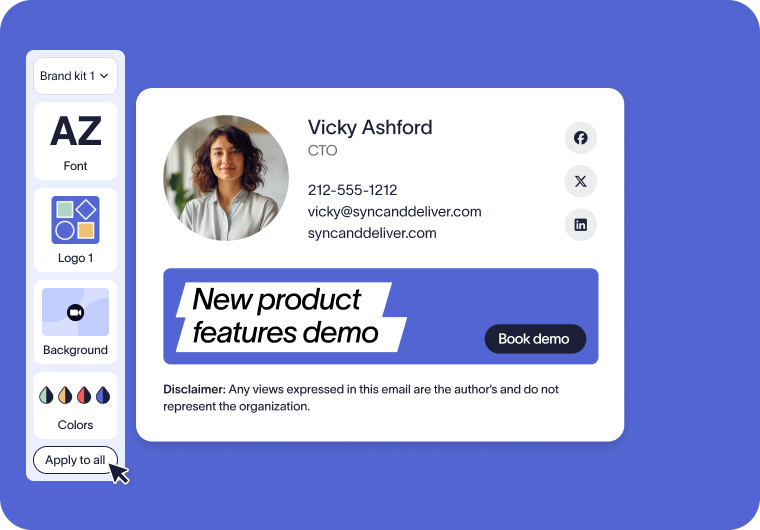
Exclaimer is the global leader in email signature management for Microsoft 365 and Google Workspace, trusted by more than 80,000 organizations worldwide, including Sony, Bank of America, the BBC, and the Academy Awards. Its platform gives marketing, IT, and brand teams central control over how every email signature and meeting branding element reflects the company, applied automatically across every user and device.
Brand and disclaimer rules are applied server-side, consistent regardless of device, email client, or who drafted the message. Smart rules adjust signatures based on sender region, department, or campaign, supporting differentiated messaging without losing central control. When a brand or legal change is made, the update applies instantly across every email signature.
Exclaimer holds ISO 27001, ISO 27018, and SOC 2 Type II certifications, processes data within regional boundaries to support GDPR compliance, and maintains audit-ready logs for compliance teams.
Watch the webinar on demand
The full session covers how Exclaimer's leaders are operating AI inside go-to-market work, where governance is most exposed as output scales, and what measurement frameworks are telling them about customer experience.
Watch the webinar on demand or book a demo to see how Exclaimer keeps brand expression consistent across every channel where AI is now producing customer-facing communication.