Elisabeth leads Exclaimer’s global brand narrative, thought leadership, and research-led storytelling. With over 15 years’ experience in PR and B2B technology marketing, she is known for turning complex ideas into clear, compelling communications that resonate with global audiences.
How America really sends its messages

When something matters to Americans, like a financial decision, a formal complaint, or information they need to keep, they reach for email. That's the clearest finding from our survey of 1,000 US adults, conducted by OnePoll in May–June 2026, as part of a wider global study of digital communication habits. For casual moments, the US is a text-first culture. But when the stakes go up, a more familiar channel takes over.
Here's what the data shows.
The phone isn't going anywhere
One of the clearest gaps between the US and UK data is how much the phone call still holds in America.
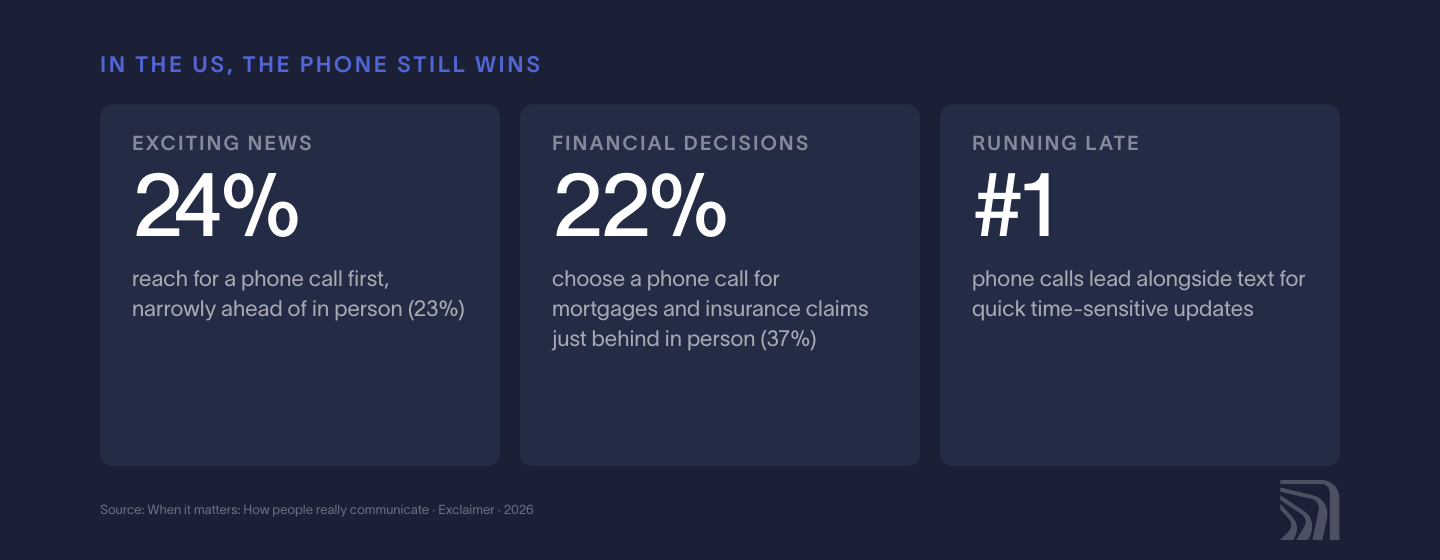
For sharing exciting personal news, 24% of US adults reach for a phone call first, narrowly ahead of in person (23%). For financial decisions like mortgages or insurance claims, phone calls come second at 22%, just behind meeting in person (37%). For letting someone know you're running late, phone calls lead alongside text.
In the UK, WhatsApp has largely displaced the phone call for personal and informal moments. In the US, the phone call is holding its ground.
Text message is America's WhatsApp
Where British adults reach for WhatsApp for casual communication, Americans reach for text.
For sharing an update, story, or joke, text leads in the US at 26% versus just 12% in the UK, where WhatsApp dominates at 36%. For exciting personal news, text is the third most popular choice in the US at 19%.
WhatsApp barely registers in American responses. The platforms are functionally similar, but cultural adoption couldn't be more different.
Situation | US | UK |
Info to keep or refer back to | 43% | 70% |
Employer HR update | 35% | 58% |
Formal complaint | 33% | 69% |
Job application | 21% | 44% |
Contract negotiation | 15% | 28% |
Email still leads when it matters
Despite lower overall email usage for casual communication, US adults still reach for email when the stakes go up.
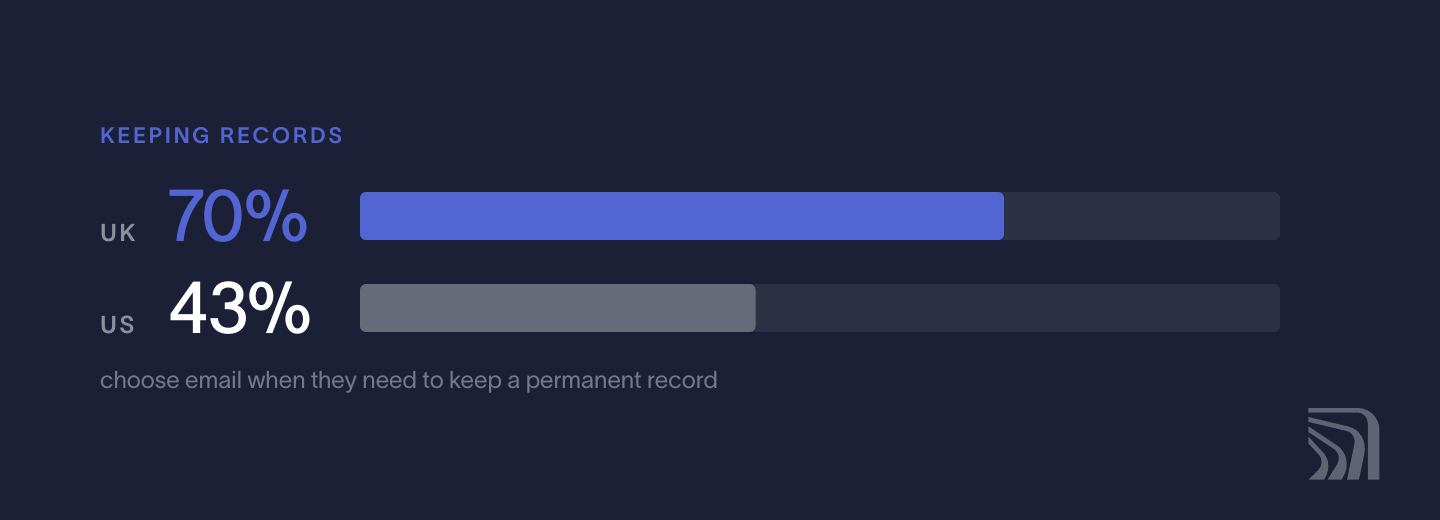
Email is the top platform for receiving or sending information to keep or refer back to (43%), for employer HR updates (35%), and for formal complaints (33%). It leads for healthcare information (27%) and contract negotiation (15%).
Those figures are lower than their UK equivalents across the board, but the direction is the same. When something matters, Americans email it. Just at a lower rate.
The job application figure is worth pausing on
For job applications, only 21% of US adults choose email as their preferred platform.
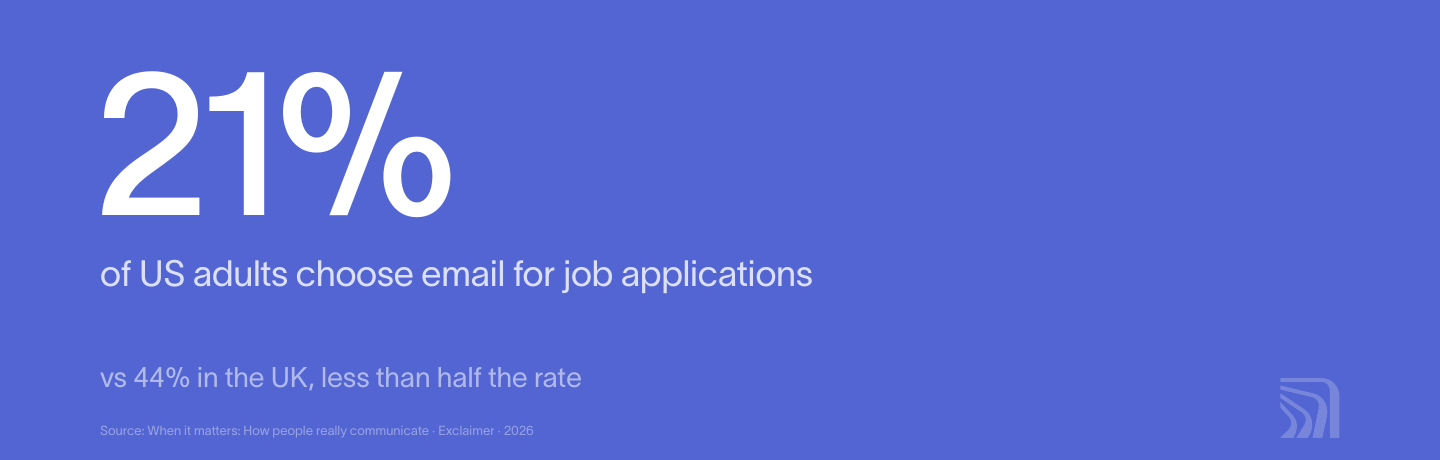
In person comes first at 35%, which is a significant gap from the UK (44% email) and from the average (32% email). It likely reflects a stronger cultural emphasis on in-person networking and direct outreach in American hiring culture.
Even so, email still ranks second among digital channels for job applications in the US. When people can't get in front of someone directly, email is where they go.
Americans are more AI-active, and they know it
The AI picture looks different in the US than in the UK. Only 35% of US adults say they never use AI in their communications, compared to 50% in the UK.
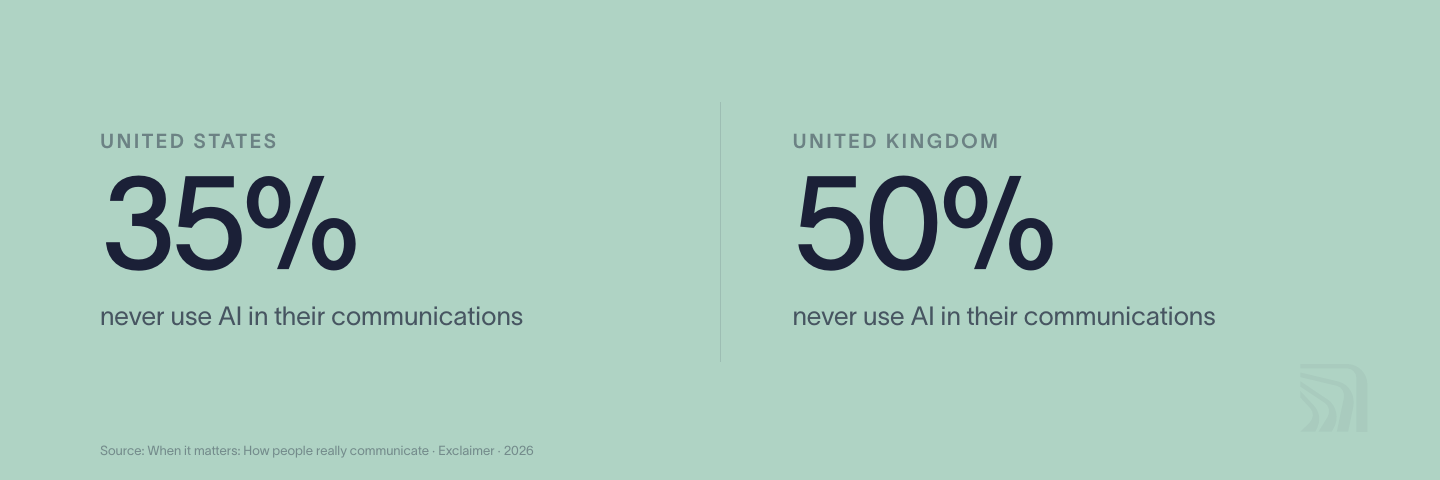
Americans are more likely to use AI to sound more confident (16% vs. 11%), respond more quickly (16% vs. 11%), and sidestep awkward conversations (10% vs. 7%).
The result is a higher baseline of AI-assisted communication, and a corresponding level of scrutiny about whether messages are genuine. 36% of US adults have questioned whether a message they received was legitimate. That's lower than the UK figure (46%), but still more than one in three. In a culture where AI adoption is more widespread, the signals that mark an email as genuinely human, like a verified sender domain, a consistent identity, or a professional email signature, carry real commercial weight.
What this means for businesses reaching American inboxes
US adults may email less instinctively than their British counterparts, but when they open an email from a business, they're making the same trust judgments. 40% look for full contact details. 35% look for a professional email address. And 23% specifically cite a professional, branded email signature as a trust signal, which is the same figure as the UK.
The bar for email trust in America starts from a different place.
For businesses communicating at scale, where individuals manage their own signatures, that consistency is hard to guarantee without a centralized system. Exclaimer's email signature management software applies professional, on-brand signatures automatically across every email, without relying on individual users to get it right.
This blog is part of the When it matters: How people really communicate report 2026, based on a survey of 2,000 adults in the UK and US conducted by OnePoll, May–June 2026. Read the full report