Elisabeth leads Exclaimer’s global brand narrative, thought leadership, and research-led storytelling. With over 15 years’ experience in PR and B2B technology marketing, she is known for turning complex ideas into clear, compelling communications that resonate with global audiences.
When it matters: How people really communicate
We asked 2,000 adults across the UK and U.S. how they really communicate. We asked which platforms they reach for when something matters, what makes a business email feel trustworthy, and what they’ve lost when messages disappeared. The answers cut across every generation, every platform, and every assumption about how people relate to email. This is what they told us.
 This report is based on a nationally representative online survey of 2,000 adults. 1,000 in the UK and 1,000 in the United States, conducted by OnePoll between May 26 and June 2, 2026. Respondents were representative by age, gender, and region in each country. All figures are rounded to the nearest whole number.
Email is the communication channel of choice when it really matters
People don't think about which platform to use for their messages. They just know. Casual, fleeting moments like running late, sharing a joke, or announcing exciting news, go to WhatsApp, text, or a phone call. Anything of high importance, anything they might need to prove, reference, or remember years from now, goes to email. Our data makes that instinct visible across eleven everyday situations.
The pattern is consistent and decisive. For the most important communications, email leads by a substantial margin. For formal complaints, it’s the overwhelming choice. For job applications, people choose email over every other messaging platform combined. And the further you move towards the high-stakes end of the spectrum, the stronger email’s dominance becomes.
This isn’t a habit left over from the pre-smartphone era. People are actively routing their most important communications to email because, consciously or not, they understand that it lasts.
Situation | Global | UK | U.S. |
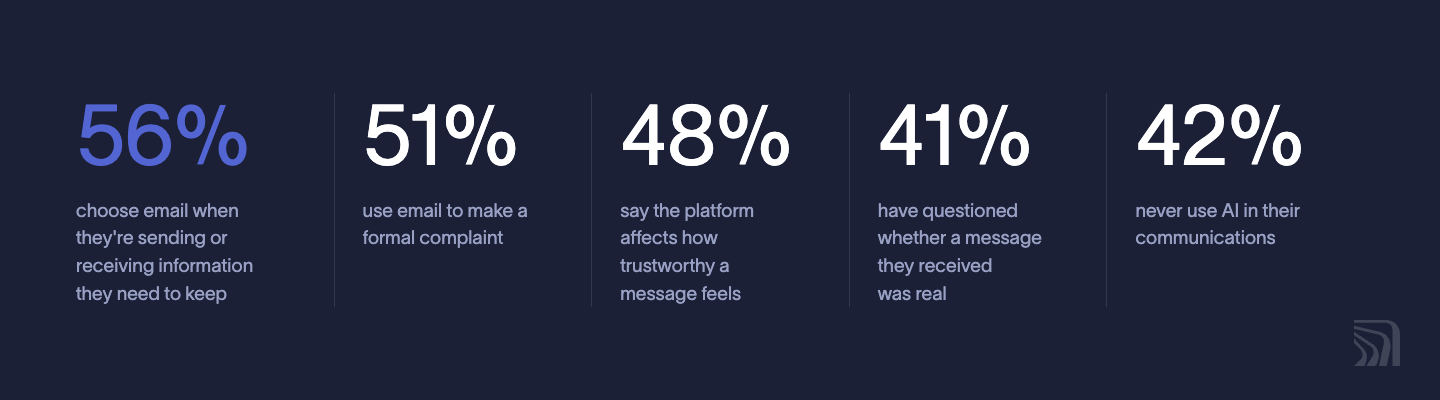
Info to refer back to | 56% | 70% | 43% |
Formal complaint to a company | 51% | 69% | 32% |
Employer HR or policy update | 47% | 58% | 35% |
Job application | 32% | 44% | 21% |
Healthcare information | 29% | 32% | 27% |
Contract negotiation | 21% | 28% | 15% |
Running late / last-minute plans | 5% | 3% | 7% |
The platforms people reach for, and when
The platforms that dominate casual moments are WhatsApp in the UK (36% for sharing a joke or update), and text message in the U.S. (26%). Yet they’re almost entirely absent from the high-stakes scenarios. WhatsApp and text aren't replacing email. They're handling everything email was never really for.
When you receive an email from a company, you’re already making a judgment
Consumers don’t passively read business emails. They evaluate them, scanning in seconds for the signals that tell them whether to trust what they’re looking at. A professional sender domain. Full contact details. A clear name. These aren’t nice-to-haves; they’re the visible proof that an email is legitimate.
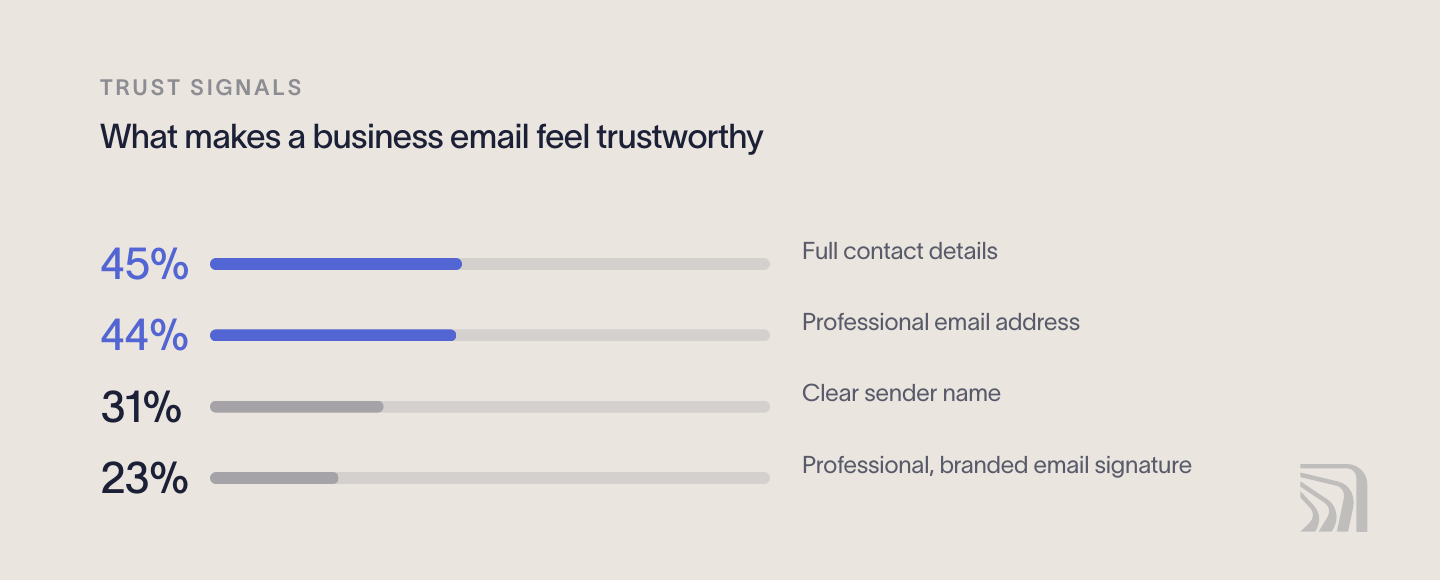
Almost half of all respondents cite a professional email address as a top trust signal. Nearly a quarter specifically look for a professional, branded email signature, and those figures rise to 29% among Gen Z and Millennials, the generations most likely to be receiving and evaluating business emails on behalf of their companies.
Trust signal | Global | Gen Z | Millennial | Baby boomer |
Full contact details | 45% | 40% | 43% | 53% |
Professional email address (company domain) | 44% | 43% | 45% | 46% |
Clear sender name | 31% | 30% | 30% | 32% |
Company logo or branding | 24% | 28% | 27% | 21% |
Professional and branded email signature | 23% | 29% | 29% | 16% |
Consistent formatting across emails | 21% | 22% | 24% | 21% |
Only 11% of respondents say they don’t find company emails trustworthy at all, meaning the vast majority are making trust judgements based on these visible signals.
The platform a message is sent on changes how it’s received
It’s both what you say, and where you say it. Nearly half of all respondents believe the platform a message arrives on affects how trustworthy it feels. Almost as many say it affects how professional it feels. Only 13% say platform makes no difference at all.
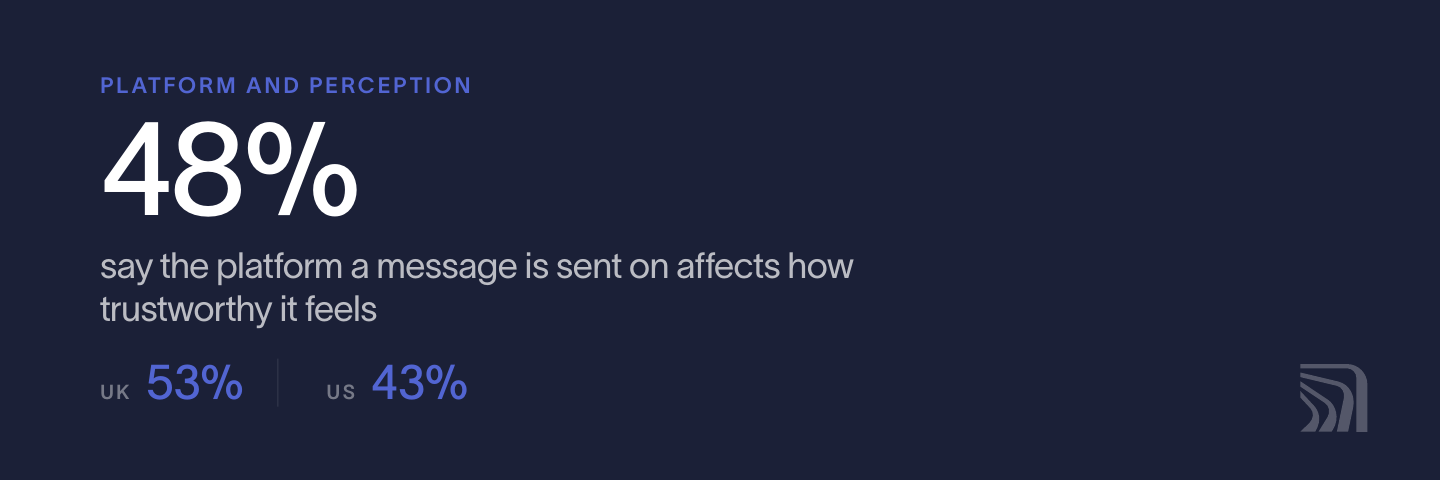
This has real consequences for businesses. Sending a formal update via WhatsApp, a complaint response via social DM, or a contract via text doesn’t just feel informal to the recipient. It actively undermines trust, professionalism and the likelihood the message will be taken seriously. The channel is part of the message.
Platform affects... | Global | UK | U.S. |
How trustworthy the message feels | 48% | 53% | 43% |
How professional it feels | 46% | 54% | 39% |
Whether it feels authentic | 43% | 47% | 39% |
How seriously the recipient takes it | 37% | 41% | 33% |
How likely to be saved or referred back to | 36% | 39% | 32% |
None of the above | 13% | 12% | 14% |
What people do with the messages that matter
Nearly half of all respondents have kept a message specifically to refer back to it later. More than a third have deliberately chosen email over another platform in order to create a permanent record. These aren’t passive behaviors. People are actively managing their digital communications based on what they understand they might need to keep.
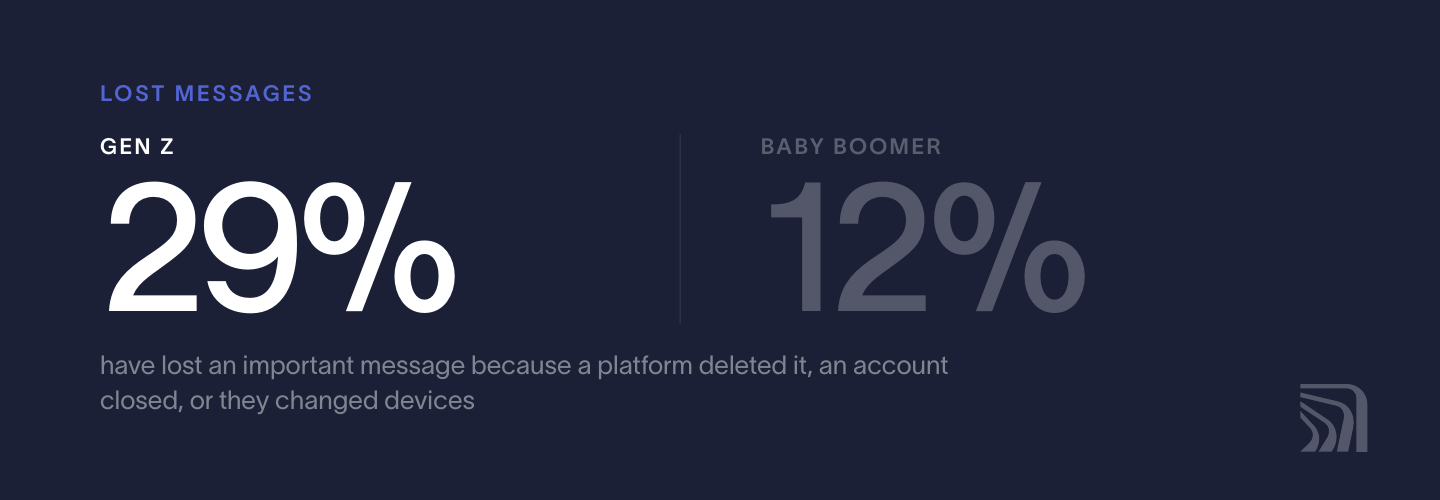
But the flip side of that is loss. 18% of respondents have lost an important message because a platform deleted it, an account closed, or they changed devices. For Gen Z, that figure rises to 29%, more than double the Boomer rate of 12%. The most digitally active generation is paying the highest price for living on the most ephemeral platforms.
Behavior | Global | UK | U.S. | Gen Z | Boomer |
Kept a message to refer back to later | 48% | 54% | 42% | 37% | 57% |
Chosen email to keep a permanent record | 38% | 44% | 33% | 32% | 42% |
Questioned if a message was genuine | 41% | 46% | 36% | 28% | 51% |
Struggled to find a message — wrong platform | 22% | 21% | 23% | 28% | 14% |
Missed info — sent to a platform rarely checked | 22% | 20% | 24% | 31% | 15% |
Lost a message (platform deleted / device change) | 18% | 16% | 19% | 29% | 12% |
Had to ask for info to be resent on different platform | 17% | 16% | 18% | 21% | 12% |
How generation gap, measured
The generational story in this data cuts against almost every assumption. Gen Z, supposedly the generation that abandoned email, choose it for job applications at a higher rate than Baby Boomers. Millennials hold the highest standards for what professional email looks like, citing consistent formatting more than any other generation. And Baby Boomers, despite being the generation least likely to use AI in their own communications, are the most suspicious that the messages they receive aren’t genuine.
Every generation has a relationship with email. They just use it differently, and at different points on the spectrum between the ephemeral and the permanent.
The counterintuitive headline
Gen Z choose email for job applications (36%) at a higher rate than Baby Boomers (23%). The generational divide is about formality and permanence, not trust.
Behavior or preference | Gen Z | Millennial | Gen X | Boomer |
Email for job applications | 36% | 43% | 31% | 23% |
Email for formal complaints | 42% | 52% | 56% | 54% |
Email for info to keep / refer back to | 37% | 52% | 59% | 70% |
Kept a message to refer back to | 37% | 46% | 48% | 57% |
Lost a message (platform / device) | 29% | 21% | 15% | 12% |
Never use AI in communications | 17% | 27% | 46% | 67% |
Questioned if a message was genuine | 28% | 38% | 42% | 51% |
Branded signature as trust signal | 29% | 29% | 23% | 16% |
More than half of us are using AI to communicate. Nearly half of us question whether what we’re reading is real.
42% of respondents globally never use AI in their communications. Among those who do, the most common uses are improving grammar (21%) and making writing sound more professional (20%). The desire to perform competence in written communication is near-universal.
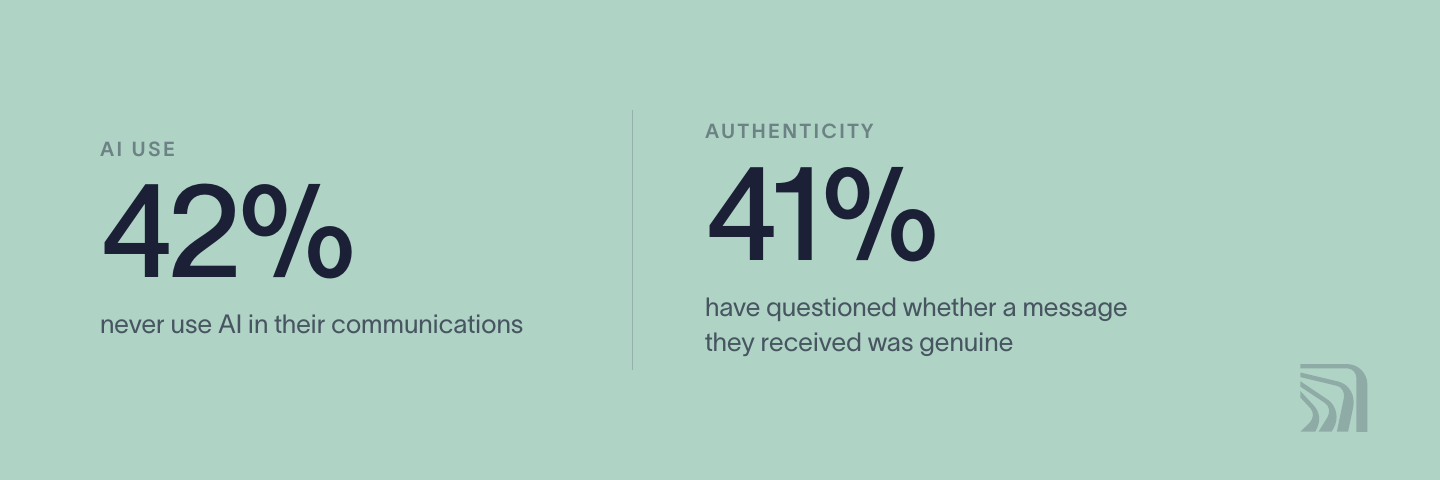
But at the same time, 41% of respondents have questioned whether a message they received was genuine or legitimate. The data captures a moment of tension: AI is being used to perform credibility at exactly the moment consumers are becoming more alert to inauthenticity. In that environment, the visible signals of a genuine sender, i.e. a consistent identity, a professional domain, a branded email signature, matter more than they ever have.
AI use | Global | Gen Z | Millennial | Boomer |
Never use AI in communications | 42% | 17% | 27% | 67% |
Improving grammar / spelling | 21% | 29% | 29% | 13% |
Making writing sound more professional | 20% | 32% | 30% | 8% |
Sounding more confident | 14% | 23% | 19% | 5% |
Responding more quickly | 13% | 21% | 19% | 5% |
Softening difficult messages | 12% | 20% | 17% | 5% |
Avoiding awkward conversations | 9% | 19% | 11% | 2% |
UK vs U.S.: 50% of UK adults never use AI in their communications vs 35% in the U.S. Boomers: 67% never use AI vs only 17% of Gen Z.
How the UK and U.S. compare
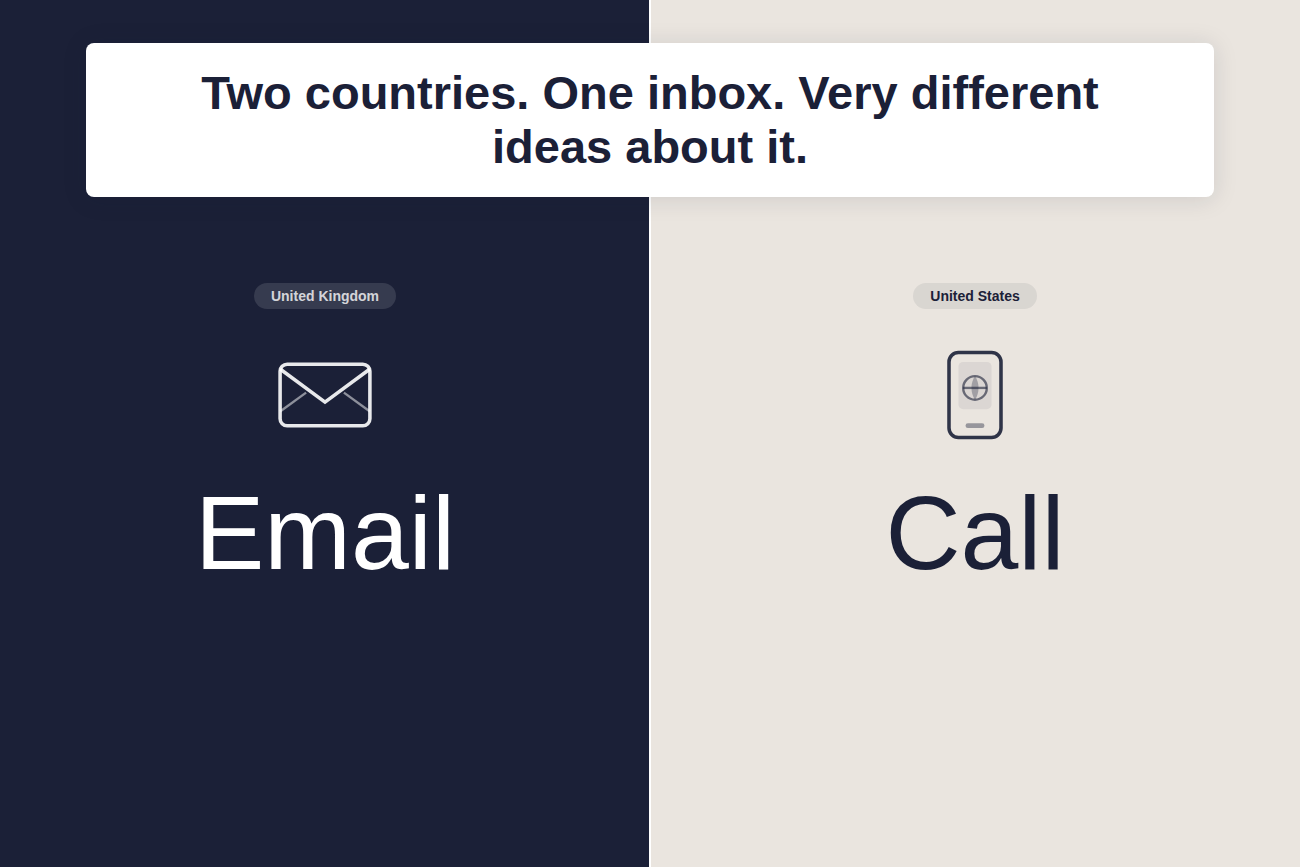
The UK and U.S. share the same instinct about what email is for, but the degree to which they act on it differs significantly. British adults reach for email at nearly twice the rate of Americans in high-stakes scenarios. Americans are more likely to pick up the phone.
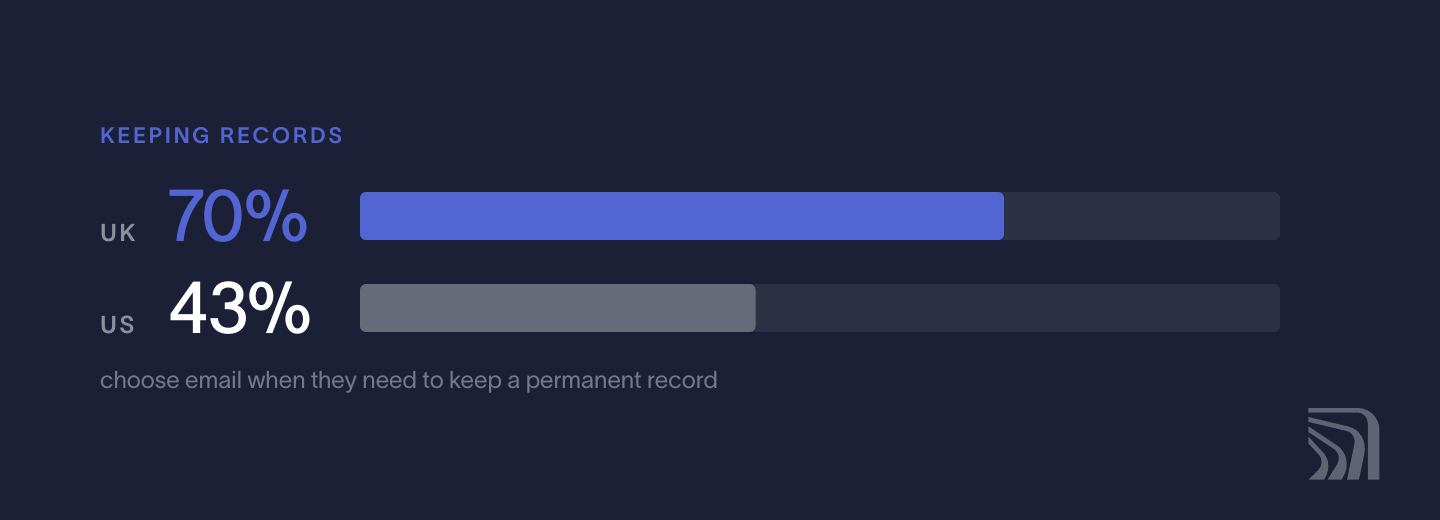
The gap is widest for formal complaints and for keeping permanent records, and it’s consistent enough across the full dataset to suggest a meaningful cultural difference in how the two countries relate to email as a professional channel.
Situation / behavior | UK | U.S. |
Email for formal complaint | 69% | 32% |
Email for info to keep / refer back to | 70% | 43% |
Email for employer HR update | 58% | 35% |
Email for job application | 44% | 21% |
Email for contract negotiation | 28% | 15% |
Platform affects trust in a message | 53% | 43% |
Never use AI in communications | 50% | 35% |
Professional email address as trust signal | 53% | 35% |
Email isn’t just a channel. It supports our most important messages.
Every business email lands in someone’s inbox as something important, something to reference, or judge. Our research shows that the signals people use to decide whether to trust a business email, the sender domain, the contact details, the consistent signature, are exactly the signals your brand has direct control over.
Exclaimer makes sure every email your business sends looks as if it came from a brand worth trusting.