Elisabeth leads Exclaimer’s global brand narrative, thought leadership, and research-led storytelling. With over 15 years’ experience in PR and B2B technology marketing, she is known for turning complex ideas into clear, compelling communications that resonate with global audiences.
How the UK really sends its messages
The UK is often painted as a nation of phone-avoiders, reluctant emailers, and WhatsApp-first communicators. The data from our survey of 1,000 UK adults shows Brits are more nuanced than that.
Key findings
36% of UK adults reach for WhatsApp first when sharing casual news or a joke, 12 times the US figure
69% of UK adults choose email when making a formal complaint to a company; in the US, it's 32%
70% prefer email for information they may need to refer back to. That's 27 points above the US
53% cite a professional email address (company domain) as a top email trust signal, six points above the global average
50% of UK adults never use AI in their communications, compared to 35% in the US
The UK draws a sharper line between casual and formal communication than any other country in our data
WhatsApp owns the informal end
For anything casual like sharing a joke, passing on a story, or making last-minute plans, WhatsApp dominates in the UK. When it comes to sharing an update, story, or joke, 36% of UK adults reach for WhatsApp first. That's nearly twice the average of 19%, and twelve times the US figure of 3%.
For running late, WhatsApp (28%) and text (26%) are neck and neck, though phone calls still lead at 33%. Email? Just 3%.
The pattern holds across generations:
Gen Z: 29%
Millennials: 43%
Gen X: 35%
Boomers: 34%
If you're in the UK and something is low stakes, it goes on WhatsApp.
But for anything that matters, the UK emails. Decisively.
Email's dominance at the formal end is sharper in the UK than anywhere else in our data.
For making a formal complaint to a company: 69% of UK adults choose email. In the US, it's 32%.
For information they might need to keep or refer back to: 70% of UK adults choose email compared to 43% in the US.
For receiving or sending information they might need to keep or refer back to, 70% of UK adults choose email. This is well above the US at 43%.
Situation | UK | Average |
Info to keep or refer back to | 70% | 56% |
Formal complaint | 69% | 51% |
Employer HR update | 58% | 47% |
Job application | 44% | 32% |
Healthcare information | 32% | 29% |
Contract negotiation | 28% | 21% |
The UK hasn't gone email-first across the board. It's drawn a particularly clear line between the two modes of communication and pushed each to an extreme.
UK adults hold email to a higher standard
UK respondents are more sensitive than average to what makes a business email trustworthy:
53% cite a professional email address (company domain) as a top trust signal, compared to 44% overall
51% say full contact details matter, versus 45% on average
27% say consistent formatting across emails builds trust — six points above the global average
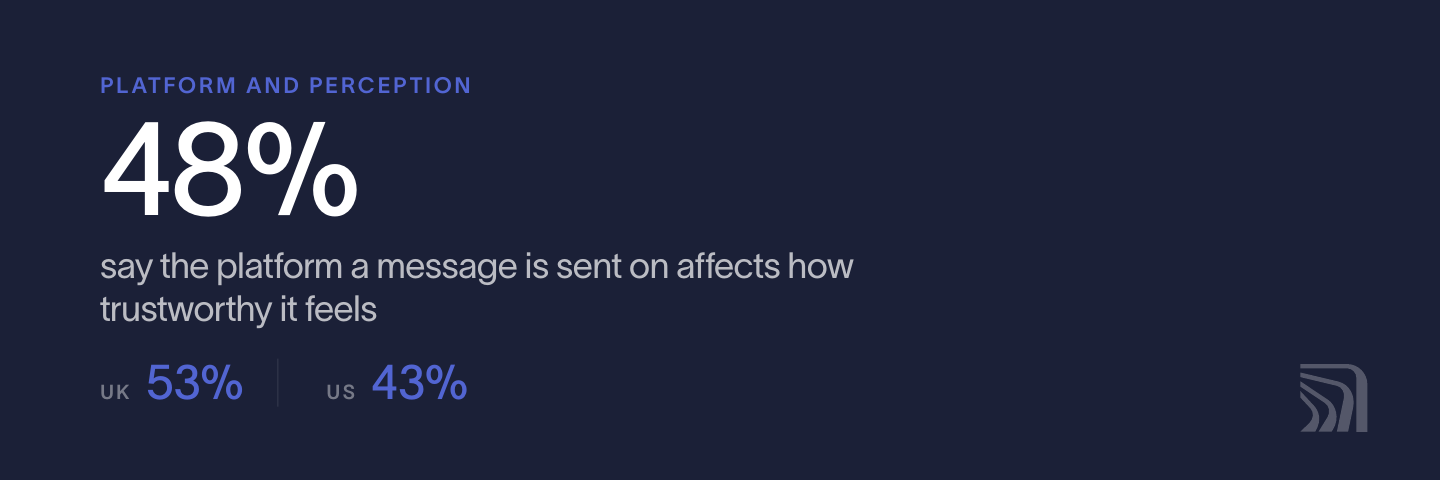
More than half of UK adults say the platform a message is sent on affects how professional it feels (54%), and how trustworthy it feels (53%).
"The UK data shows a heightened sensitivity to email presentation that we don't see at the same level elsewhere. When 70% of your recipients are treating their inbox as a formal record, the signals your email sends like sender name, domain, or formatting, carry real weight." Elisabeth Goossens, Director of Brand, Exclaimer
What "email trust signals" means in practice
Email trust signals are the visible cues a recipient uses to judge whether a business email is professional and legitimate: the sender name, the domain it's sent from, the formatting, and the contact details attached to it. In the UK, these signals matter more than anywhere else in our data.
Half of UK adults have never used AI in their communications
On AI, the UK sits notably apart from the average. 50% of UK adults say they never use AI in their communications, compared to just 35% in the US.
Among all UK adults, the most common uses are improving grammar (22%) and making writing sound more professional (22%). When UK adults turn to AI, it's largely to refine their own writing rather than replace it.
What this means for businesses emailing UK audiences
44% of UK adults have already chosen email over another channel specifically to keep an important message. They're not passive recipients. They're actively curating what lands in their inbox and judging it accordingly.
For IT and marketing teams, that means the signals attached to every outbound email carry more weight in the UK than almost anywhere else. A consistent sender identity, company branding, and accurate contact details are the criteria a UK recipient uses to decide whether to trust the message.
Exclaimer applies professional, on-brand email signatures automatically across every email, without relying on individual employees to get it right.
This blog is part of the When it matters: How people really communicate report 2026, based on a survey of 2,000 adults in the UK and US conducted by OnePoll, May–June 2026. Read the full report