



Attorney and lawyer email signature examples and best practices
26 February 2026
0 min read
TL;DR
A professional attorney email signature should include full name, title, firm details, direct contact information, and required legal disclaimers.
Disclaimer requirements vary by jurisdiction and practice area, so firms must define and apply approved language consistently.
Inconsistent signatures across offices, devices, or attorneys create compliance gaps and weaken brand credibility.
Multi-office law firms need structured standards for formatting, jurisdiction-based variations, and promotional content.
Signatures must render correctly across Microsoft 365, Gmail, and mobile environments to avoid formatting or disclosure issues.
Centralized email signature management helps law firms maintain compliant, consistent branding at scale.
It’s important to note that HTML email signatures for lawyers and attorneys are digital business cards. They let people know who you are, what type of law you specialize in, and how they can contact you. Attorney email signatures are also the perfect place to promote your services as a legal professional.
Search results are full of generic email signature templates. Most overlook what makes a lawyer email signature different. Attorneys operate in regulated environments. Bar admissions, confidentiality notices, data protection requirements, and firm branding all need to appear correctly and consistently.
In this guide, you’ll see practical attorney email signature examples, learn what to include, and understand how law firms maintain compliance and brand consistency at scale. Whether you’re reviewing formatting guidance or evaluating governance across multiple offices, the goal is the same: every email should reflect the standards your firm stands for.
Attorney email signature examples
Below are practical attorney and lawyer email signature examples based on real-world law firm structures. Each format reflects different firm needs, from solo practitioners to multi-office partnerships.
Example 1: Employment lawyer email signature with personal branding

This attorney email signature balances personal credibility with firm branding.
Why this format works
- Clear professional identity: The attorney’s name and practice area appear prominently. “Employment Lawyer” sets immediate context.
- Direct contact details: Phone, mobile, and email are easy to scan.
- Firm identity reinforced: The law firm name, website, and physical address are clearly displayed.
- Practice area listing: Employment, human resources, consumer rights, corporate — this improves clarity without overcrowding.
- Confidentiality disclaimer included: A standard legal email disclaimer appears below the signature content.
- Professional headshot: Adds trust and personalization, especially in client-facing communications.
- Social media icons: Appropriate where attorneys use LinkedIn or other platforms professionally.
Best for
- Boutique firms
- Client-facing employment lawyers
- Practices where relationship-building is central
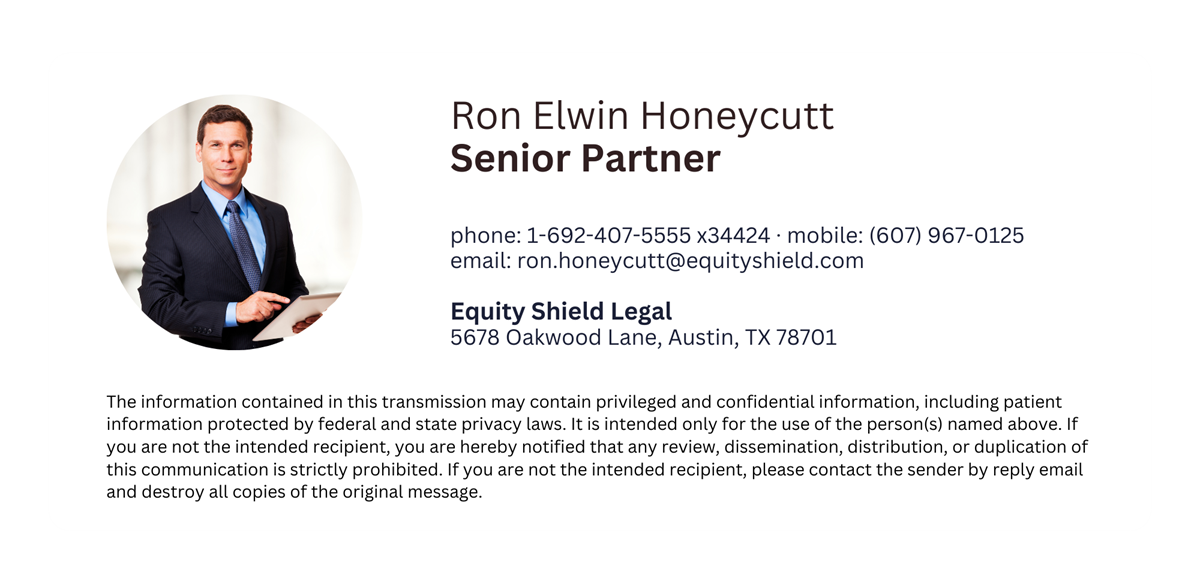
Example 2: Senior partner email signature for multi-partner firms

This lawyer email signature prioritizes authority and firm reputation.
Why this format works
- Firm logo dominance: The visual weight emphasizes the LLP brand over the individual.
- Title clarity: “Senior Partner” reinforces hierarchy and credibility.
- Structured layout: Contact details are separated cleanly for readability.
- Formal disclaimer language: Broader liability language is included, suitable for larger partnerships.
- Minimal design elements: Clean, restrained formatting reflects traditional law firm standards.
Best for
- Established partnerships
- Corporate law firms
- Firms operating in regulated financial or cross-border environments
For firms with multiple partners, managing this type of attorney email signature manually often leads to variations. Centralized control reduces that risk.
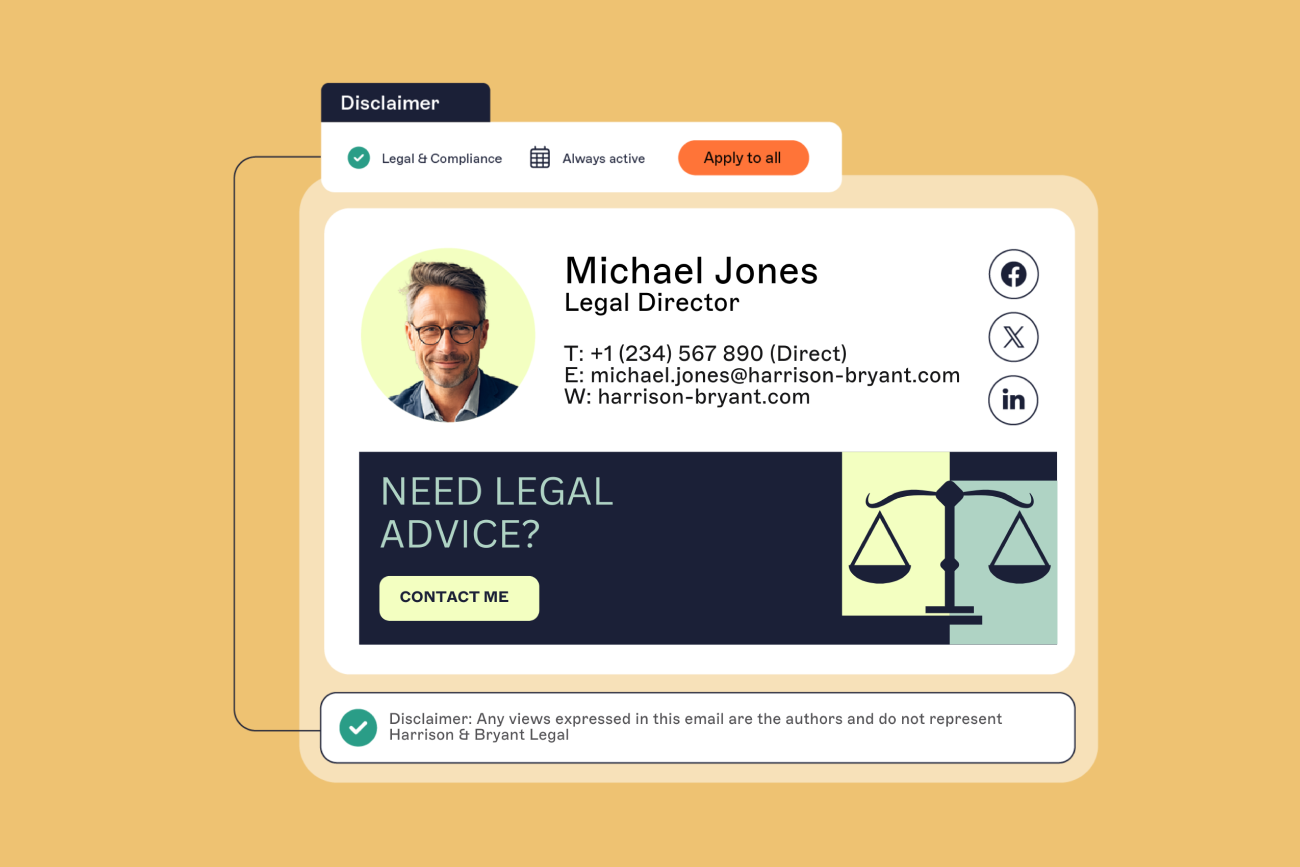
Example 3: Law firm email signature with campaign banner

This example introduces a marketing element while maintaining legal professionalism.
Why this format works
- Clear contact information at the top
- Firm identity prominent
- Promotional banner positioned below core details
- Call-to-action button (“Contact us”)
- Disclaimer separated from campaign content
When to use this structure
- Promoting specific services such as personal injury or employment claims
- Driving consultations
- Supporting demand generation without sending additional marketing emails
Governance considerations
- Messaging must align with advertising rules in the relevant jurisdiction
- Disclaimers must remain intact
- Promotional wording may differ by region
Example 4: Solicitor email signature with meeting booking link

This solicitor email signature emphasizes accessibility and appointment booking.
Why this format works
- Professional headshot
- Clear role identification (“Solicitor”)
- Icon-supported contact details
- Full office address included
- Integrated meeting booking button
Ideal for
- UK-based firms
- Practices where consultations are frequent
- Firms using structured intake workflows
Additional considerations
In jurisdictions like the UK, solicitors may need:
- SRA regulatory wording
- VAT or registration numbers
- Office location disclosures
Embedding these elements consistently across every solicitor email signature prevents compliance gaps.
While these attorney email signature examples differ in layout and emphasis, they all prioritize clarity, compliance, and professional presentation. For law firms, maintaining that standard across every attorney, office, and device requires structured oversight and consistent governance.
What to include in an attorney or lawyer email signature
An effective attorney email signature balances professionalism, regulatory awareness, and clarity. While formatting may vary by firm, certain elements should appear consistently across every lawyer email signature.
Below is a structured breakdown aligned with legal best practices.
Full name and professional title
The attorney’s full name should appear exactly as registered with the relevant bar or regulatory body.
Include:
Full legal name
Professional designation such as Attorney at Law, Partner, Associate, Solicitor
Practice area where appropriate
Clarity and hierarchy matter. The name should be visually dominant, followed by title.
Firm name and branding
Every attorney email signature should clearly display:
Official law firm name
LLP, LLC, or other legal entity designation
Firm website
Brand consistency is critical in multi-office firms. Variations in logo placement, typography, or firm naming conventions can create reputational friction.
For larger firms, this element should be standardized centrally rather than manually formatted by individual attorneys.
Direct contact information
A lawyer email signature should make it easy for clients to reach the attorney without searching.
Include:
Direct phone line
Mobile number where appropriate
Professional email address
Office address if required by jurisdiction
Bar admissions and credentials
In some jurisdictions such as the U.S., listing bar admissions or qualifications strengthens credibility and may be required.
Examples:
Admitted in New York and California
Member, State Bar of Texas
Regulated by the Solicitors Regulation Authority
Where included, credentials should be accurate and updated immediately when status changes. Outdated admissions create risk and undermine trust.
Confidentiality and legal disclaimers
Most law firm email signatures include a confidentiality disclaimer. Depending on jurisdiction, additional regulatory language may also apply.
Common elements include:
Confidentiality notice
Liability limitation
Regulatory body disclosure
Data protection references
Disclaimers must remain consistent across the firm. Manual editing introduces the risk of omissions, outdated language, or inconsistent wording between offices.
Because requirements vary by jurisdiction, firms should review regulatory guidance before standardizing wording.
Social media and professional profiles
Some attorneys include links to:
LinkedIn
Firm publications
Practice area pages
These should be used selectively. Social media icons must link to professional accounts and align with firm policy.
Meeting booking links and calls to action
In certain practice areas, especially consultation-driven services, attorneys include:
“Book a consultation” button
Calendar scheduling link
Service-specific call to action
This approach can support client intake while maintaining professionalism. Promotional elements shouldn't override core legal disclosures.
Mobile and cross-device formatting
Many emails are sent from mobile devices. An attorney email signature must render correctly across:
Outlook desktop
Microsoft 365 web
Gmail
Mobile email apps
Broken formatting or missing disclaimers on mobile devices creates inconsistency and potential compliance gaps.
Consistency across devices is often overlooked in generic lawyer email signature templates.
A well-structured attorney email signature is straightforward to design. Maintaining the correct version across every lawyer, office, and jurisdiction is more complex. Law firms operating at scale need a consistent framework that keeps branding aligned, disclosures accurate, and formatting uniform across all communications.
Attorney email signature compliance considerations for law firms
Attorney email signatures sit at the intersection of professional branding and regulatory obligation. While many online templates focus on layout and design, law firms must also consider jurisdictional rules, advertising standards, and data protection requirements.

Compliance isn't optional. It must be applied consistently across every attorney and every outgoing message.
Jurisdiction-specific disclaimer requirements
Different regions impose different obligations on legal communications.
For example:
U.S. firms may need advertising disclaimers depending on practice area and state bar rules.
UK solicitors may need to reference SRA regulation details.
EU-based firms must consider GDPR-related transparency.
Certain practice areas, such as healthcare or financial services, may require additional disclosures.
Advertising and promotional language
Campaign banners such as “No win, no fee” or consultation offers must align with professional conduct rules.
Considerations include:
Whether the language constitutes advertising
Whether disclaimers must accompany promotional statements
Whether specific wording is restricted by local bar rules
Consistency across multi-office firms
Large firms often operate:
Across states or countries
Under multiple brand entities
Through merged or acquired practices
If each attorney manually edits their email signature, inconsistencies appear quickly:
Outdated disclaimers
Incorrect office addresses
Misaligned firm naming conventions
Missing regulatory references
Confidentiality and data protection language
Most attorney email signatures include confidentiality notices. However, firms should periodically review:
Whether liability wording remains current
Whether data protection references align with evolving regulations
Whether disclaimer placement is consistent across devices
Mobile and hybrid work environments
Hybrid work introduces another layer of complexity. Law firms must account for cross-device consistency when designing and managing attorney email signatures.
Auditability and accountability
In regulated sectors, firms must demonstrate control over communication standards.
Consider:
Who approves disclaimer wording
How updates are distributed
How quickly regulatory changes are reflected
Whether changes are tracked
Attorney email signatures must reflect current regulatory requirements, approved firm language, and accurate office information. Law firms should define clear standards for disclaimer wording, formatting, and branding, and apply them uniformly across all attorneys and devices.
How law firms manage attorney email signatures at scale
Designing a compliant attorney email signature is straightforward. Applying the correct version across every lawyer, office, and device requires structure.

As firms grow, email signature management becomes complex. Multiple practice areas, jurisdictions, and office locations introduce variation. Without defined controls, inconsistencies appear quickly.
Standardizing signature templates across the firm
Law firms should define approved templates for:
Partners
Associates
Paralegals
Practice-specific roles
Each template should include:
Approved logo placement
- Standardized font and formatting
Jurisdiction-specific disclaimer rules
Required regulatory references
Managing jurisdictional variations
Firms operating across states or countries often require different disclaimer language depending on:
Office location
Regulatory authority
Practice area
Client type
Applying a single universal disclaimer rarely satisfies every requirement. Firms should define rules for when specific language applies and ensure those rules are applied consistently.
Keeping contact details accurate
Attorney email signatures must reflect current:
Job titles
Office addresses
Direct phone numbers
Practice areas
Changes in role, promotions, or office moves should trigger updates. Manual editing increases the risk of outdated information remaining in circulation.
Supporting hybrid and mobile environments
Attorneys send email from multiple environments. Firms should test signature rendering across devices before standardizing deployment.
Controlling promotional content
Where firms use campaign banners or consultation prompts, controls should define:
Approved wording
Placement within the signature
Start and end dates
Applicable jurisdictions
Maintaining oversight and review cycles
Email signature standards should be reviewed regularly to account for:
Regulatory changes
Firm rebranding
Mergers and acquisitions
New practice areas
Responsibility for updates should be clearly assigned. Informal processes introduce delays and inconsistencies.
Managing attorney email signatures at scale requires defined standards, consistent application, and regular review. Law firms that formalize this process reduce compliance gaps and maintain professional consistency across all communications.
Maintaining brand consistency in attorney email signatures
Law firms need a practical way to apply signature standards consistently, update regulatory language without delay, and maintain control across offices and devices.
 Inconsistent formatting, outdated disclaimers, or incorrect office information can weaken credibility. For multi-office or multi-jurisdiction firms, maintaining alignment across hundreds of attorneys requires defined governance.
Exclaimer gives legal teams oversight of every attorney email signature, with automated updates, jurisdiction-based disclaimer rules, and brand controls built for Microsoft 365 and Google Workspace environments. The result is consistent, compliant email communication that reflects the firm’s standards in every message.
Start a free trial of Exclaimer to manage attorney email signatures centrally, apply approved disclaimers automatically, and maintain consistent branding on every message.