




Doctor email signature examples and templates
27 February 2026
0 min read
TL;DR
A professional doctor email signature reinforces clinical authority, builds trust, and supports compliance with healthcare regulations such as HIPAA and GDPR.
Every signature should include full name, qualifications, role or specialty, workplace details, and clear contact information.
Healthcare providers must include appropriate confidentiality disclaimers and avoid exposing protected health information.
Standardized signatures across hospitals or practices protect brand identity and reduce compliance risk.
Additional elements such as certification badges, headshots, booking links, and banners should remain professional and aligned with organizational policy.
Centralized email signature management helps healthcare organizations maintain consistent, compliant communication across all doctors and departments.
A doctor email signature is the professional block of information automatically added to the end of your emails. It typically includes your full name, medical credentials, specialty, practice details, and any required disclaimers.
Patients, colleagues, insurers, and administrators rely on clear identification and accurate credentials in every communication. A poorly formatted or incomplete physician email signature can create confusion, weaken credibility, or omit important compliance information.
A well-designed medical email signature helps you:
Clearly present your name and medical qualifications
Reinforce trust and professionalism
Provide accurate contact details
Include appropriate legal or HIPAA-related disclaimers
Maintain consistency across devices and email platforms
In this guide, you’ll learn exactly what to include in a professional doctor email signature, how to format your credentials correctly, when disclaimers are appropriate, and see practical templates you can use in private practice, hospital settings, or telehealth environments.
What should a doctor include in an email signature?
A doctor email signature should include your full name, medical credentials, specialty, workplace, direct contact details, and any required legal disclaimers. The goal is clear identification, credibility, and easy contact.
 A professional physician email signature typically contains:
Full name followed by primary medical degree (e.g., Jane Smith, MD or Robert Lee, DO)
Specialty or area of practice (e.g., Cardiology, Family Medicine)
Practice, clinic, or hospital name
Direct phone number
Office address (if relevant for patient communication)
Professional website or secure patient portal link
Confidentiality or compliance disclaimer, if required by your organization
Optional additions may include:
Board certifications (e.g., Board Certified in Internal Medicine)
- Fellowship or professional designations
Academic appointments
Appointment scheduling link
Secure fax number
Keep the signature structured and readable. A medical email signature should communicate authority and clarity, not overwhelm the reader with excessive credentials or decorative elements.
How to format medical credentials correctly in an email signature
In a doctor email signature, credentials should be clear, structured, and easy to scan. The goal is to communicate authority without overwhelming the reader.
List your primary medical degree first
Place your main qualification immediately after your name. This establishes your clinical authority at a glance.
Example:
Jane Smith, MD
Robert Lee, DO
Add additional degrees only if relevant
Advanced academic degrees such as MPH, MBA, or PhD can be included when they directly support your role.
Example:
Jane Smith, MD, MPH
Keep this line concise. Avoid listing every academic qualification unless it strengthens your professional identity.
Place board certifications on a separate line
Instead of stacking certifications after your name, list them beneath your title.
Board Certified in Internal Medicine
This keeps your physician email signature readable while still reinforcing expertise.
Should you include license numbers?
In most cases, license numbers are not required in an email signature unless your organization or local regulations specify it. If included, place them on a separate line to avoid clutter.
International formatting considerations
Outside the United States, medical degree abbreviations and ordering may differ. Follow your country’s professional conventions while maintaining clarity and consistency.
A professional medical email signature should reflect confidence and structure. Short, precise credential formatting is almost always more effective than long credential lists.
Do doctors need a disclaimer in their email signature?
Doctors may need an email disclaimer if required by their organization, state regulations, or internal compliance policy. In most healthcare settings, standardized disclaimer text is applied to support confidentiality and risk management.
 A doctor email disclaimer often includes:
A confidentiality notice
A statement about unintended recipients
Instructions for secure communication
A limitation of liability statement
However, it’s important to be clear: a disclaimer does not make an email HIPAA compliant. Compliance depends on secure messaging systems, encryption, and proper handling of protected health information.
If you work within a hospital, clinic, or healthcare network, always use the disclaimer text provided by your compliance or IT team. Modifying approved language can create risk.
For physicians in private practice, consult local regulatory guidance before adding custom legal statements.
A professional doctor email signature should support compliance — but it should never rely on disclaimer text alone as a substitute for secure communication practices.
HIPAA and legal requirements (U.S. only)
If you're practicing in the United States, your email signature must align with HIPAA (Health Insurance Portability and Accountability Act) standards.
 This applies to anyone handling protected health information (PHI)—including physicians, specialists, administrators, and affiliated staff.
A HIPAA-compliant doctor signature must not expose any patient data. It should also include a standard disclaimer that clarifies the confidential nature of email communications.
Here’s an example of a HIPAA disclaimer you can use:
“This email and any attachments are confidential and intended solely for the use of the individual to whom it is addressed. If you have received this message in error, please notify the sender and delete it immediately.”
This kind of statement is especially important when forwarding or replying to chains that may be shared with colleagues, partners, or third parties.
If you're based outside the U.S., consult the appropriate regulations for your country—such as GDPR in the UK and EU, or PIPEDA in Canada.
Doctor email signature examples and templates
Below are structured doctor email signature examples that reflect different healthcare settings. Each physician email signature template balances clarity, credentials, and patient accessibility.
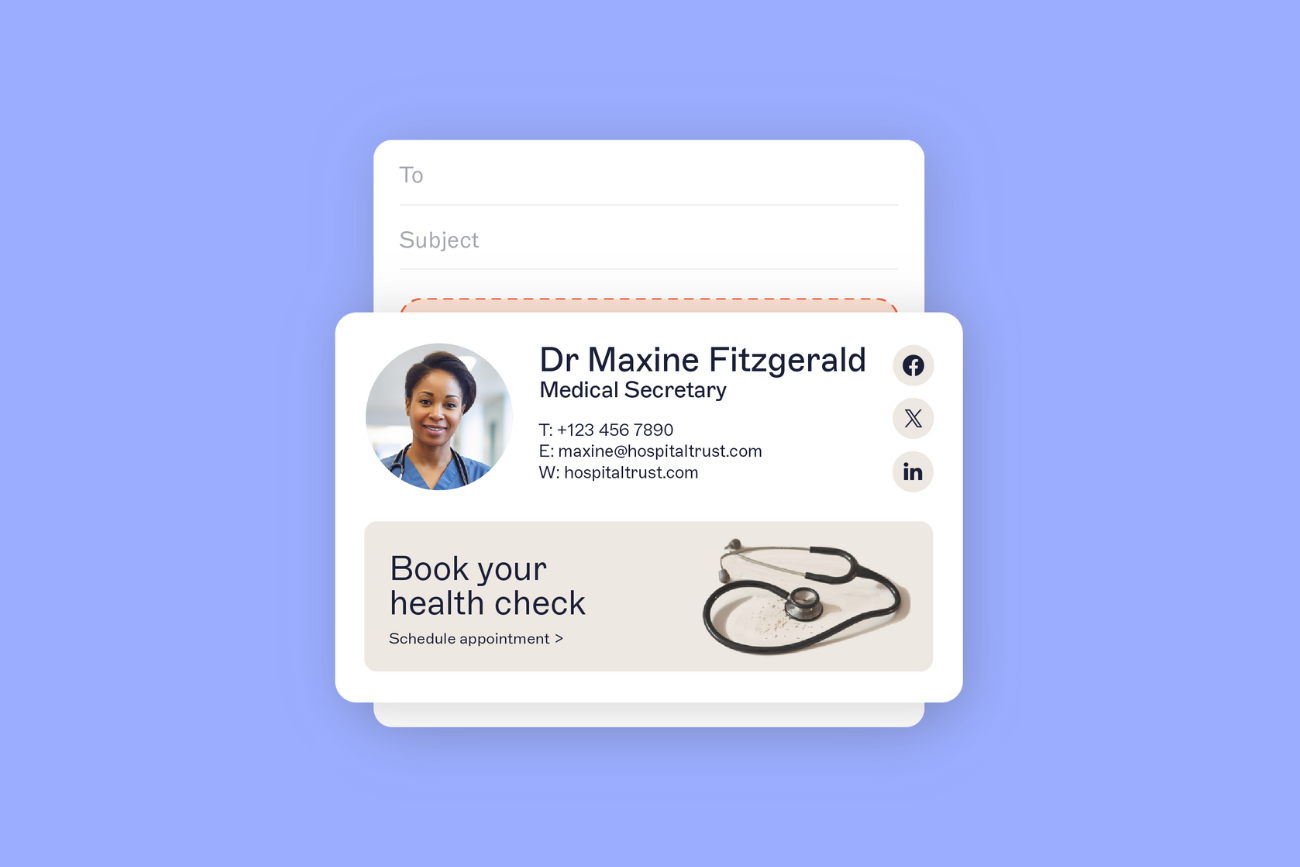
Doctor email signature example: General physician

This doctor email signature example includes:
- Name and MD credential prominently displayed
- Specialty and clinic name
- Direct phone, email, and website
- Professional headshot
- Social icons
- Appointment booking call-to-action
This format works well for private practice physicians who want to encourage appointment bookings directly from email.
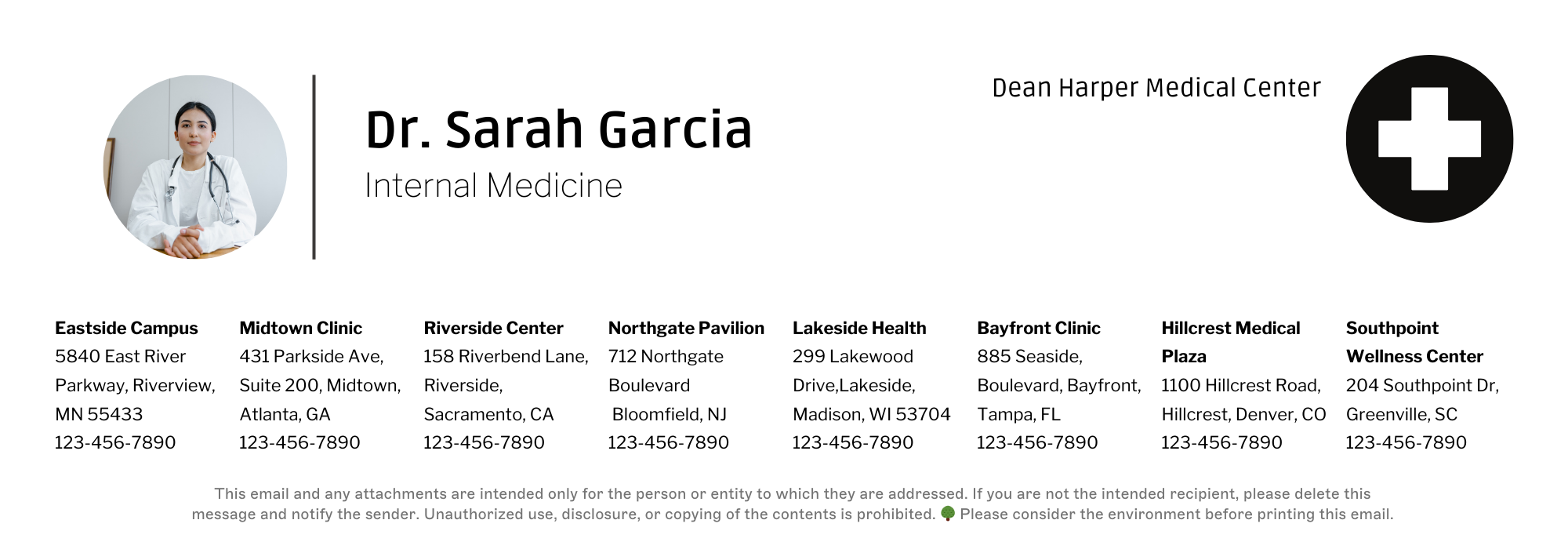
Physician email signature template: Hospital-based specialist

This physician email signature template emphasizes:
- Formal structure
- Hospital branding
- Clear contact details
- Standardized confidentiality disclaimer
Best suited for hospital-employed doctors operating under strict compliance requirements.
Medical email signature example: Pediatric specialist

This medical email signature example includes:
- Senior clinical designation
- Structured contact information
- Patient-focused banner
- Compliance notice
Effective for pediatricians and family doctors communicating with parents.
Structured healthcare signature example: Clinical environment

This layout demonstrates how to include:
- Extended contact numbers
- Hospital address
- Formal disclaimer text
Useful when routing and compliance are priorities.
Private practice email signature with promotional banner

This doctor-style email signature shows how promotional banners and social icons can be added without compromising professionalism.
What these doctor email signature examples have in common
Across all formats, strong medical email signatures share five traits:
Clear credential formatting
Structured layout
Professional tone
Accurate contact information
Appropriate compliance language
Common mistakes to avoid in a doctor email signature
A professional doctor email signature should be clear, structured, and accurate. These are the most common mistakes physicians make.

Overloading credentials
Long strings of degrees can reduce readability. Your primary medical qualification should stand out. Additional credentials should only be included if they strengthen your clinical authority.
Inconsistent formatting
Mixed fonts, uneven spacing, or excessive colors make a physician email signature look unprofessional. Keep the layout clean and consistent.
Using personal email accounts
A personal email address can weaken credibility in a clinical setting. Always use your official hospital or practice domain.
Adding unnecessary social links
Limit social media icons to professional platforms. Avoid linking to personal profiles.
Writing unapproved disclaimer text
Do not create or copy legal language without guidance. Use standardized text provided by your organization or regulatory advisor.
Letting contact details become outdated
An outdated phone number or incorrect title can create confusion and undermine trust. Review your medical email signature regularly to keep information accurate.
Clarity builds confidence. A well-structured doctor email signature should communicate authority in seconds.
Simplify email signature management across your medical team
A professional doctor email signature does more than display contact information. It confirms your credentials, clarifies your role, and reinforces credibility in every interaction.
A strong medical email signature should:
Present your name and primary medical qualification clearly
Identify your specialty and organization
Include accurate contact details
Use approved disclaimer language when required
Remain structured, concise, and consistent
But managing professional, compliant, and branded email signatures across an entire healthcare organization doesn't have to be complex.
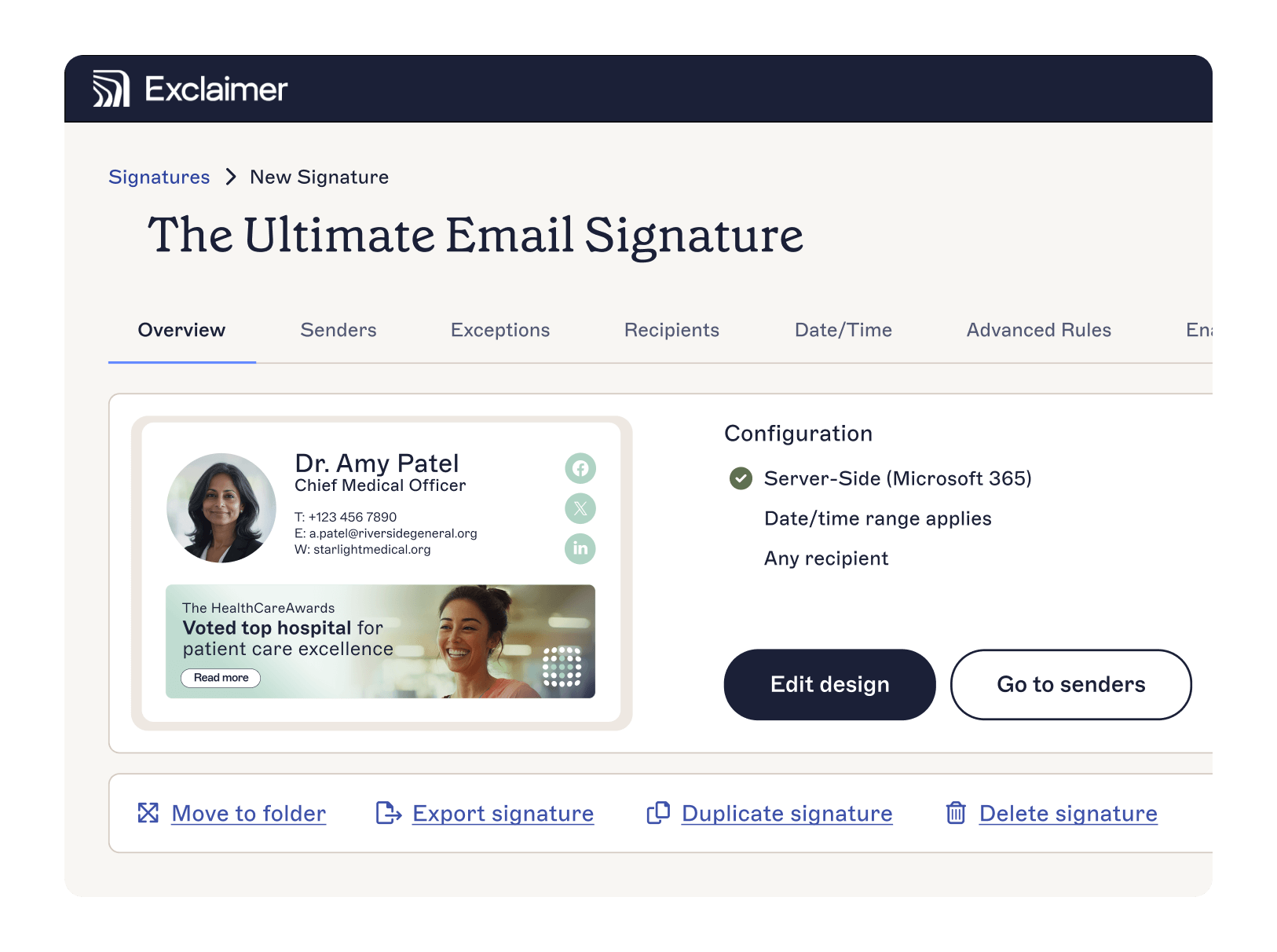
With Exclaimer, you can centrally manage and update signatures for all doctors, staff, and departments — ensuring consistency and compliance in every email.
Learn more or get yourself a free trial to see the power of email signature software for yourself.