If you work in IT, you probably don't want a conversation with a support agent. You want your problem gone so you can get back to your day. That's the reason I built our support around AI first, and I'd like to explain it properly.
Why do IT professionals want a fast fix more than a conversation?
Most of Exclaimer's customers are IT professionals, and they would rather help themselves than contact us.
By the time you write in, you've usually tried everything. You want a quick, efficient answer from someone who speaks your language. Small talk doesn't give you that.
That changes what good support means. For an IT team managing signatures across Microsoft 365 or Google Workspace, a stuck ticket can hold up a brand or compliance change, so good support is measured in minutes saved, not rapport built.
It's also why we moved our technical support team to a region with deep Microsoft expertise, so the person who picks up your ticket knows your environment.
What does Exclaimer's AI-first support actually do?
Exclaimer's AI-first support does three things:
An autoresponder answers tickets automatically. It now resolves about 20% of them.
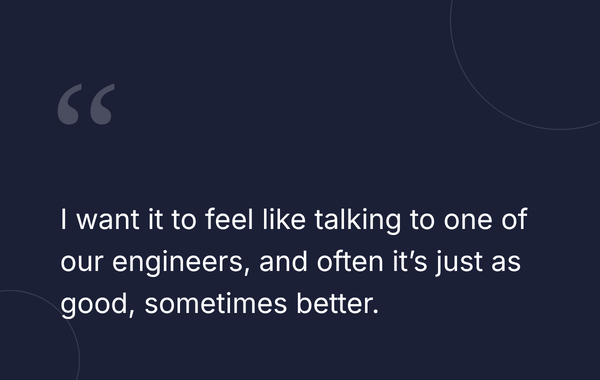
Maven, our AI chat tool, draws on far more knowledge about our solutions than any one person can hold. I want it to feel like talking to one of our engineers, and often it’s just as good, sometimes better. Customers have started telling us so in their satisfaction feedback. One wrote that they couldn't believe their problem was solved within 24 hours.
Urgent issues skip the AI. The moment we sense something is urgent, you’re put through to a person, with no hoops.
Because so many conversations now happen with AI, we can also learn from them at scale, which a queue of individual agents can't do.
Is Exclaimer's AI-first support just a way to save money?
Exclaimer built AI-first support around where a person adds value, not around cost. I understand why you'd ask. In my experience, AI support is often introduced as a cost measure.
I started from a different question: where does a person add value, and where does a good answer do the job faster? If a good answer solves your problem, a human conversation adds nothing for you. If your problem is complex, you should reach a person who knows the product.
So we're moving to a model where AI handles the first line and specialists take what genuinely needs them. Those specialists will also feed what they learn from your tickets to our product team, so the product improves because of your problems and not despite them.
What happens if you would rather talk to a person?
Exclaimer's AI handles routine questions, and a person takes anything urgent or anything that genuinely needs one.
Your situation | Who helps you |
A routine question the product knowledge can answer | The autoresponder or Maven |
An urgent issue | A person, straight away, with no AI first |
An issue that genuinely needs a person | A person who knows the product |
Some customers have said in G2 reviews that they found dealing with AI frustrating, particularly on pricing questions. I take that seriously. If you've felt stuck behind an AI when you needed a person, tell us. That is the kind of feedback I act on.
What does human-only support say about a product?
Some vendors wear "human support only" as a badge. It sounds reassuring. But a product that needs that much standing human support is telling you something about the product.
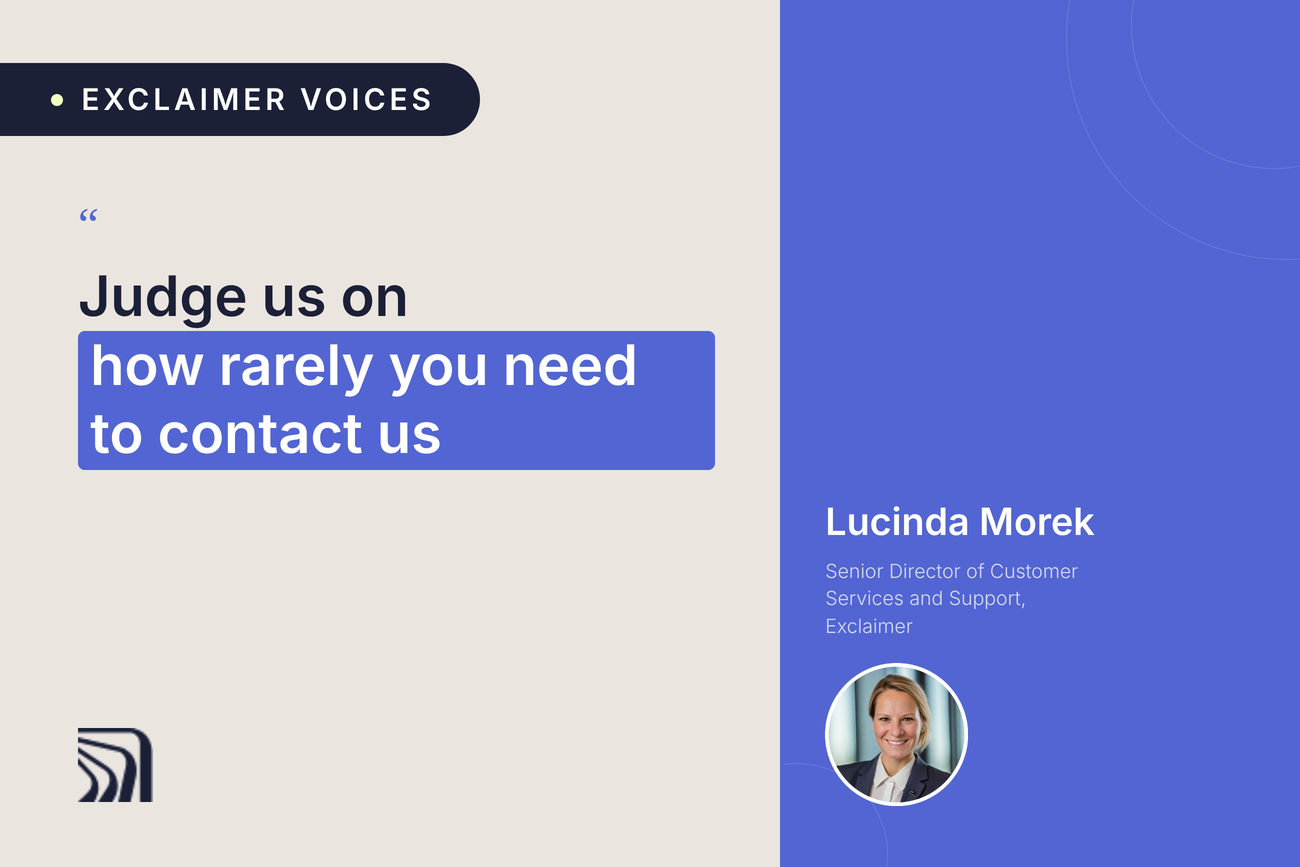
I'd rather build a product and a self-serve experience so reliable that you rarely need to contact anyone, with a sharp AI behind it for the times you do. Recent G2 reviewers describe Exclaimer as set up and forget, and as something that runs itself once templates are in place, which is how automated signature management should feel. Judge us on how rarely you need to contact us, and on how good it is when you do.
What's still unfinished in Exclaimer's AI-first support?
Exclaimer started its AI-first work in January 2026. Our phone support is still handled by an outsourced team: we want voice-to-voice AI there, and we're excited to say it's coming soon.
We haven't yet brought AI to our account services team either. It's taking longer than I wanted, and that's frustrating. But getting it right matters more than getting it live quickly.
My aim is for Maven to be the most knowledgeable agent in the business. It's doing a good job on chat and on tickets today. I want it to be something you enjoy spending time with, and that's still work in progress.
What can you expect from Exclaimer support?
Exclaimer's goal is that, if you run IT, you should rarely need to contact us at all, and our Exclaimer for IT teams page shows how we've built for that.
When you do contact us, I want it to be surprisingly good, with a real person there the moment it matters. You can see what customers say about working with us in our customer stories.
If it falls short, let us know where it has let you down.
Lucinda Morek
Senior Director of Customer Service
Lucinda is Senior Director of Customer Services and Success at Exclaimer, where she leads the technical support and account services teams. She joined in August 2024 and has since overhauled how Exclaimer handles support.
Lucinda has 20 years of experience in customer service and operations, including roles at the Financial Times and Bark.com. She holds an MBA from Warwick Business School and a CIPD Level 5 diploma in people management.