Consolidation and marketplace and API buying have moved the channel model, so we now measure recurring revenue, time to first transaction, and net revenue growth in place of partner count.
Incremental change works when the underlying model is right and just needs tuning. A rebuild is for when the model itself has moved.
In the channel it has moved in two ways at once, and that’s why we rebuilt Exclaimer’s partner program instead of adjusting what we had. Tuning a program built for a different shape of partner only gives you adjustments to something you can’t measure properly.
What actually changed in the channel?
Partners consolidated, and buying moved to marketplace and API routes. Take the partner you designed a program for in 2020.
Say it has since been acquired. It now sits inside a platform business with centralized tooling and a procurement function, and its buying runs through marketplace and automated routes.
What that partner needs from a vendor has changed operationally, far more than commercially. A program designed around the 2020 version of that partner is now measuring and rewarding the wrong things.
That is the reason tuning fails. Every incremental change is an adjustment to a model that no longer fits the market, and one we can’t properly evaluate. At some point you have to stop and fix the instruments.
What do we measure instead of partner count?
Partner count is a long list of names. None of the four measures I’m using is a count of partners.
Growth of net revenue, not gross. Revenue that has only moved from direct to partner, or from one partner to another, isn’t growth.
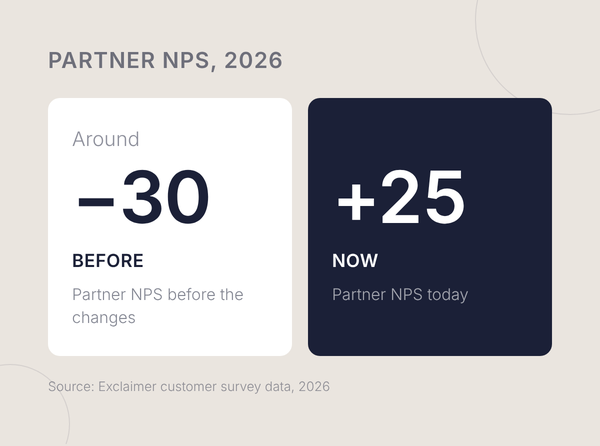
Early signals point the right way. Partner NPS has moved from around -30 to +25 this year, alongside the support changes Lucinda Morek sets out in her account of what we got wrong in support and billing. The rebuilt program is only now being released, so I make no claim that it was the sole contributor to the NPS increase.
What does the new program look like in practice?
It is built mainly around MSP partners, the ones who sell a product with a service wrapped around it, and three design choices follow from the measures above.
There are no traditional tiers. Tiering assumes MSPs are similar enough to be sorted into bands by size or spend, and that isn’t how they work. We allocate human attention and funding by how a partner operates, and I’d rather be judged on whether partners can transact easily than defend a ladder. The full structure is on our partner program page.

Isn't a rebuild a bigger gamble than tuning?
Yes. Replacing a model carries more risk than adjusting one, and with the program only now being released, the evidence is early.
Tuning carries a risk that’s easier to miss. You can adjust for years and never learn whether the model works, because the measures were never built for it. A rebuild lets us see what’s underneath.
Where do distributors and Microsoft Marketplace fit?
Alongside the rebuild. An MSP may consolidate its billing and buy through a distributor, and that route stays.
Microsoft Marketplace is the factor every partner needs to plan for, whichever route they buy by. A vendor that can’t support multi-party private offers will reduce the number of customers it sells to, because some buyers use Marketplace to offset their MAC agreements. I expect that to matter more each year. Build the program around how partners buy, because that is what has moved.
If you want to see how we think about partner enablement, read our partner playbook or browse our partner case studies.