Channel partners carry their own sales infrastructure and customer relationships.
The margin you extend to them is the cost of distribution, not a concession.
Most vendor programmes are built for the vendor's convenience. A channel-first programme is built around what a partner actually needs to transact at volume, without friction.
Segmentation matters: global VARs, regional VARs, and MSPs are three different commercial relationships that need three different programme designs.
Channel-first infrastructure means self-service tooling, flexible billing, and data access that helps partners run their own business better, not just a better discount tier.
Direct sales teams are expensive to build, slow to scale, and if you're honest about it, rarely give you the kind of blunt product feedback that actually improves what you're selling. A partner who's struggling to transact with you will tell you exactly what's broken. Your own rep will find a workaround.
I've been making the internal case for channel-first at Exclaimer since I took over channel and global business operations.
The commercial logic isn't complicated. But the execution requires something most vendors aren't willing to do: build the programme for the partner, not for yourself.
The commercial argument for channel is straightforward: partners bring their own sales infrastructure, their own customer relationships, and in the case of MSPs and regional VARs, a level of trust with the end customer that a vendor rep will spend months trying to earn. You don't pay for that infrastructure. You earn the right to benefit from it by building a programme worth working with.
For a product like Exclaimer, where average deal sizes sit at a level that makes large direct sales teams economically challenging, the partner model is structurally more efficient. The margin we extend to partners is the cost of distribution. In return, we get reach we could never replicate with a direct team, in markets and verticals where partners already operate.
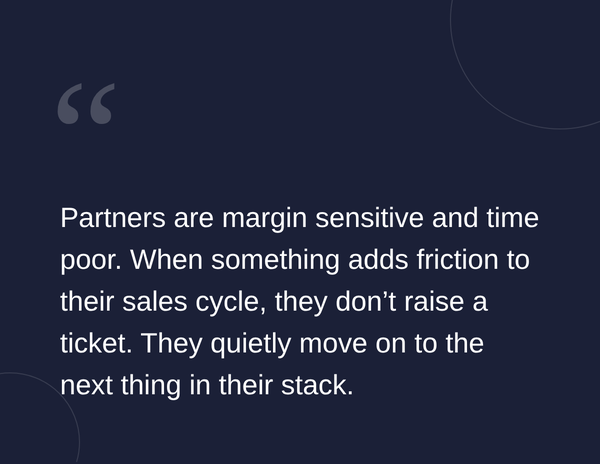
The other return, product intelligence, is completely undervalued. Partners are margin sensitive and time poor. When something adds friction to their sales cycle, they don't raise a ticket; they quietly move on to the next thing in their stack. That immediate feedback loop is more honest than most internal product reviews. If partners aren't selling you, the programme is the problem. That clarity is valuable.
If I was building a SaaS vendor from scratch tomorrow, I would make it channel-only. Partners scale faster than direct, give you better product feedback, and if your programme actually works, will sell harder for you than your own team. The caveat is that last part: if your programme actually works.
What separates a channel-first programme from a channel-friendly one?
Most vendor channel programmes are built for the vendor's convenience, not the partner's. The discount tiers, the certification levels, the co-marketing funds. All of it is designed to manage partner behavior from the vendor's side. The partners who thrive in those programmes aren't thriving because of the programme. They're thriving despite it.
Channel-first means starting from a different question: what does a partner actually need to transact with us, at volume, without friction? In most cases, the answer is not a huge amount. They want to self-serve. They want accurate billing. They want someone useful to call when something isn't working. They want pricing that reflects how they actually operate, which for MSPs means consumption models and monthly flexibility, not annual contracts built around vendor finance cycles.
The distinction also shows up in how you segment your partner base. Not all partners need the same things, and treating them as if they do is one of the most common programme design failures I've seen. Global VARs have scale, but you'll never be their priority. You're one of hundreds of vendor relationships, and the deals that stick tend to come from somewhere else. A regional VAR in a focused geography with a strong local customer base is a completely different conversation. They want to grow with you. They want to run co-marketing. They want to know the commercial opportunity. Those partners are worth more investment, more CAM time, and more flexibility.
MSPs sit in their own category entirely. They operate as a business within a business: managing infrastructure for their customers, bundling services into managed contracts, and expecting a vendor programme that reflects that model. Monthly rolling consumption, the ability to provision at scale across multiple customers, and flexible billing. These are table stakes for MSPs, not premium features. Most vendor programmes still don't deliver them.
What channel-first infrastructure actually looks like in practice
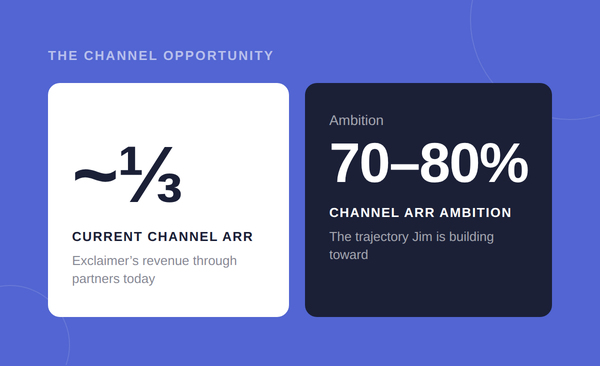
At Exclaimer, channel currently accounts for roughly a third of our ARR. My ambition is to move that significantly higher, to a point where the majority of our revenue flows through partners. That's the target that shapes every infrastructure decision we're making right now.
The first piece of that infrastructure is the self-service partner portal. Partners shouldn't need to log a support ticket to change a subscription date, add a customer, or check their billing. Every time they have to ask us for something they should be able to do themselves, we've added friction. And friction is the thing partners will not tolerate. The portal removes those calls from the system entirely.
The second is MSP Connect, a dedicated product built specifically for how managed service providers operate. MSPs need to provision email signatures at scale across many customers at once. They need a consumption model that maps to how they bill their clients. MSP Connect integrates with the tools MSPs already use like ConnectWise, Kaseya, the Microsoft Marketplace. Because credibility in the MSP market comes partly from being present in those ecosystems, not just from having a good product.
The third piece is data. One of the most underused levers in channel is the intelligence a vendor can surface to partners about their own customer base. When you can show a partner trends in how their end users are behaving like where expansion is happening, or where there are signals of risk, you're showing them something they genuinely can't see themselves. That shifts the conversation from a vendor asking for mindshare to a vendor who is actively helping partners run their business better. That's the relationship that compounds.
The case for keeping direct, and why it doesn't change the conclusion
The obvious objection to channel-primary is that direct gives you control. You own the customer relationship. You control the sales narrative. For complex enterprise deals or new product introductions where the story is still being refined, a direct rep can adapt in ways a partner can't.
That's a legitimate point, and I'm not arguing for abandoning direct entirely. There are deals and customer relationships where direct will always be the right model. But the mistake most vendors make is treating channel as the supplement and direct as the default when, for a product at Exclaimer's stage of scale, the economics run in the other direction.
Partners also struggle with newer product categories, we've seen this ourselves. When a conversation requires explaining a new concept before selling it, partners default to what's proven. That's not a failure of the channel model; it's a signal about where the category education needs to happen first. The answer is better enablement and clearer positioning, not a shift back to direct.
Where the channel-primary vendor goes from here
The channel-first SaaS vendor doesn't really exist yet at scale. Most vendors say they're partner-led. Few have actually built the infrastructure to make it true: the billing flexibility, the self-service tooling, the CAM coverage model that treats regional partners as seriously as global logos, the data access that makes partners smarter about their own customers.
The bundling trend is accelerating this shift. MSPs are moving away from distribution machines, where partners can switch vendors with a monthly rolling contract and a better price, toward managed service models where Exclaimer sits inside a bundle that's genuinely hard to leave. That stickiness is good for the partner and good for us. It's also only possible if the programme makes bundling easy to do.
We're building toward a point where the majority of Exclaimer's revenue flows through partners who have genuinely chosen to prioritize us, because the programme makes commercial sense and the tooling makes it frictionless. That's a programme design problem, and programme design problems have solutions.
The vendors who figure this out first will have a structural distribution advantage that direct sales teams can't match. The ones who keep treating channel as a supplement will keep wondering why their partner-sourced revenue never moves.
If you manage a channel programme or are evaluating Exclaimer as a partner, explore our MSP and reseller programme or download the partner playbook to see what working with Exclaimer looks like in practice.