Genuine governance has three parts: consistency (doing things the same way every time), auditability (being able to prove it), and identity (knowing who or what is transacting on your behalf). Most organizations are only delivering one of the three.
As AI increases the volume of outbound communications, organizations that have compliance without governance lose the ability to verify what's being said in their name, at exactly the moment that matters most.
An organization I know passed every audit it faced for three years. ISO certification. GDPR review. Sector-specific regulatory sign-offs. The compliance programme was solid: policies documented, boxes ticked, external obligations met.
Then a senior employee left.
Over the following months, it became clear that a meaningful portion of the organization's outbound communications had been running through processes only that person fully understood. No written procedure. No audit trail. No way to verify, after the fact, what had gone out in the company's name or whether it had met the standards the organization claimed to operate to.
The auditors had never found a problem because there was nothing to find. The compliance framework only required proof that policies existed. It didn't require proof that those policies were being followed, consistently, at the operational level, by everyone.
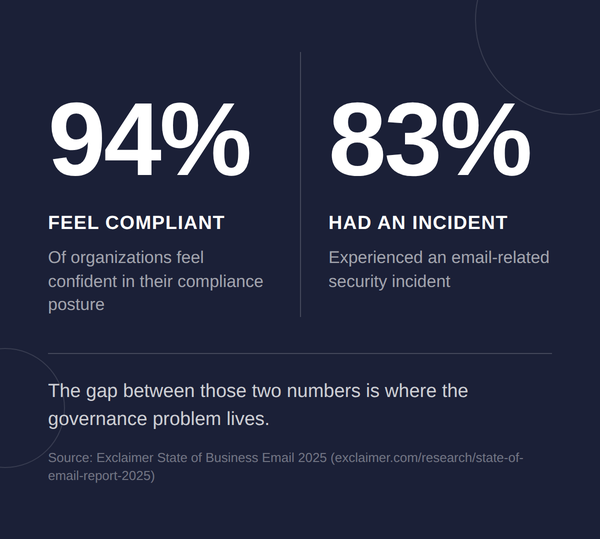
That gap between compliance and governance is one of the most expensive mistakes a board can make. Exclaimer's research across 4,000 IT professionals found that 94% of organizations feel confident in their compliance posture. In the same survey, 83% had experienced an email-related security incident. The gap between those two numbers is where the governance problem lives.
Compliance is a point in time. Governance is continuous.
The distinction matters, and it's not semantic. Compliance answers a specific external question: does this organization meet the obligations placed on it by regulators, contracts, or industry standards? It's measured at a point in time, usually through an audit or certification process, and it produces a binary answer. Pass or fail.
Governance is something different. Governance is the set of internal mechanisms that determines whether an organization can operate consistently, predictably, and accountably. Not just while someone is checking, but all the time. Governance is what makes it possible to answer, with evidence, the question: are we doing what we say we do?
Most executives conflate the two because compliance frameworks require internal controls, and internal controls look like governance. They're not the same thing. A policy document is a compliance artefact. A mechanism that proves the policy is being followed is governance. At scale, and across every person and process that touches it.
The three properties governance actually needs
In my experience, genuine governance has three constituent parts. Most organizations are only delivering one of them at any given time.
Consistency means doing things in a defined way, across the organization, every time. Not most of the time. Not when the right person is in the room. Every time. For business communications, this means every email, every signature, every disclaimer, every AI-assisted message going out the door meets the same standard. Consistency is the foundation. Without it, the other two are impossible.
Auditability means being able to prove it. This is where most compliance frameworks fall short. A policy that says "all outbound communications must include a compliant legal disclaimer" is a compliance requirement. A system that can demonstrate, on demand, that every outbound communication did include a compliant legal disclaimer, and that the version used was the approved version at that point in time, is governance. The difference is a log, a process, and accountability for maintaining it.
Identity is the most underappreciated of the three. It means knowing who's transacting on behalf of your organization at any given moment. Not just which employee, but which system, which integration, which automated process. In Exclaimer's research, a third of IT leaders reported that employees routinely ignore their organization's own email signature guidelines. That's not a compliance failure, it's a governance failure. The policy exists. The mechanism to enforce it consistently, across every person and every device, does not. As more business activity is mediated by software and, increasingly, by AI agents acting on behalf of humans, identity becomes the hardest governance problem to solve. If you can't answer "who sent that, and under what authority?" you have a gap.
The stack problem nobody talks about in the boardroom
Here's where this gets materially harder. Governance isn't a single-tool problem. It's a stack problem.
One tool, and one governance surface is manageable. But the moment that tool integrates with another, be it a CRM, a calendar system, an AI writing assistant, or a workflow platform, you don't have two governance problems. You have the matrix of connections between them. Three tools talking to each other creates seven or eight distinct integration points, each of which is a place where your defined process can break down, your audit trail can go dark, and your identity controls can fail.
Your overall governance posture is only as strong as the weakest point in that stack. Exclaimer's research found that only 41% of organizations have integrated their email infrastructure with their security and compliance stack.
The rest are running them in parallel which means the audit trail on one side has no visibility into what the other is doing. A highly controlled email system with a clean audit trail means very little if an AI assistant can draft and send messages through it without triggering any of the governance controls you've built. The compliant layer gets bypassed by the non-compliant one.
This is an operational reality of most enterprise environments right now, and it's why the compliance-vs-governance confusion is so costly. Compliance asks whether each tool in isolation meets the standard. Governance asks whether the system as a whole holds.
What the AI moment changes
Generative AI is accelerating the volume, speed, and variability of business communications faster than most governance frameworks can adapt.
In that context, the governance layer is the operating system that determines whether the organization can function at pace without losing control of what's being said and done in its name.
Boards that are asking "are we compliant?" are asking a necessary question. But it isn't sufficient. The question that follows is usually, "can we prove, continuously, that we operate consistently with our stated standards, and do we know who's transacting on our behalf?". And this is the governance question. For most organizations, the honest answer is not yet.
Closing that gap is a structural decision about how the organization operates. The technology follows from that decision. But it has to start with the board understanding what governance actually requires, and recognizing that passing the audit is just the beginning.
Paul Hammond is Chief Product Officer at Exclaimer, which helps organizations govern their business communications at scale. Exclaimer serves over 80,000 organizations globally, including businesses in highly regulated industries. Learn more about communications governance and how Exclaimer approaches email compliance for IT and legal teams.