Rogue email signatures create genuine litigation exposure in regulated sectors. Employees routinely add personal content, outdated titles, and unauthorized disclaimers that companies don't know about until something goes wrong
The fastest-closing conversations I see channel partners have are never the ones where they introduce something new.
They're the ones where they surface a risk the client didn't know they were carrying.
That's the difference between a product conversation and a compliance conversation. A product conversation asks the client to evaluate. A compliance conversation tells them something they need to act on. The urgency is built in. You're not selling a capability. You're showing them a gap.
In email signature management, there are three compliance angles that do exactly this. Each one works in sectors your partners already serve. Each one opens with a single question. None of them require a deck.
Why do compliance conversations close faster than product conversations?
Because you're not asking the client to want something. You're showing them something they can't unsee.
When a partner introduces a new product, the client has to decide whether they need it, whether the timing is right, whether the budget is there.
That evaluation takes time.
Compliance is different. Once a client understands they're exposed, that they're potentially non-compliant or that employees are sending things out under the company name that nobody has approved, the question shifts from "should we look at this?" to "how quickly can we fix it?"
That shift is where deals close fast.
If your partners have any state, local, or education clients, this is the most time-sensitive conversation in this article.
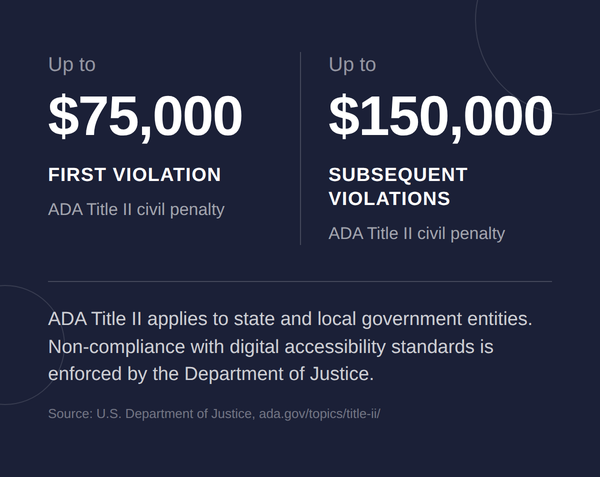
ADA Section 508 accessibility requirements apply to digital communications, and enforcement has sharpened considerably. State and local government entities that don't meet email accessibility standards face real financial penalties. The criteria are specific, and most government IT contacts are already aware they have something to do here. They just haven't done it yet. Under ADA Title II, state and local government entities face fines of up to $75,000 for a first violation and up to $150,000 for subsequent violations for failing to meet digital accessibility standards, enforced by the Department of Justice.
The reason SLED is 100% channel-driven for us is straightforward: government procurement runs through partners. Partners already have those relationships. They're already in those accounts. All they need is the conversation opener.
It's this: "Are you across what ADA compliance means for your email footers?"
Most contacts will say no. That's where the conversation starts. You don't need to walk them through the full regulatory detail. You need to show them that there's a requirement, that there are penalties for not meeting it, and that the fix is straightforward. The urgency is built into the regulation itself.
What litigation risk do rogue signatures create in regulated sectors?
This is the angle that surprises people most, because they've never thought about it.
Here's what unmanaged email signatures look like in practice. Employees add personal content: motivational quotes, personal beliefs, unofficial titles. People leave the company and their contact details stay active in the signature for months. Someone in a client-facing role adds a claim the company never approved and can't substantiate.
In most industries, that's an embarrassment. In regulated sectors, it's exposure.
We see companies come to us after legal challenges that trace back to something an employee put in their email footer. A statement read as a commitment. A title that implied authority the person didn't have. Content that contradicted the company's official position on something that mattered.
The conversation opener for this one is: "Do you know what your clients' employees are actually putting in their email signatures right now?"
When you show them, and it takes about five minutes to pull examples together, the reaction is almost always the same. They want to know how to fix it immediately.
This lands particularly well in financial services, healthcare, and legal, where the gap between what an employee says and what the company is permitted to say carries direct regulatory and legal consequence.
What makes legal and financial services the easiest compliance conversation?
In those sectors, every outbound email is effectively a business communication subject to regulatory and contractual obligations. This is a mandatory governance requirement.
Law firms carry professional liability obligations. Financial services organizations operate under FCA, SEC, and equivalent regulatory frameworks that specify what must appear in outbound client communications. Legal disclaimers. Conflict of interest disclosures. Regulatory notices that must be present, accurate, and consistent on every message, without exception.
Firms including Baker McKenzie, Leigh Day, FieldFisher, and Sidley manage this with Exclaimer. None of them came to us because they wanted better-looking signatures. They came after a compliance gap surfaced and needed fixing fast.
The opener here is the most direct of the three: "How are you ensuring every outbound email from your firm carries the correct disclaimers right now?"
Partners with legal or financial services clients don't need to manufacture urgency. The regulatory pressure already exists. They just need to be the ones who surface it.
What does a compliance-led channel conversation actually look like?
Here are three openers, ready to use:
For SLED clients: "Are you across what ADA compliance means for your email footers?"
For regulated sectors with rogue signature risk: "Do you know what your employees are actually putting in their email signatures right now?"
For legal and financial services: "How are you ensuring every outbound email carries the correct disclaimers?"
None of these need a deck or a scheduled demo. Just five minutes and a willingness to show the client something they haven't looked at.
The compliance conversation closes faster than almost anything else in the channel because it starts from urgency that already exists. Your partners' job is not to create that urgency. It's to surface it before the client finds out a harder way.