You’re margin sensitive and time poor. Every unnecessary step a vendor adds to your process is a cost you’re absorbing, usually quietly, and usually before you’ve consciously decided to deprioritize them.
Friction in a vendor relationship hides in four places most reliably: self-service, billing, CAM coverage, and data access. Most vendors are creating it without knowing it.
Four questions give you a practical way to evaluate any vendor relationship and to hold vendors accountable for the things that actually affect your commercial outcomes.
The vendors worth prioritizing are the ones who make it genuinely easy to do business with them. Everything else like the margin, the product, the marketing support, sits on top of that foundation.
You know which vendors you prioritize. And you know the ones you don’t, even if you’ve never said so explicitly. The difference is rarely the product. It’s the experience of doing business with them.
As a channel leader, your time is finite and your margin is under pressure. When a vendor relationship costs you more time than it should through billing errors, provisioning delays, CAM contacts who add no value, or data you can’t access, you absorb it for a while. Then you stop. Not dramatically. You just allocate your next opportunity somewhere else.
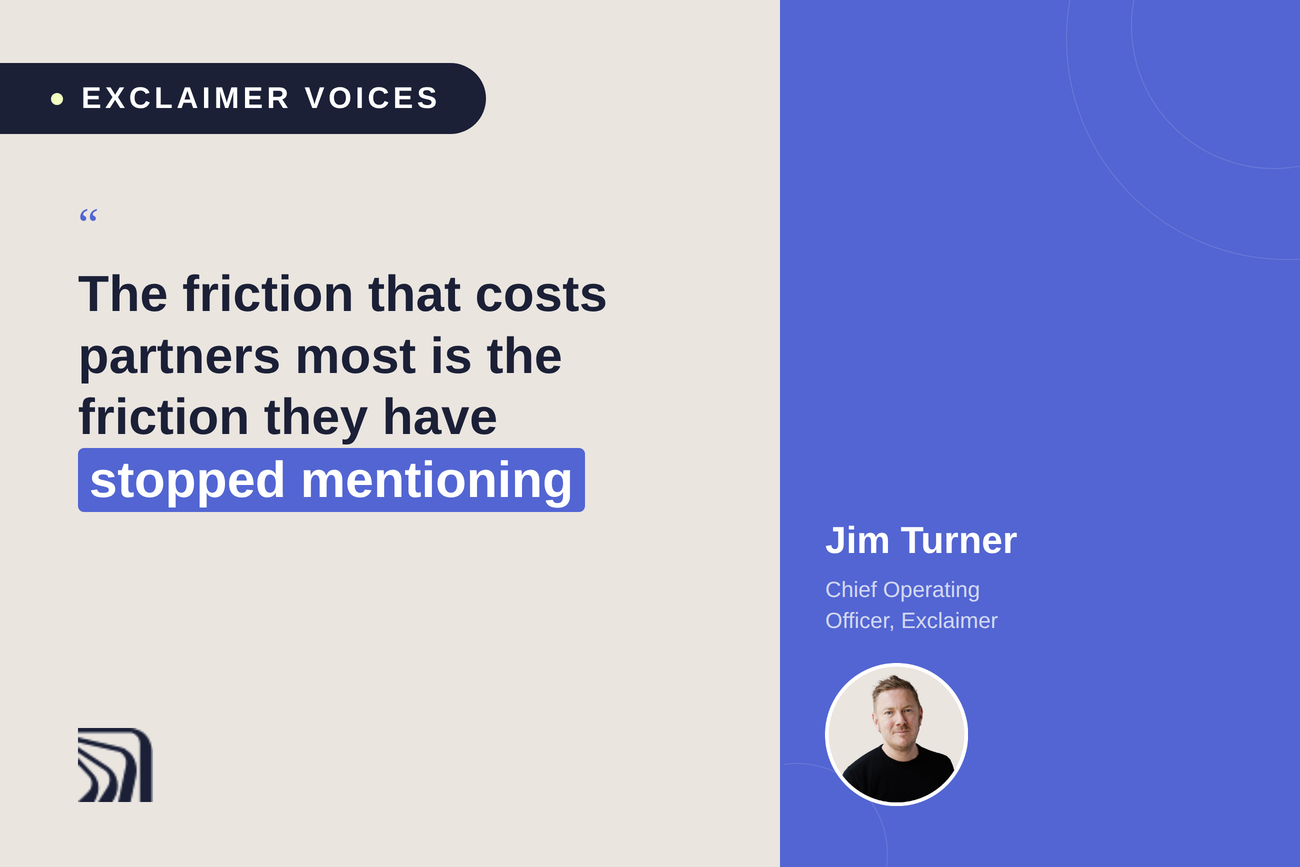
I’ve spent two years rebuilding Exclaimer's partner programme, and the clearest thing I’ve learned is this: the friction that costs partners most is the friction they’ve stopped mentioning. They gave up raising it. So what follows is a set of questions I think you should be asking of every vendor in your stack, including us. If a vendor cannot answer them well, you’re absorbing costs they’ve decided are your problem.
Why friction costs you more than you realize
Most friction in a vendor relationship doesn’t announce itself. It accumulates. A support ticket to change a subscription date. A billing query that takes two weeks to resolve. A CAM who only calls when there’s a problem. Individually, each one is manageable. Together, they represent a hidden tax on your time that compounds every month.
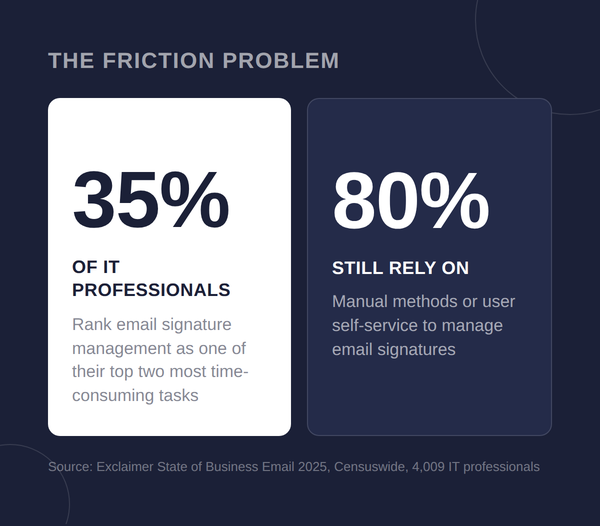
Exclaimer's own State of Business Email 2025 research found that 35% of IT professionals rank email signature management as one of their top two most time-consuming tasks, and 80% still rely on manual methods to handle it. That’s a friction problem: the process of managing something that should take minutes is instead consuming hours. Multiply that across your client base and the cost becomes significant.
The vendors who understand this build their programmes around removing that friction. The ones who don’t, treat operational ease as a back-office concern and wonder why their partner activation rates stay low. According to Canalys, partner-delivered IT accounts for approximately 70% of global IT spending. The vendors capturing that spend aren’t doing it on product alone.
Four questions to ask every vendor you work with
Friction hides in four places most reliably. These questions are designed to find that friction.
1. Can you actually self-serve?
You should be able to manage subscriptions, change dates, add customers, and check your billing without logging a ticket or calling anyone. Every time you have to contact a vendor to do something you should be able to do yourself, they’ve added a cost to your operation.
The practical test: when did you last have to contact this vendor to complete a routine task? If the answer is recently, and often, their self-service infrastructure isn’t working, and the time you’re spending compensating for it is time you’re not billing.
2. Is the billing accurate, flexible, and built around how you actually operate?
Billing is where trust in a vendor relationship gets destroyed fastest. An inaccurate invoice is a signal that the vendor doesn’t understand your business. For MSPs specifically, the billing model matters as much as the price point. You need monthly rolling consumption, the ability to scale up and down with your own client base, and pricing that reflects how managed service providers actually operate.
Annual contracts built around vendor finance cycles don’t fit your model. If a vendor is insisting on them, they’re asking you to absorb a structural cost that exists for their benefit, not yours.
A channel account manager who exists to manage escalations isn’t CAM coverage. It’s a complaints function with a better job title.
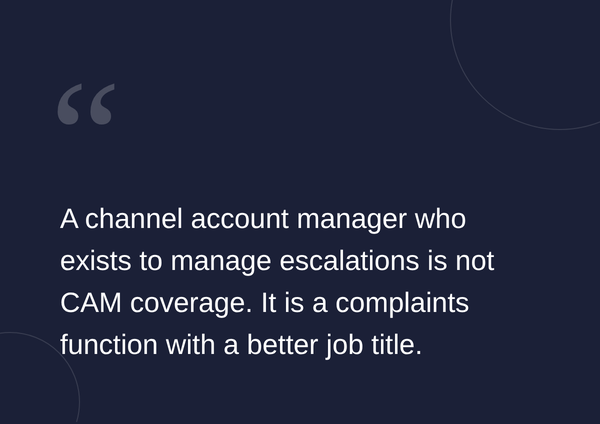
The CAM contact worth having is the one you call when you’re about to acquire a new customer, want to run a joint campaign, or need to understand what commercial opportunity exists in your current base. That person has to add value before something goes wrong, not only when it does. If your primary contact at a vendor is someone you only hear from when there’s a problem, you aren’t being supported. You’re being managed.
4. Can you see what’s happening with your end users in a way that helps you have commercial conversations?
The best vendors show you things about your own client base you couldn’t see without them. Where expansion is happening. Where renewals are at risk. Where a customer is growing in ways that create a natural upsell conversation.
That intelligence is what allows you to have commercial conversations before your client raises the issue themselves, rather than after. If a vendor cannot surface that data in a form you can act on, they’re treating your client relationships as their distribution channel rather than as a partnership.
What a vendor who gets this right actually delivers
The commercial difference is measurable. ADM Computing, an Exclaimer partner, reduced Service Desk time on email signature management by approximately 90% after moving to a centralized, self-service model and now completes signature updates in around 12 minutes.
Grapevine, another Exclaimer partner, closes new client conversations on email signature management in under 10 minutes. These results are what becomes possible when a vendor builds around how you operate rather than around how they find it convenient to sell.
The inverse matters too. The partner community is close-knit and talks to each other. A vendor with a reputation for being difficult to work with accumulates that reputation faster than any marketing effort can counter. You probably already know which vendors in your stack have it.
The objection: isn't some friction just the cost of doing business?
The standard response from vendors when these questions are raised is that some process is unavoidable at scale. Running a programme across thousands of partners in multiple geographies requires guardrails, and guardrails create friction.
That’s true to a point. But there’s a meaningful difference between process that protects the integrity of the programme and process that protects the vendor's internal convenience at your expense. The self-service test is the clearest proxy: if you’re contacting a vendor's support team to complete something you should be able to do yourself, that’s just friction that’s been reclassified as policy.
The other version of this objection is that product quality and margin matter more than operational ease. They do not, or rather, they cannot compensate for its absence. A vendor whose product you can’t provision efficiently, whose billing you can’t trust, and whose CAM adds no commercial value will be deprioritized regardless of what is on the product roadmap. Operational frictionlessness is the baseline everything else has to be built on.
Hold your vendors to this, including us
The vendors worth prioritizing are the ones who make it genuinely easy to do business with them. Not just on paper, and not just at the point of signing. Easy to provision. Easy to bill. Easy to get intelligent support from. Easy to access the data that helps you have better client conversations.
Run these four questions against every vendor in your stack. The answers will tell you more about which relationships are actually worth your time than any QBR presentation or partner tier structure. And if you run them against Exclaimer and find we aren’t delivering on any of them, I want to know. That conversation is more useful to both of us than a satisfaction survey.
The vendors who consistently clear this bar will earn your time and your business. The ones who cannot should not be surprised when you allocate both elsewhere.
If you want to see how Exclaimer's partner programme answers these questions in practice, explore our MSP and reseller programme or download the partner playbook. For the data behind the friction problem, the State of Business Email 2025 report sets out what IT professionals across four markets are spending their time on, and where the operational gaps are widest.