Four measures show whether a program works: partners producing recurring revenue, time from signature to first transaction, revenue per productive partner, and net revenue growth.
A vendor that leads with its partner count is telling you how many partners it has signed, not whether any of them make money. I've worked on the vendor side of channel for a long time, and I can tell you which number to ignore. If you're an MSP or VAR deciding where to invest, partner count is the one to skip. Let's look at four numbers worth asking for instead.
Why is a vendor's partner count the wrong number to judge a program by?
Partner count measures how many partners have signed up, so it says nothing about whether partners earn.
In my view, a partner is only a good partner if it generates revenue for the vendor. A dormant partner inflates the number on the vendor's slide and drags revenue per partner down, which makes the economics worse for the whole book.
Run a direct sales team this way and you would measure headcount, call the hiring spree a success, and ignore the revenue. Plenty of vendors run their channel exactly like that. Here's the difference, as an illustration rather than data:
| Vendor A | Vendor B |
Partners on the book | 1,000 | 10 |
Partners producing revenue | None | All ten, generating millions |
What the slide says | "1,000 partners" | "10 partners" |
What it tells a new partner | A long list of names and no proof anyone earns | Proof that partners like you earn |
Which four numbers show what a vendor program is worth to you?
Here are four numbers show what a vendor program is worth to a partner, and none of them is partner count.
Measure | What it means for you | What to ask the vendor |
|---|
Partners producing recurring revenue | Whether partners like you earn, or the program is a long list of names | How many partners produce recurring revenue? |
Time from signature to first transaction | How long you invest before you earn anything | How long does a new partner wait for a first transaction? |
Revenue per productive partner | What a partner who works the program earns | What does a productive partner earn? |
Growth of net revenue | Whether the channel is creating new business or moving existing deals to partners | How much of the growth is net? |
Net revenue matters most here. Revenue that moved from direct to partner, or from one partner to another, is not growth. It's a reshuffle of business that already existed. A program growing on gross numbers can look healthy while creating nothing new for you.
As a vendor, the number I would push hardest is revenue per productive partner. Making existing partners more effective is the part that scales, and signing more partners is the part that flatters. These measures sit behind our partner program.
Why won't most vendors show you these numbers?
Most vendors won't volunteer these numbers because each one exposes something partner count hides.
Partners producing recurring revenue shows the dormant ones. Time to first transaction shows slow onboarding. Revenue per productive partner shows thin earnings. Net growth shows revenue that only changed hands. Partner count only rises, which makes it the easy headline. A vendor that can answer these four questions has measured its own channel. One that can't has either not looked or chosen not to share what it found.
Isn't a big partner count a sign the program is working?
A big partner count shows a vendor can recruit, and nothing more.
Every productive partner starts as a signed one, so recruiting widely matters when a market is new. What matters is how many signed partners become productive, and the share producing recurring revenue tracks exactly that.
I should be straight about my own position. Our program is only now being released, so these are the measures I am holding us to, not results I can show you today. Judge us by the same four questions.
What should you ask before you invest in a vendor's program?
Ask the vendor for the numbers that show whether partners like you earn, and decide beforehand what you will accept as an answer.
Start with these four questions:
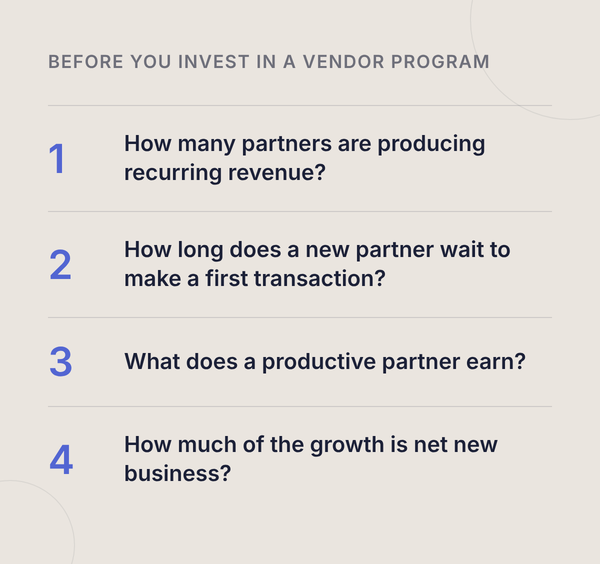
Your time, your training budget and your customers are the investment. A vendor should be able to show you the return.
To see how we work with partners, read our partner playbook or browse our partner case studies. If you're an MSP or VAR, start with our MSP and reseller page.