Elisabeth leads Exclaimer’s global brand narrative, thought leadership, and research-led storytelling. With over 15 years’ experience in PR and B2B technology marketing, she is known for turning complex ideas into clear, compelling communications that resonate with global audiences.
AI made everyone sound professional. Here's what still proves you're real.

AI has made it easy to sound polished. It has also made polish worthless as a sign of who is genuine.
More than half of us now use AI in our communications, most often to tidy up our grammar or make our writing sound more professional. At the same time, 41% of people have questioned whether a message they received was genuine. New research into how 2,000 adults across the UK and US communicate captures the tension: AI is being used to perform credibility at the very moment people are growing more alert to anything that feels off.
When anyone can produce a flawless, professional-sounding email, a flawless, professional-sounding email stops proving much at all.
Key findings
42% never use AI in their communications, which means most of us do (50% of UK adults never use it, against 35% in the US)
21% use AI to improve their grammar and spelling
20% use AI to make their writing sound more professional, rising to 32% of Gen Z and just 8% of Boomers
41% have questioned whether a message they received was genuine
23% cite a professional, branded email signature as a trust signal, rising to 29% among both Gen Z and Millennials
Most of us now have a co-writer
Using AI to sharpen how we come across is fast becoming ordinary.
Only 42% of people never reach for AI in their communications. The most common uses are quietly cosmetic: improving grammar and spelling (21%) and making writing sound more professional (20%). The generational split is stark, with nearly a third of Gen Z (32%) using AI to sound more professional against 8% of Boomers.
Exclaimer's earlier study, The Personal Touch, explored how consumers feel about AI-generated emails across generations. This research adds the other half of the picture: the instinct to present ourselves as capable and credible in writing is close to universal, and AI has made acting on it effortless.
And we trust what we read a little less
As polish gets cheaper, suspicion climbs.
A carefully written email used to carry a quiet signal that the sender was a real, professional human. When a machine can produce that in seconds, the signal fades. Fluent writing no longer separates the genuine from the generic. It becomes tougher to determine whether a business email is legitimate, leading us to seek new signs of proof.
When words stop being proof, signals take over
If the writing can no longer vouch for you, something else has to.
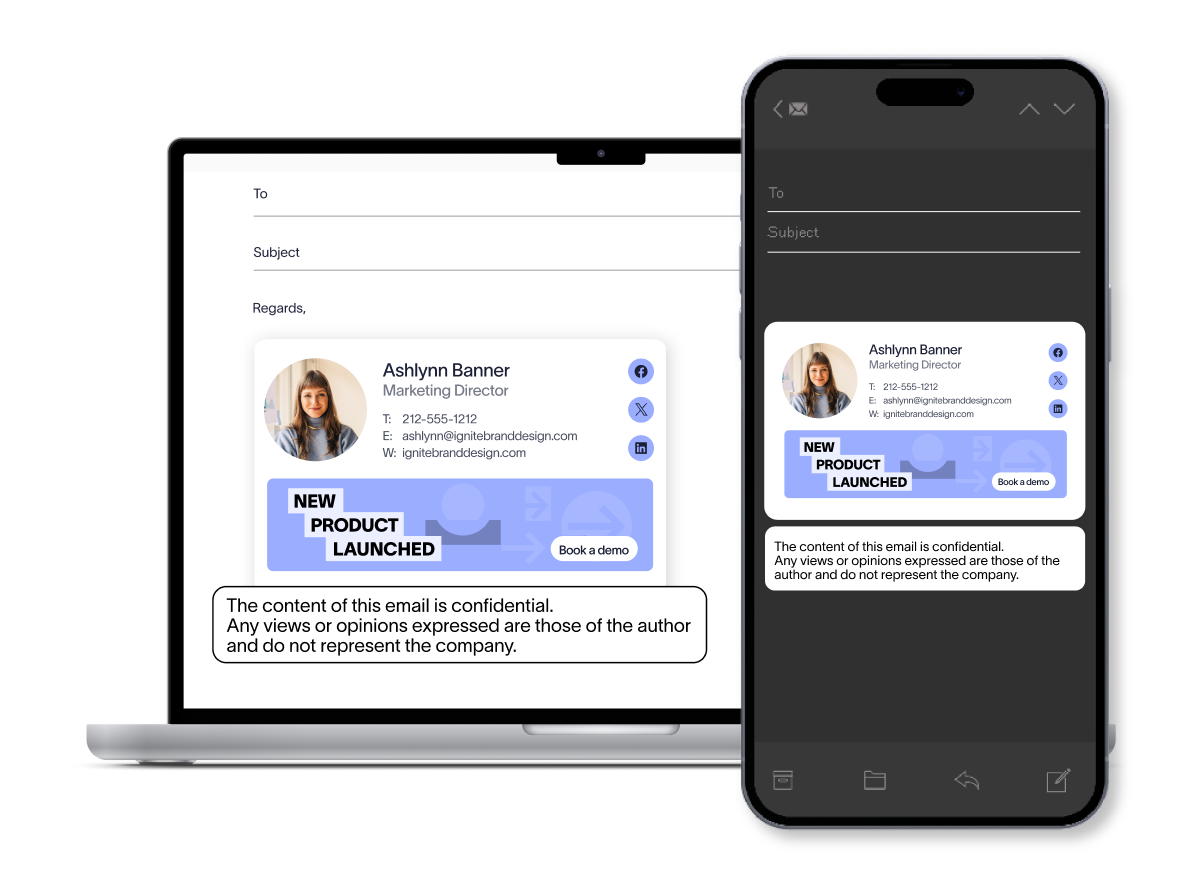
This is where the visible markers of a real sender become decisive, and the research shows people already lean on them: a professional email address on a company domain, a clear and consistent sender name, and a professional, branded email signature, cited by 23% overall and by 29% of both Gen Z and Millennials, the groups most likely to be judging business email on behalf of an employer.
These signals do the work the words no longer can. They tie a message to a real, identifiable organization, one that looks the same every time it lands. In an inbox where everything reads well, a consistent, recognizable sender identity carries the reassurance that fluent language used to.
What this means for businesses
For brands, the implication is clear enough.
As AI lifts the baseline for how everyone's email reads, the things that set a sender apart move to the edges of the message: a consistent identity, a professional domain, accurate contact details, and a branded email signature on every send. These are the signals a business controls, and the ones a wary recipient now reads first. The perennial difficulty is applying them consistently across a whole workforce and every device.
Exclaimer applies professional, on-brand email signatures automatically across every email your organization sends, so the signals of a genuine sender stay consistent on every message, whoever hits send.
This blog is part of When it matters: How people really communicate, a report based on a survey of 2,000 adults in the UK and US conducted by OnePoll in May and June 2026. Read the full report.