Karl heads up Information Security at Exclaimer, where he’s focused on keeping data secure and ensuring compliance with standards like ISO 27001 and SOC2. With years of hands-on experience, Karl is dedicated to simplifying security processes and staying ahead of potential threats. He’s passionate about using automation and smart practices to strengthen security without adding unnecessary complexity.
Communications governance beyond email: What IT leaders need to know

Most compliance programs were built around email. Over decades, it built up mature controls: disclaimers, archiving, audit trails, brand standards. Email remains the highest-volume communication channel in most organizations, but it's no longer the only channel that carries compliance exposure.
Teams, Slack, WhatsApp, video calls, CRM messages, and AI-generated responses are now part of how organizations communicate externally. The challenge for IT and compliance teams is that the same regulatory expectations have to follow communication into channels that were never built with governance in mind.
That was the focus of a recent Exclaimer webinar bringing together Philip Vetter, VP of Engineering, and Ed Bodey, General Counsel, with Caleb White, Product Marketing Manager, moderating. The session looked at why governance gets harder as channels multiply and what IT leaders can do about it before something goes wrong.
Why has compliance moved beyond email?
Mandatory disclosures, accessibility requirements, and data handling rules apply across every channel where your organization communicates, not only the one where your policies were first written.
Regulatory obligations don't shrink when communication moves into different channels. Mandatory disclosures, data subject access requests, and disclaimer obligations apply to communication in Slack, Teams, and video meetings the same way they apply to email. Accessibility requirements work the same way, mature under the UK Equality Act and increasingly enforced through the ADA in the U.S.
What's changed is the surface area those obligations cover. Policies written with email in mind often haven't been updated to reflect how Teams, video meetings, and third-party collaborative tools now host external communication. Many organizations are running an email-era governance program in a much wider communication environment.
The operational risk shows up when you're asked for evidence. A written policy on file isn't enough on its own. Regulators want to see that controls work in practice, which means producing a record of how communication actually happened. Third-party audits, Ed noted, are often where the gap between documented and operational governance first surfaces.
How does fragmented communication create compliance risk?
Policies that work for email don't automatically extend to the channels sitting next to it. The gap stays unseen until someone asks for an audit trail.
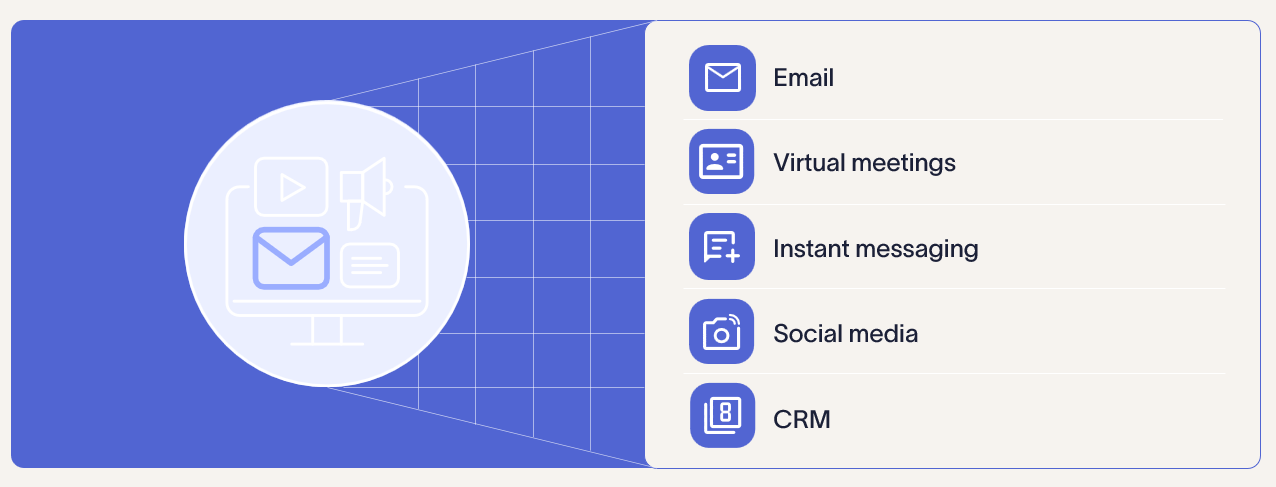
Governance built for email doesn't automatically transfer to the channels around it. Each tool comes with different defaults and different administrative owners inside the organization, which leaves IT managing multiple parallel policy environments. Brand updates, current disclaimers, and consistent tone have to be reapplied to each tool separately, and the maintenance load compounds quickly.
Internal communications are a frequent blind spot. Organizations often assume messages between colleagues carry lighter obligations. In practice, internal communications can contain personal data, contractual statements, and information that becomes discoverable during disputes or DSAR responses. Retention policy matters here as much as it does for external-facing email.
The practical impact lands on IT. When something goes wrong, whether a complaint, an audit, or a data breach, the team that gets called is usually IT. That's when teams find out there's no clean audit trail for a channel that's not formally governed.
How can IT teams assess their communications governance maturity?
The communication maturity model places organizations on a spectrum from fragmented to strategic, giving IT teams a starting point for the gap between current state and target.
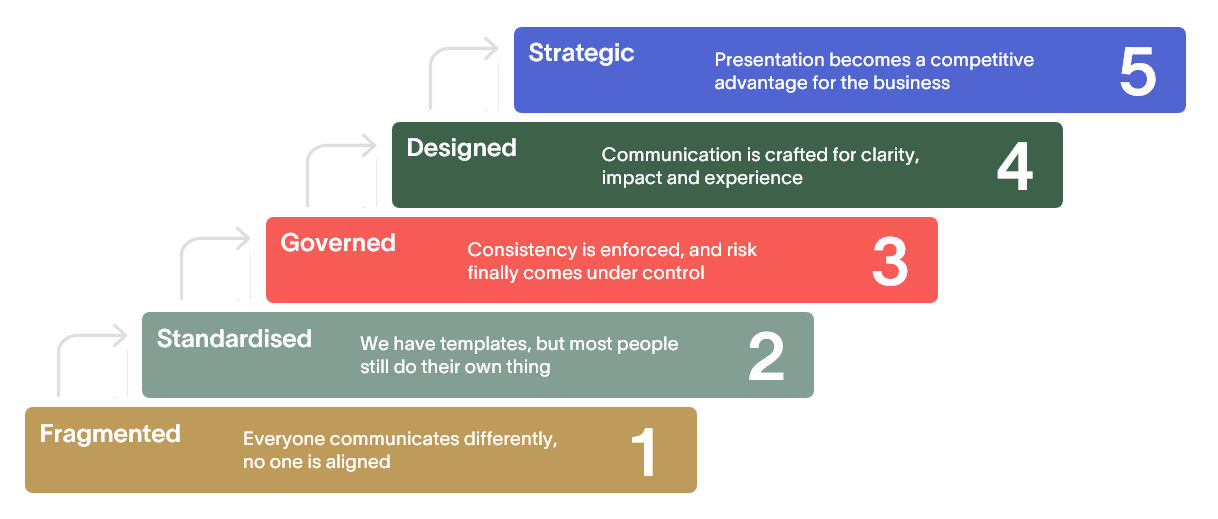
The communication maturity model maps governance from ad hoc to intentional across five levels, with each level building on the one before it.
Level 1, fragmented: Individuals communicate in their own way. Quality may be high, but consistency isn't guaranteed. There's no repeatable standard for new staff to follow.
Level 2, templated: Templates bring consistency to outbound communication. Processes can be replicated as the team scales.
Level 3, monitored: Communication is tracked. The organization sees what's working, where standards are drifting, and where to intervene.
Level 4, optimized: Templates are refined, and branding is applied across channels. Email signatures, meeting backgrounds, and other branded touchpoints start to connect.
Level 5, strategic: Consistent, professional communication becomes a competitive differentiator. Organizations that show up reliably and on-brand get remembered.
Most progress up the model comes from applying better structure to existing tools rather than buying new ones.
What are the four pillars of designed communication?
Consistency, clarity, compliance, and confidence describe what designed communication looks like across an organization, with each pillar reinforcing the next.
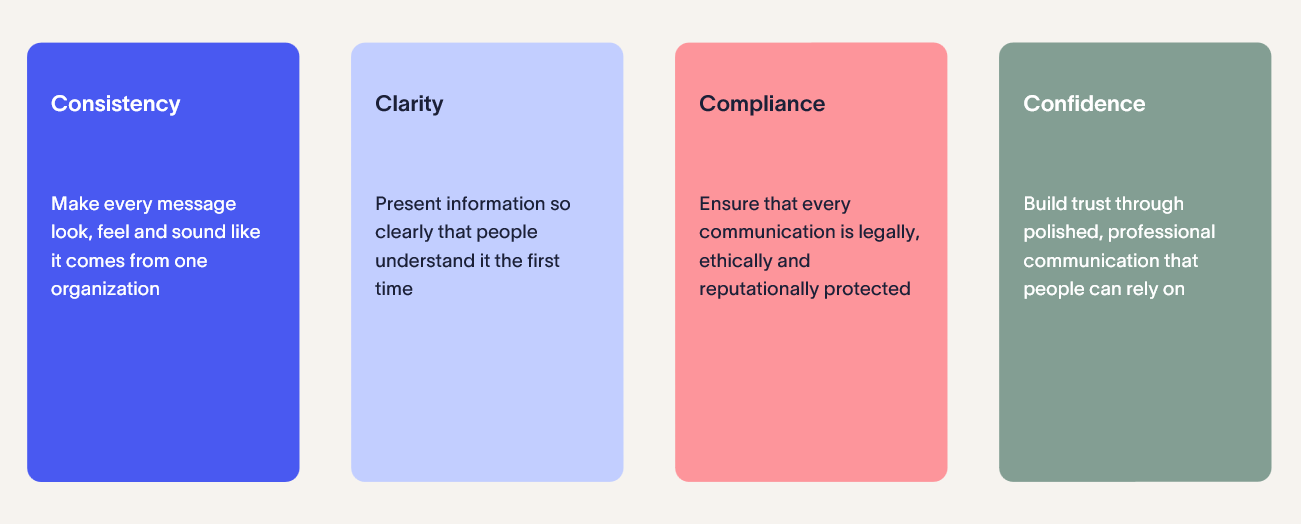
Designed communication rests on four pillars: consistency, clarity, compliance, and confidence. Each one supports the others, and together they describe the target state for an organization working its way up the maturity model.
Consistency: Every message looks and sounds like it comes from the same organization. Mixed messaging confuses recipients and creates compliance risk.
Clarity: Information is presented clearly enough to be understood the first time. Ambiguous wording introduces legal exposure that clearer drafting removes.
Compliance: Every piece of communication is legal, ethical, and reputation-protected. That covers disclaimers, mandatory disclosures, accessibility obligations, and data handling, applied consistently rather than on a case-by-case basis.
Confidence: What gets built when the first three pillars are working. Consistent, clear, compliant communication earns trust with customers, partners, and regulators.
The maturity model and the four pillars work as a pair. Together, they give IT teams a way to map the current state against the target and identify where the structural gaps are.
How is AI changing communications governance?
AI amplifies existing governance gaps rather than creating new ones. The compliance obligations that apply to human-written messages apply to AI-written ones.
AI removes the human bottleneck on communication volume, which means existing governance gaps get amplified faster than they otherwise would. Agent-to-agent communication, where an AI system communicates with a customer or another AI on behalf of the organization, is already happening in some contexts. Organizations need to know what their AI is communicating and be able to produce an audit trail on request.
The regulatory framework is already shifting to address this. Ed pointed to EU AI Act Article 50 as the relevant reference. Where a communication hasn't been edited by a human before sending, it has to disclose that it's AI-generated. Company identification, industry-specific disclosures, and disclaimers still apply to AI-written messages. The compliance obligation sits with the organization that sent the message, regardless of authorship. Record-keeping requirements are equally unchanged.
If an AI tool generates customer-facing communication, the legal obligation to verify it's compliant still sits with the organization. Philip's practical guidance was that organizations need to govern the output of AI tools to the same standard they apply to AI inputs. Strong controls on what AI sends will matter more as volume keeps rising.
Vendor evaluation matters more in an AI-heavy environment. AI has made it easier to spin up new tools quickly, which raises the importance of asking the standard vendor questions about data residency, security infrastructure, and documented governance. A cheaper option without those answers introduces risk into the supply chain.
How should IT leaders make the case for communications governance?
The case for communications governance lands with leadership when it's framed as a commercial risk that includes the cost of doing nothing.
Making the case to leadership works best in financial terms. The direct penalties for non-compliance are well-documented, including fines under GDPR and sector-specific regulatory action. The full picture extends further into reputational damage, the cost of incident response, and the revenue impact of eroded customer trust. Each of those costs can exceed the direct financial penalty.
Personal liability is the other factor that often shifts attention. Compliance failures can carry personal exposure for board members, CFOs, and CTOs, which tends to move governance investment up the priority list when surfaced in the right way.
The operational argument sits alongside the financial one. Reactive work eats significant IT time. Teams chase records that should have been governed from the start, reconstructing audit trails after the incident rather than producing them from existing logs. Building the right structure before an issue surfaces removes most of that reactive work and the cost that comes with it.
The cost of inaction is the figure that tends to be missing from these conversations. Quantifying what it costs to keep operating without governance often does more to shift executive decisions than any pitch for new investment.
How Exclaimer supports email governance
Email is the channel where centralized governance is most operationally achievable today, which makes it the practical first step toward the maturity model's higher levels.
 The fragmentation problem doesn't get solved everywhere at once. Email is where the brand, compliance, and audit-trail requirements covered in the four pillars apply most directly, and where centralization is most achievable. Getting email signatures, disclaimers, and brand standards under central control is what moves an organization from level one or two of the maturity model toward levels three and four.
Exclaimer is the global leader in email signature management for Microsoft 365 and Google Workspace, trusted by more than 80,000 organizations worldwide, including Sony, Bank of America, the BBC, and the Academy Awards. Exclaimer's cloud solution centralizes every email signature, applied automatically and consistently across every device and email client.
For IT teams, that means brand updates, disclaimer changes, and legal disclosures roll out across every user without manual intervention. Signature Rules govern which signatures apply to which senders, by region, department, or campaign. When legal requirements change, the update applies instantly.
Exclaimer holds ISO 27001, ISO 27018, and SOC 2 Type II certifications, processes data within regional boundaries to support GDPR compliance, and maintains audit-ready logs for compliance teams.
Watch the webinar on demand
The full session covers the communication maturity model, the four pillars of designed communication, and how AI is reshaping the governance conversation for IT leaders.
Watch the webinar on demand to hear Philip and Ed walk through where communications governance is breaking down today and what a structured response looks like. Book a demo to see how Exclaimer helps IT teams centralize email signature governance across the organization.