Karl heads up Information Security at Exclaimer, where he’s focused on keeping data secure and ensuring compliance with standards like ISO 27001 and SOC2. With years of hands-on experience, Karl is dedicated to simplifying security processes and staying ahead of potential threats. He’s passionate about using automation and smart practices to strengthen security without adding unnecessary complexity.
The IT leader's guide to shadow AI: how to say yes safely and make it stick
Key takeaway
Over-permissioned AI agents, shadow AI, and slow attack response are usually treated as three separate problems. They're the same governance decision applied three times
Good security automation should remove unnecessary delay, not remove accountability, the human checkpoint has to be deliberate, not accidental
Blocking an AI tool without a sanctioned alternative doesn't remove the risk, it removes visibility into it
AI agents are often given far broader permissions than they need, simply because it's faster to build that way
65% of US adults now use AI in some aspect of their communications, and 36% have questioned whether a message they received was genuine, according to Exclaimer's July 2026 research
The fix in all three cases is the same question, asked earlier: where exactly does the human decision need to sit, and what can move without one
Cybersecurity Awareness Month is a vital awareness day, but it can quickly become a checklist of familiar advice. Patch your systems, train your staff, review your access controls. But this year the useful version of that list isn't a checklist at all. It’s a single question showing up in three places where most security teams haven’t noticed it’s the same question, first raised in Exclaimer’s own Cybersecurity Awareness Month commentary.
What do over-permissioned agents, shadow AI, and attack speed actually have in common?
On the surface, nothing. One is a development shortcut, one is an employee behavior problem, and one is a defensive timing issue. But put them side by side and a pattern shows up: each is a decision about where automation gets to act without a human, made under time pressure, usually made by default rather than on purpose.
Attackers are using AI, and they can already move faster than most human response processes. The instinct is to close that gap with more automation on the defensive side. That instinct is only half right. We can't just make everything instant, because that creates its own risk: an AI system can make the wrong decision, block the wrong thing, or act without understanding the wider business context.
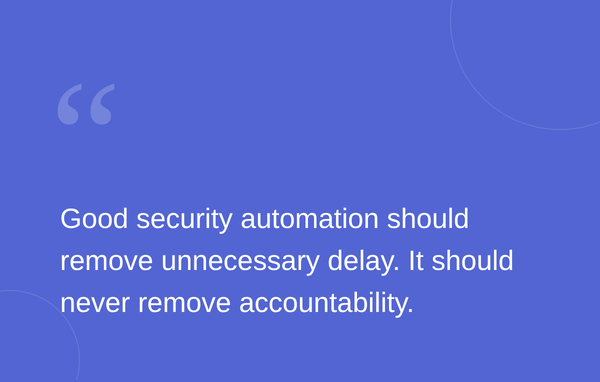
The actual goal is getting as close as possible to attacker speed while being deliberate about exactly where a human still needs to be in the loop, the same argument I made in more detail in why your incident response plan is only as good as your last live simulation. Good security automation should remove unnecessary delay. It should never remove accountability.
Where does this show up in how agents get built?
In development shortcuts that outlive the deadline that created them. When people build AI agents, they give them broad access because it's quicker, then ship to production.
We’re already seeing agents given far broader permissions than they need, simply because it makes development easier. The access decision gets made once, under time pressure, and then nobody revisits it once the agent is live and acting on its own.
This is the same governance decision as the attack-speed question above, just asked earlier in the process. Instead of “should this response happen automatically,” it's “should this agent be allowed to do this without asking.” Answered carelessly, by default, instead of deliberately, the first time it comes up.
Where does this show up in how employees adopt AI?
It shows up in the assumption that saying no makes the problem disappear. One of the biggest mistakes organizations make with AI is assuming that blocking a tool removes the risk of people using it.
Employees want AI because it helps them work faster, and if the organization doesn't give them a safe, sanctioned route, some will use personal accounts, personal devices, or unapproved tools instead. The organization ends up with less visibility, not less risk, and the exact same shadow AI problem, just invisible to IT instead of merely unsanctioned.
The fix is the same shape as the fix for over-permissioned agents and slow attack response, give people an approved route with clear boundaries rather than defaulting to an absolute no, and make the safe option the easy one.
Doesn't treating them as one problem oversimplify three genuinely different technical challenges?
That’s a fair question, and the answer is this. Agent permissions are an access-control problem. Shadow AI is a behavioral and policy problem.
Attack response speed is an infrastructure and detection problem. The technical fixes for each are completely different, and nobody should architect all three the same way.
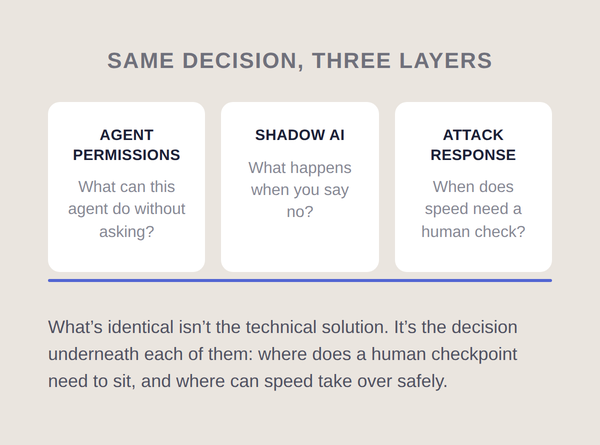
What's identical isn't the technical solution. It's the decision underneath each of them: where does a human checkpoint need to sit, and where can speed take over safely. That decision gets made in the same way across all three: by default, under pressure, and without anyone deciding it on purpose. Which is exactly why naming the pattern is useful even though the fixes themselves stay distinct.
What should security leaders actually do with this?
Stop treating agent permissions, shadow AI, and incident response speed as three separate initiatives on three separate project plans. They're one audit, asked three times.
Where in your stack is a human decision happening by accident instead of on purpose, and where has speed quietly become the default because nobody stopped to ask whether it should be?
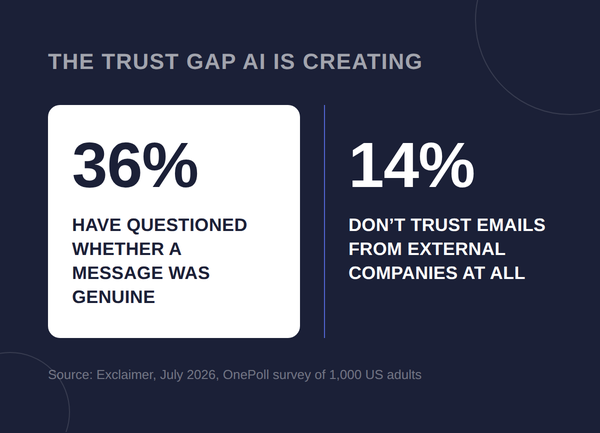
Trust in AI-mediated communication is already thinner than most organizations assume, 36% of US adults have questioned whether a message they received was genuine, and 14% don't trust emails from external companies at all, according to Exclaimer's own research into the trust gap AI is creating. That erosion happens fastest in exactly the places this article has covered: an agent that acted without the right permission, a tool nobody sanctioned, a response that moved too fast to make a good call.
Cybersecurity Awareness Month is a reasonable prompt to go find out which one of the three you've been making by accident.