Elisabeth leads Exclaimer’s global brand narrative, thought leadership, and research-led storytelling. With over 15 years’ experience in PR and B2B technology marketing, she is known for turning complex ideas into clear, compelling communications that resonate with global audiences.
How different generations use email at work

Quick answer —
Millennials are the heaviest formal email users (52% use it for complaints, 43% for job applications).
Baby Boomers are most skeptical about message authenticity (51% question whether emails are genuine).
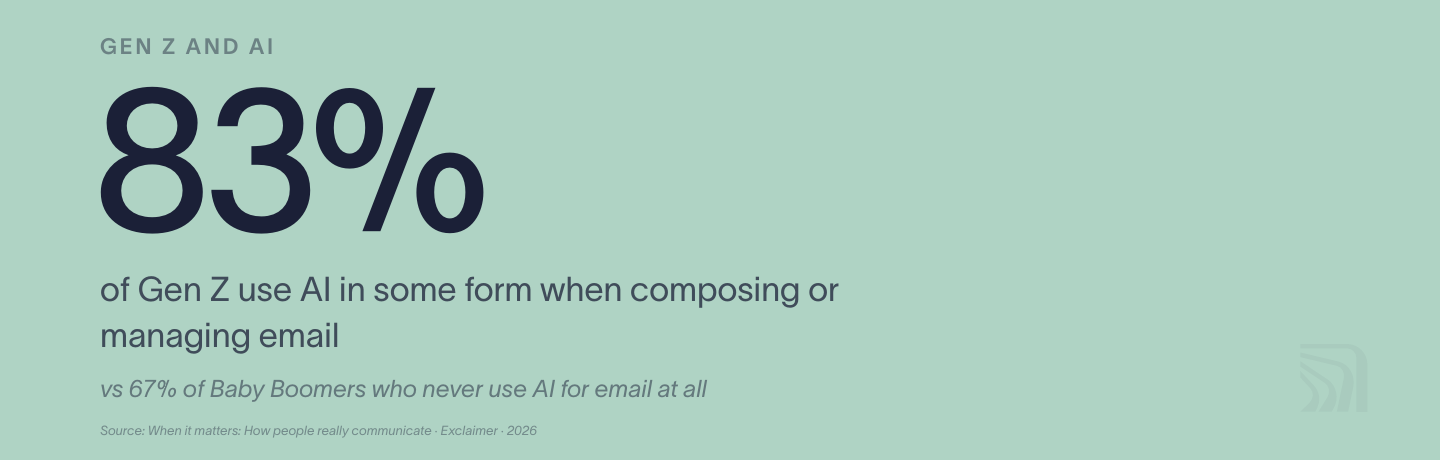
Gen Z leads on AI adoption, with 83% using AI in some form when composing or managing email.
Two-thirds of Baby Boomers (67%) never use AI for email at all.
Gen X sit in the middle on almost every measure.
Source: Exclaimer generational email research. Survey of 2,000 respondents across four generational cohorts, conducted June 2026.
Who are the four generations?
Four generations now share the same inbox. Baby Boomers, Gen X, Millennials, and Gen Z all use email. But the way they use it, trust it, and relate to it varies considerably. New research from Exclaimer maps those differences in detail, across everything from how people handle job applications to how they feel about AI drafting their messages.
Before getting into the specifics, here's who we're talking about:
Baby Boomers (born 1946–1964): grew up before email existed, adopted it as a professional tool, and still treat it that way.
Gen X (born 1965–1980): came of age as email arrived; experienced users with habits formed over decades.
Millennials (born 1981–1996): early adopters who adapted quickly; they now dominate the workforce.
Gen Z (born 1997 onward): the first generation to grow up with smartphones; they arrived at email on their own terms.
The generational stereotypes like Baby Boomers emailing like it's 1999, Gen Z preferring everything but email, don't hold up in the data. The picture is more interesting than that.
How do different generations use email for formal communication?
Email remains the preferred channel for high-stakes communication, and the generational data makes that clear.
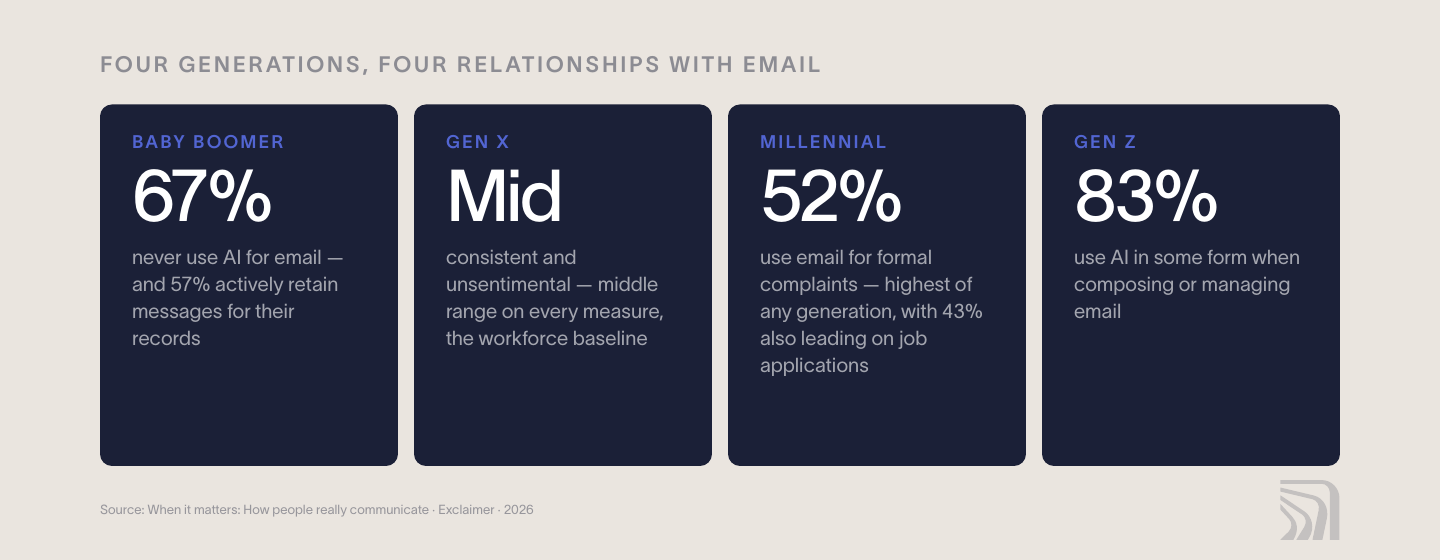
Millennials lead on email for job applications, with 43% saying they use it as their primary channel for applying for jobs. Gen Z follows at 36%. Both numbers suggest that despite the rise of LinkedIn applications and applicant tracking system (ATS) platforms, email retains a meaningful role in how people approach job seeking.
Millennials also use email most heavily for formal complaints (52%) and for keeping up with employer updates (53%). These are both scenarios where having a paper trail matters. People want a record, and the formal register of email feels right for it. That instinct appears to be stronger in Millennials than in any other generation.
Gen Z's numbers are lower across these use cases, but they're not absent. The idea that Gen Z avoids email for serious communication doesn't hold up. They use it; they're just less likely to reach for it first.
Which generation is most likely to lose important emails?
The sharpest generational divide in the research concerns what people do with messages after they've been sent or received.
Generation | Behavior |
Baby Boomer | 57% actively retain emails for their records |
Gen X | Middle range, no strong lean either way |
Millennial | Middle range, no strong lean either way |
Gen Z | 29% report losing important communications |
Baby Boomers are the most likely to keep messages: 57% say they actively retain emails for their records. This fits a broader pattern of treating email as documentation. Something worth keeping because it might matter later.
Gen Z sits at the opposite end. They're the generation most likely to lose messages, with 29% reporting that they've lost important communications. Whether that's because they're managing more channels simultaneously, because their inboxes are less organized, or simply because they're less likely to think of email as archival, the research doesn't say definitively. But the gap between a 57% retention rate among Baby Boomers and a 29% message-loss rate among Gen Z tells a meaningful story about how differently these two generations relate to email as a record.
Do Baby Boomers trust email more or less than younger generations?
One of the more striking findings concerns how suspicious people are about whether messages are actually from who they claim to be from.
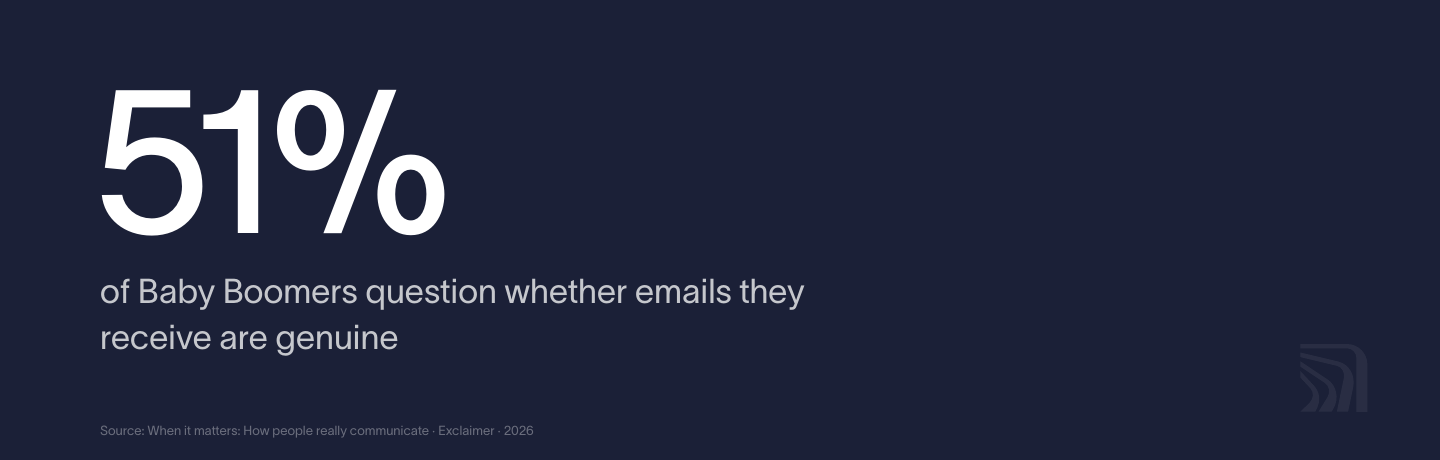
Baby Boomers are the most skeptical generation: 51% say they have concerns about the authenticity of messages they receive. That's a majority of Baby Boomers actively questioning whether emails are genuine.
This matters for organizations. If you're trying to communicate with a Baby Boomer workforce or Baby Boomer customer base, your emails need to look credible. Inconsistent branding, missing contact details, or no recognizable email signatures erode trust with an audience that's already primed to be cautious. Consistent, professional email signatures aren't cosmetic. For a generation this skeptical about authenticity, they're part of what makes a message believable.
The authentication concern is lower in younger generations, though it doesn't disappear. Gen Z, who've grown up with phishing awareness as a fact of digital life, show a different but not necessarily lesser concern. They're often quicker to dismiss suspicious messages outright.
How does Gen x use email compared to other generations?
Gen X shows up in the data as the most consistent generation across all measured behaviors. They're not the highest or lowest on any single metric. They sit reliably in the middle.
This reflects a generation that adapted to email as it developed, absorbed its conventions fully, and now applies them steadily. Gen X workers tend to be competent, unsentimental email users who neither romanticize the channel nor look for alternatives. They get on with it.
For organizations building communication policies or governance programs, Gen X behavior is effectively the baseline. They represent what "normal" email use looks like when someone has internalized the tool without strong opinions about it.
How is AI changing how different generations use email?
The most striking split in the dataset concerns AI. This is where generational differences are sharpest, and where the implications for organizations run deepest.
Generation | AI use in email |
Baby Boomer | 83% use AI in some form when composing or managing email |
Gen X | Mixed. Early adopters and non-users. |
Millennial | Mixed. Early adopters and non-users. |
Gen Z | 67% never use AI for email |
Gen Z is the most AI-active generation: 83% report using AI in some form when composing or managing email. For Gen Z, AI assistance is already a normal part of how email gets done. Whether it’s drafting, summarizing, or suggesting replies.
Baby Boomers sit at the opposite end. 67% of Baby Boomers say they never use AI for email. Two-thirds of a generation opting out entirely.
The gap has practical consequences. Organizations that assume employees across all ages will adopt AI-assisted communication tools at the same pace will find themselves wrong. Boomers aren't simply behind, many have made an active choice. And Gen Z's 83% adoption rate means any governance or compliance framework for email needs to account for AI-generated content as a default, not an edge case.
When a large portion of the workforce is using AI to compose messages, the question of what's in an email, who wrote it, and how consistent it is becomes harder to answer. Centralized email signature management controlled by IT rather than depending on individual effort, is one layer of governance that holds regardless of how the message above the signature was written.
What does the cross-generational picture tell us?
Read together, the data describes four genuinely different relationships with email:
Generation | Email relationship | AI use | Key behavior |
Baby Boomer | Formal record; high authenticity concern | 67% never use AI | High message retention (57%); most skeptical of email legitimacy (51%) |
Gen X | Consistent, unsentimental; the workforce baseline | Mixed | Middle range on all measures |
Millennial | High-intensity formal use; purposeful and record-focused | Mixed | Highest use for complaints (52%), job applications (43%), employer updates (53%) |
Gen Z | Pragmatic; email is one tool among many | 83% use AI in email | Highest message-loss rate (29%); lowest attachment to archiving |
These differences add up to a communication environment where the same message lands differently depending on who's reading it. Governance assumptions built around any single generation's behavior will always have gaps.
Why do email signatures matter across all generations?
One consistent thread across all four generations: professional, recognizable email signatures matter. Baby Boomers rely on them for authenticity signals. Millennials use email for high-stakes communications where credibility counts. Gen Z may not consciously register a missing email signature, but they notice unprofessional communications in their own way.
The challenge for IT and communications teams is that email signature consistency is genuinely hard to maintain at scale when employees are managing their own signatures, or not managing them at all. It gets harder as AI tools make it easier to send higher volumes of email faster. More email, more variation, more brand drift.
Exclaimer addresses that by removing the dependency on individual behavior. It doesn't matter whether the employee is a Baby Boomer who formats their email carefully or a Gen Z team member who used AI to draft the whole message: the email signature is correct, consistent, and on-brand either way.
Further reading
This article draws on Exclaimer's generational email research. For the full dataset and methodology, visit the When it Matters: How People Really Communicate report.