Dave is a marketing expert with 15 years experience in the tech and SaaS world. He specializes in educating IT and channel audiences, with a focus on security, privacy, compliance, and marketing technology. With a talent for storytelling and a deep understanding of the industry, Dave transforms complex IT topics into clear, engaging, and impactful narratives.
Migrating from Letsignit to Exclaimer: A step-by-step guide

TL;DR
Why switch from Letsignit to Exclaimer? Letsignit works for email signatures in Microsoft-centric environments, but scaling across multiple brands, integrations, and governance needs gets harder. Exclaimer provides centralized control, stronger governance, and broader integrations.
What changes after migration? You gain consistent, automated control over signatures across users, regions, and systems, with less reliance on manual updates.
What should you prepare before migrating? Review your templates and permissions, clean directory data, and define how signatures should work across teams.
How does the migration work? Set up Exclaimer, rebuild templates, test with a pilot group, then roll out in phases.
What's the result? Consistent branding, smart targeting, and less manual work for IT and other teams.
If you're using Letsignit, you already understand the value of managing email signatures centrally. But as your organization grows across brands, regions, and integrations, maintaining consistency, enforcing policies, and supporting more advanced use cases like multi-brand management or targeted campaigns can become harder to manage.
Migrating to Exclaimer simplifies that. It reduces the need for manual updates while giving you more control over how signatures are managed across users, teams, and systems.
This guide shows you how to move from Letsignit to Exclaimer without disrupting email flow. You’ll see what to prepare, how to migrate step by step, and how to confirm everything is working as expected.
Why switch from Letsignit to Exclaimer?
Letsignit is a solid option for managing email signatures in smaller or more centralized environments.
But as requirements expand, teams often run into challenges like:
Less granular control over branding across multiple brands, regions, or business units
Manual updates that increase the risk of inconsistencies
Limited audit visibility and delegated permissions
A narrower integration stack beyond the Microsoft ecosystem
Difficulty scaling governance as the organization grows
Exclaimer is designed to address those challenges.
It centralizes governance while supporting role-based access, applies updates automatically, and provides the visibility needed to manage signatures consistently across the business.
If you’re looking to scale signature management without increasing manual effort, it’s a switch worth considering.
How do Letsignit and Exclaimer compare on features and integrations?
Letsignit and Exclaimer take different approaches to managing email signatures. Here's a look at how these play out across key areas.
Capability | Exclaimer | Letsignit |
Control and governance | Role-based access with audit logs for full visibility and safe delegation. | Action traceability built in, but less granular delegation and audit reporting for end customers. |
Security and compliance | SOC 2 Type II, ISO 27001/27018, Microsoft 365 certified, with public Trust Center. | ISO 27001/27018 and GDPR compliant, and a Microsoft Partner — but no SOC 2 Type II. |
Directory support | Syncs with many sources, including Entra ID, Google Directory, Okta, and Workday. | Built around Microsoft environments, with Azure AD/Entra ID sync at the core. |
Brand consistency at scale | Brand Kits and centralized controls for multiple brands, regions, and compliance needs. | Multi-branch workspaces support multiple entities, but with fewer centralized brand controls. |
Integrations | Native integrations with Microsoft 365, Google Workspace, Salesforce, HubSpot, and more. | Microsoft 365 integration with newer additions like Salesforce, but a narrower overall stack. |
Campaign tools | Supports banner rotation, targeting, and analytics integrations. | Banner campaigns with scheduling and basic tracking, but less advanced targeting and analytics depth. |
Automation and management | Centralized automation reduces manual updates and IT workload. | More manual processes and limited permissions can increase overhead at scale. |
Beyond email | Extends branding to Teams, Zoom, and Google Meet. | Email signatures and digital business cards (vCards); no meeting branding. |
Both platforms support email signature management. The difference is how each one handles governance, automation, and integration depth as your organization grows, particularly across multiple brands, regions, and tools.
Where Letsignit and Exclaimer differ at scale
A side-by-side look at governance, integrations, and scalability across both platforms.
Prerequisites for migrating from Letsignit to Exclaimer
Before starting your migration, ensure you have the following in place:
Supported email platform: Microsoft 365, Exchange Server, or Google Workspace
Admin permissions: Global admin or Exchange admin rights for your email environment
Directory system: Access to Entra ID, Google Directory, Okta, or Workday for user sync
Current template access: Admin access to your existing Letsignit account to export or review templates
Stakeholder alignment: Sign-off from IT, marketing, and compliance teams on migration timeline
What should you prepare before migrating from Letsignit to Exclaimer?
A smooth migration starts with understanding how your current setup works and where manual processes may be introducing risk or inconsistency.
1. Audit your current signatures
Start by reviewing your existing Letsignit templates and configurations.
Identify how many signature variations exist across teams
Check for inconsistencies in branding, formatting, or disclaimers
Note where updates rely on manual changes
This helps you identify what should be standardized in your new setup.
2. Define how signatures should work going forward
Use the migration as an opportunity to improve how signatures are managed.
Decide how signatures should vary by department, role, or region
Confirm which elements must remain fixed for compliance
Align IT, marketing, and compliance teams on ownership
Exclaimer supports centralized control with delegation, so establishing clear ownership helps avoid confusion later.
3. Clean and validate user data
Accurate directory data is essential for consistent signatures.
Review fields like job titles, contact details, and locations
Remove outdated or inconsistent entries
Standardize formats across users
Exclaimer syncs employee details from your directory or HRIS of choice, so getting that data right helps prevent errors at scale.
4. Review integrations and targeting needs
Take stock of how signatures are used beyond basic contact details.
Identify CRM systems or tools you want to integrate
Consider how you want to use signatures to deliver marketing campaigns
Review where your current setup falls short
This helps you take advantage of Exclaimer’s broader targeting and integration capabilities.
5. Plan your rollout approach
A phased rollout reduces risk and keeps the migration controlled.
Select a pilot group to test first
Roll out by team, region, or business unit
Prepare a simple internal message for users
If done correctly, most users will never even notice the change.
Migration steps summary |
|
How to migrate from Letsignit to Exclaimer, step by step
A structured approach helps you avoid disruption and ensures your new setup is cleaner and easier to manage.
1. Set up Exclaimer
Connect Exclaimer to your email environment:
Once configured, directory sync pulls in the latest employee details automatically from your source of truth.
2. Rebuild and improve your templates
Start with one of Exclaimer's pre-built email signature templates and adjust it to suit your teams' needs. Or create a custom template from the ground up—the drag-and-drop editor makes it easy. Allow 2-4 hours for template creation and refinement.
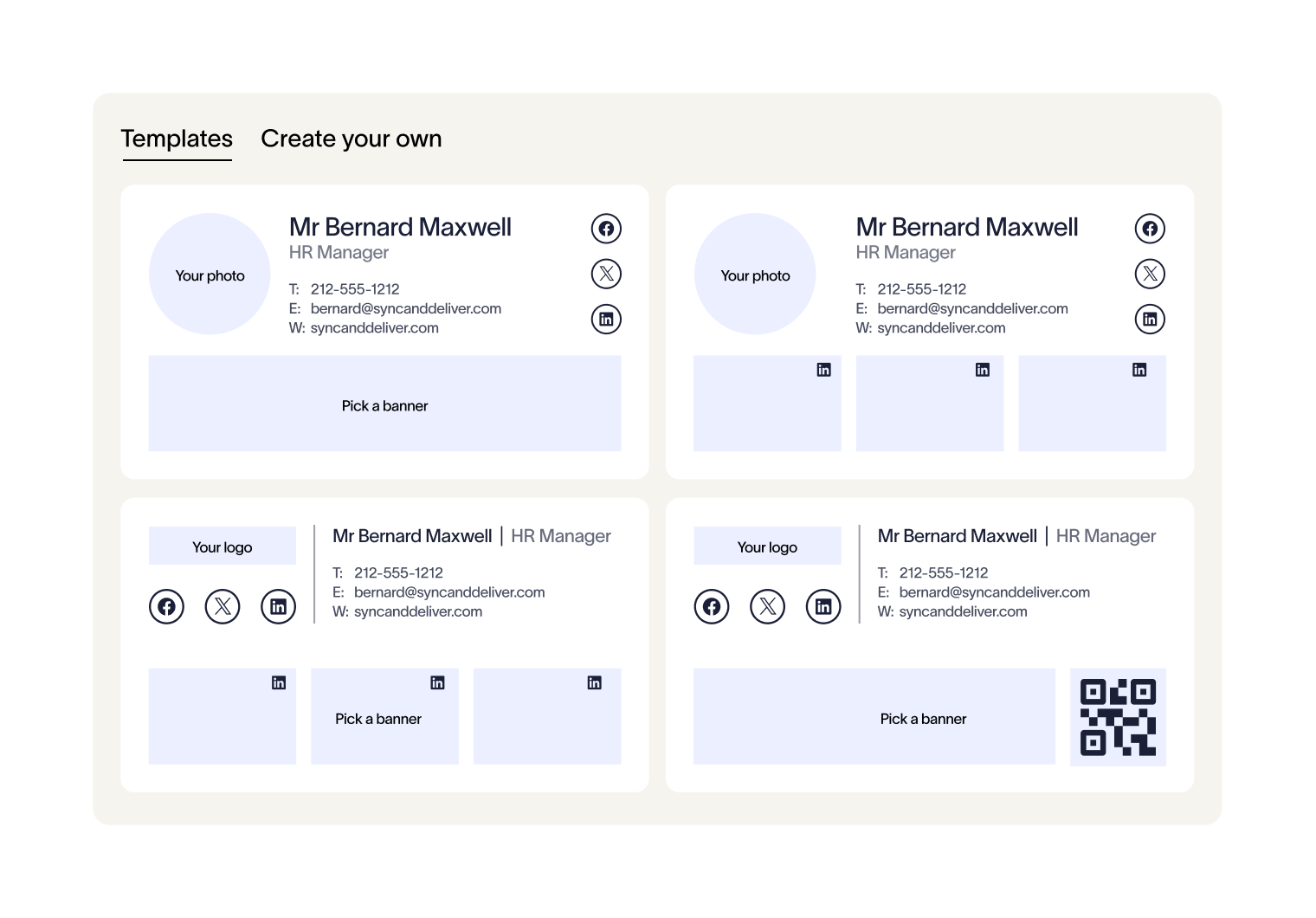
This is your opportunity to apply consistent branding, plus any required disclaimers or legal text, at scale.
3. Configure rules and permissions
Define how signatures should be applied and managed.
Assign signature variations by group, role, or region
Set role-based access for safe delegation of signature updates
Lock down key elements where needed for governance
These signature rules remove the need for constant manual updates or for relying on users to get it right themselves.
4. Test before rollout
Validate your setup across different environments.
Test signature rendering across devices and clients
Verify that formatting, links, and disclaimers appear as they should
Validate different user scenarios
The testing period is your chance to catch edge cases and ensure consistency at scale before full rollout.
5. Deploy in phases
Roll out gradually to reduce disruption.
Start with a pilot group
Gather feedback and refine
Expand rollout across the organization
This keeps the process predictable and the risk at a minimum.
6. Decommission Letsignit
Once Exclaimer is fully live, remove your previous setup.
Disable Letsignit templates and configurations
Confirm all users are routed through Exclaimer
Remove any legacy processes
Congratulations—your email signature management is now centralized and controlled.
What are common issues when migrating from Letsignit to Exclaimer?
Issue: Signatures not appearing for some users
Solution: Verify that affected users are included in the correct directory sync groups and that mail flow rules are properly configured. Check that no conflicting transport rules exist in your email environment.Issue: Formatting inconsistencies across email clients
Solution: Use Exclaimer's built-in preview feature to test across Outlook, Apple Mail, and mobile clients. Avoid custom HTML that may not render consistently and stick to supported fonts and image formats.Issue: Directory data not syncing correctly
Solution: Confirm admin permissions for directory access, check that required user attributes are populated, and verify sync schedule settings. Re-authorize the connection if sync errors persist.
How do you verify your Exclaimer rollout after migrating from Letsignit?
After rollout, confirm everything is working as expected and that manual processes have been removed from your setup.
Signatures apply consistently across all devices
User data syncs correctly
Branding is consistent across all templates
Disclaimers appear where required
Role-based access is set for safe delegation
Campaigns and banners behave as expected
Audit logs track changes and activity
If all has gone well, you should see a significant drop in signature-related support tickets going forward.
Ready to migrate from Letsignit to Exclaimer?
Moving from Letsignit to Exclaimer is a move to more consistent control, stronger governance, and less manual effort.
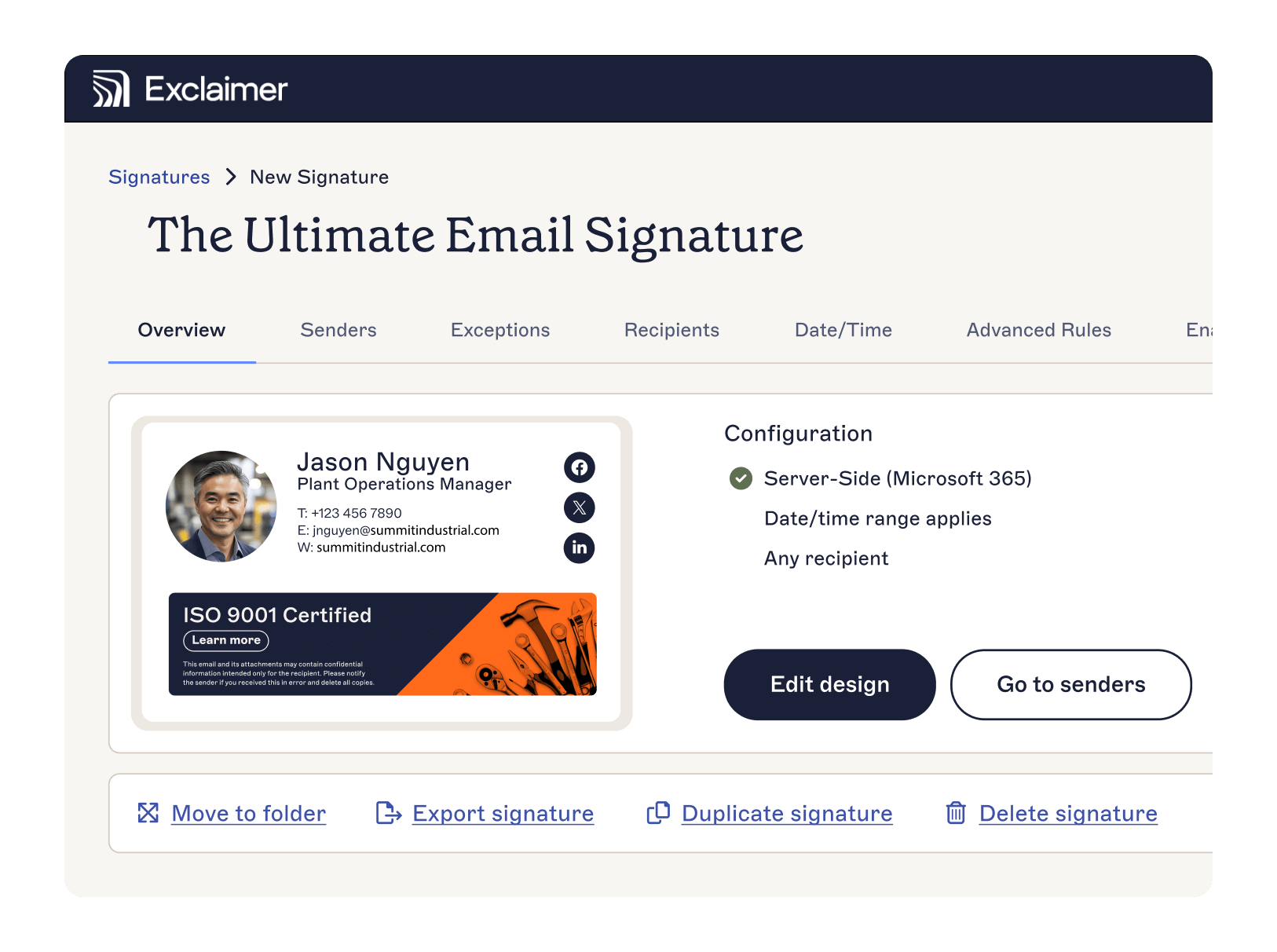 With Exclaimer, you’ll get:
Consistent signatures across every user and device
Centralized control with safe delegation
Better visibility for compliance and audits
More flexibility with integrations and campaigns
If your current setup is becoming harder to manage, simplifying it is worth the effort. Get a free trial of Exclaimer today.