Elisabeth leads Exclaimer’s global brand narrative, thought leadership, and research-led storytelling. With over 15 years’ experience in PR and B2B technology marketing, she is known for turning complex ideas into clear, compelling communications that resonate with global audiences.
AI is creating a trust gap in American business email, new Exclaimer research finds

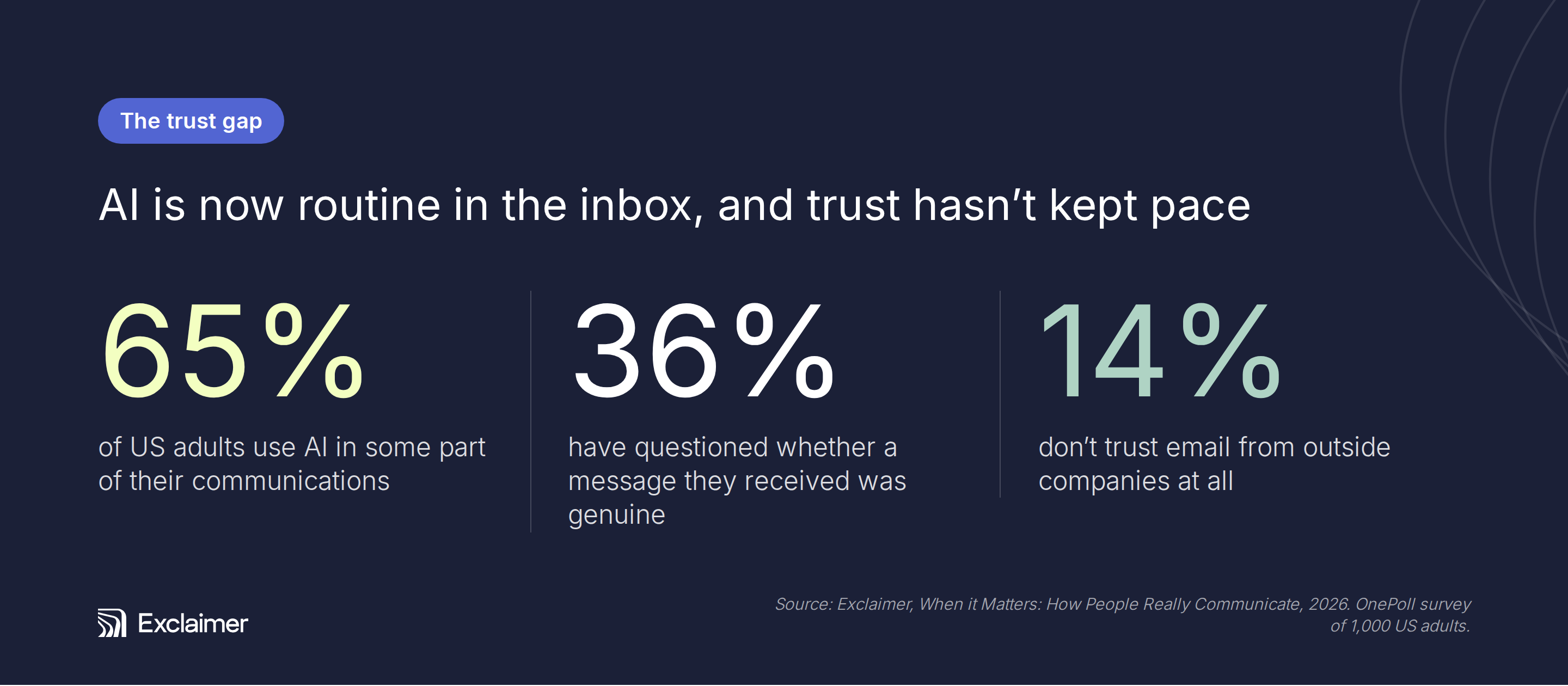
More than a third of Americans, 36%, say they've questioned whether a message they received was genuine. 14% say they don't trust email from outside companies at all. At the same time, 65% of US adults now use AI in some part of their communications, and the tone of a message may no longer tell you much about the person who actually sent it. New research from Exclaimer explores that trust gap: what's behind it, and what convinces someone an email is real.
This is based on a nationally representative online survey of 1,000 US adults, conducted by OnePoll between May 26 and June 2, 2026, as part of a wider 2,000-person study across the UK and US. Figures are rounded to the nearest whole number.
How is AI changing the way Americans write email?
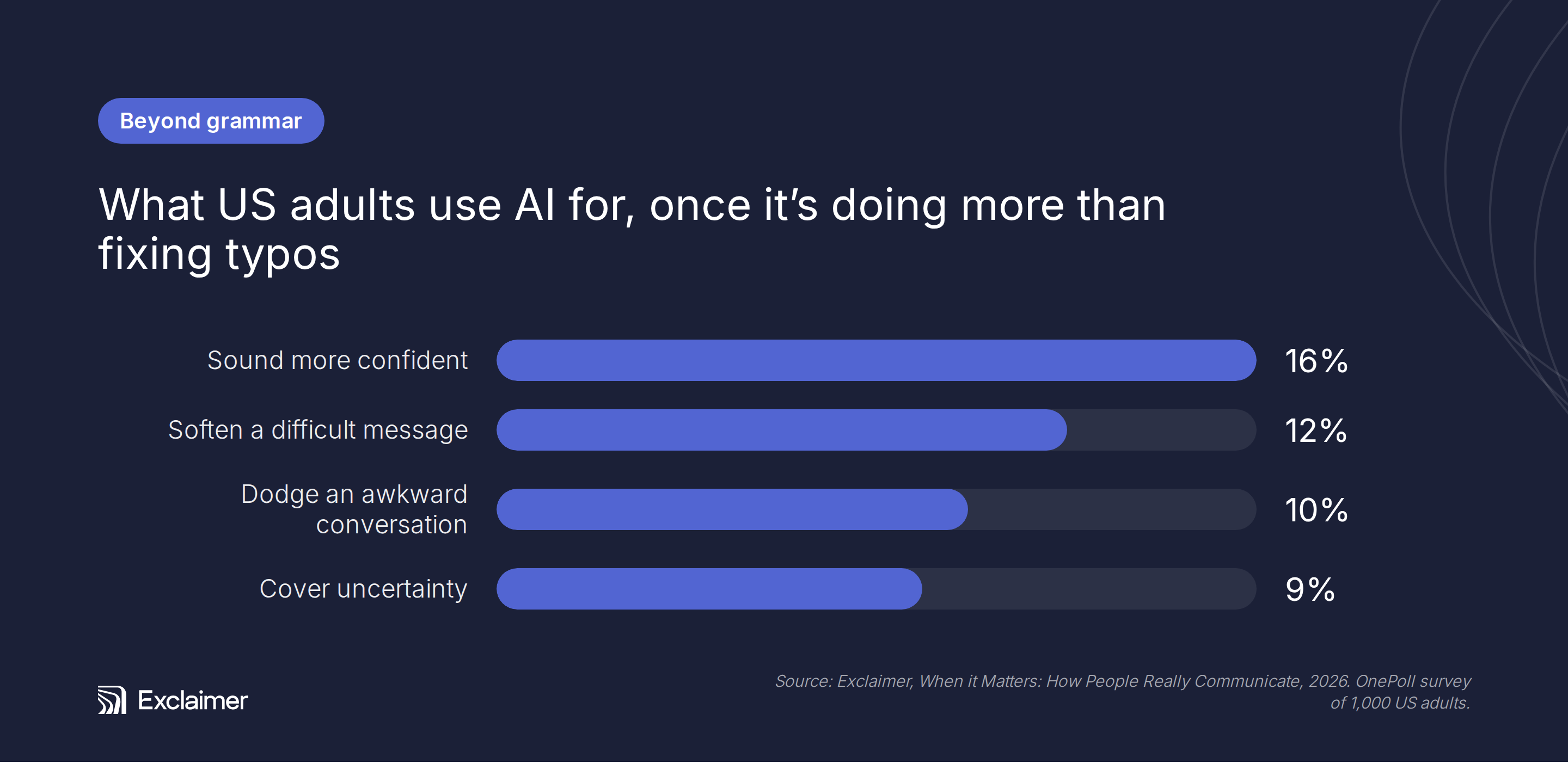
For a meaningful share of US adults, AI does more than clean up grammar:
16% use it to sound more confident
12% use it to soften a difficult message
10% use it to dodge an awkward conversation
9% use it to cover uncertainty they'd rather not show
The more familiar uses are still the most common: 20% use AI for grammar and spelling, and 19% to sound more professional. But once AI is doing that much editorial work, the line between "helped write this" and "wrote this for me" gets hard to see. A confident, professional-sounding email might reflect genuine confidence, or it might be AI standing in for someone who has none, and increasingly, there's no way to tell which from the outside.
It's a shift Exclaimer's earlier research into AI and email sentiment also picked up on, well before it showed up this clearly in the data.
Why does a more professional-looking email feel harder to trust?
The best-written email you got this month, polished, no typos, warm without being try-hard, could have come from the person who signed it. Or it could have come from AI standing in for someone who didn't have time to write it themselves. There's no way to tell which just by reading it, and that's exactly what makes the message harder to trust.
Professional-sounding writing no longer signals a real, careful person behind it. Confident-sounding copy is available to anyone in seconds, so the words on the page don't prove who sent them.
Laura Wilkinson, VP of Global Marketing at Exclaimer, points to this shift directly:
"The findings show that AI isn't reducing the importance of trust in business communications, but how people establish it," she says. "When anyone can generate a polished, professional email in seconds, recipients look beyond the words for proof that a message is genuine. For businesses, email governance is more important than ever. And trust comes from giving every email a clear, verifiable identity that customers, employees, and partners can recognize and rely on."
She unpacks this shift further in a conversation on where brand structure fits into AI-driven communication.
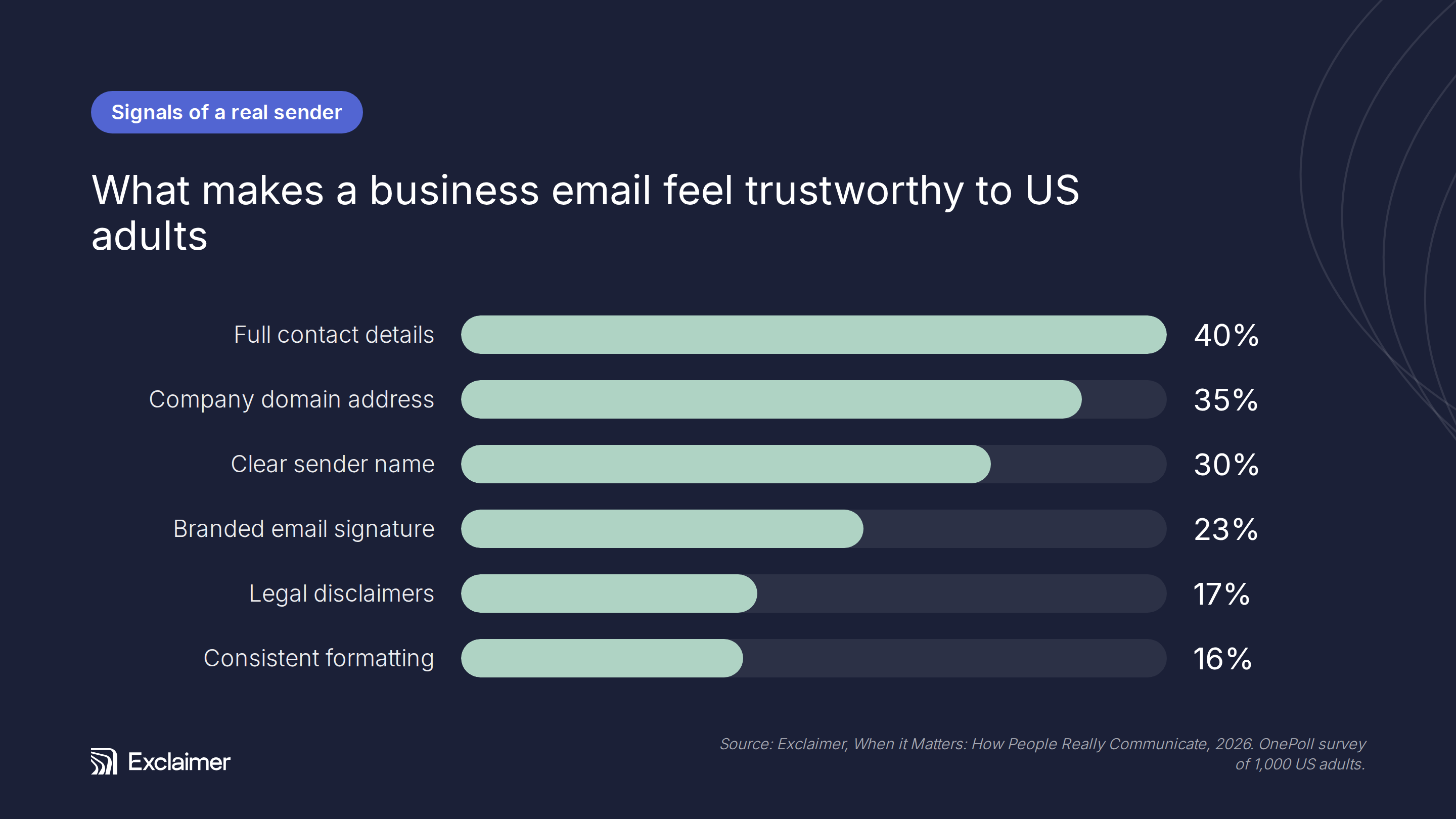
That's exactly what recipients have started checking for instead. A branded, professional email signature makes an email feel more trustworthy, ranking above legal disclaimers (17%) and consistent formatting (16%). The next section breaks down that signal, and the exact share who cite it, alongside the other signals people check first.
What actually makes a business email feel trustworthy?
Full contact details are the single biggest signal, cited by 40% of US adults. A professional email address on a company domain matters to 35%, a clear sender name to 30%, and a branded, professional email signature to 23%.
What these four signals share matters more than any one of them alone: a domain, a name, contact details, a signature. None require reading a word of the message. They tell a recipient who's on the other end before the content of the email even factors in. A consistent, well-designed email signature does more of that work than most companies give it credit for, and keeping that consistency across every employee is its own separate challenge once a company grows past a handful of people.
Why does this matter more for some emails than others?
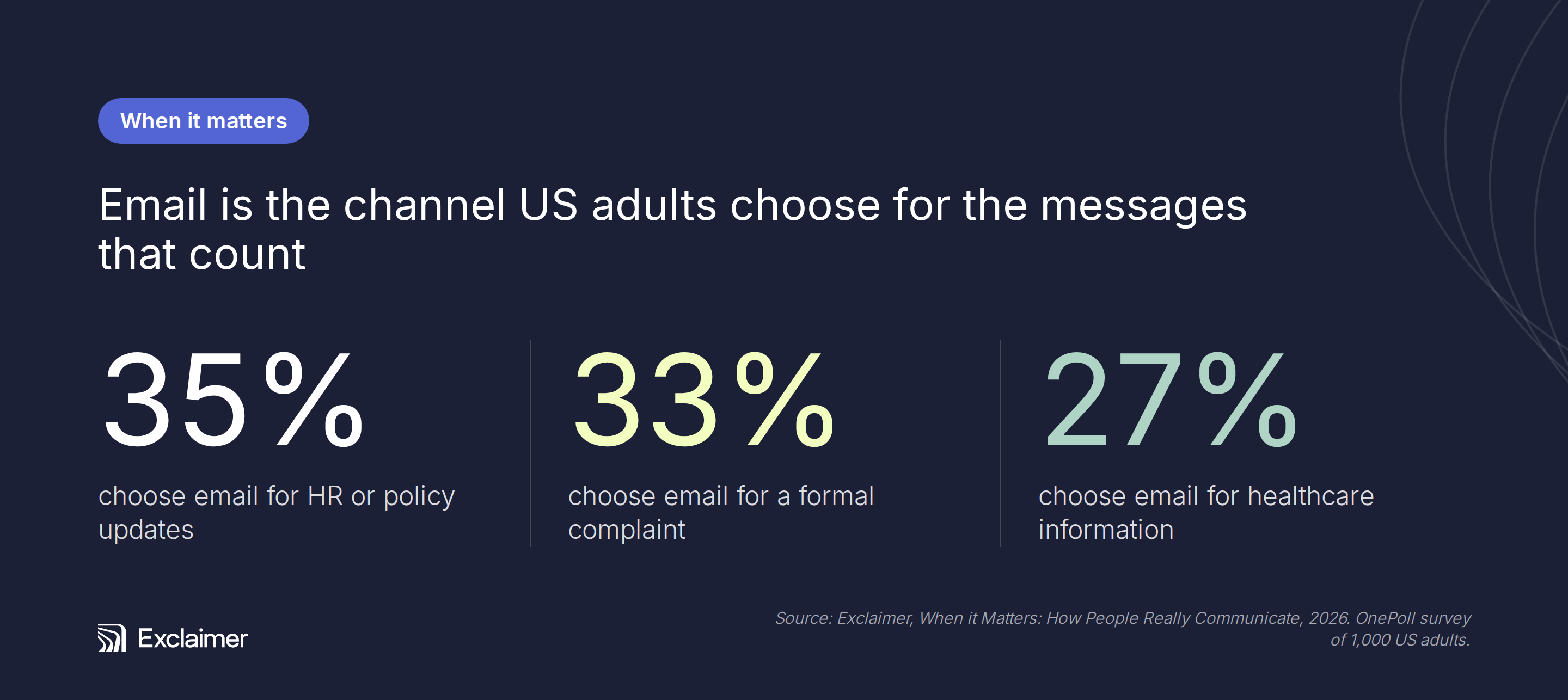
Domain, name, contact details, signature: these signals matter most for the messages people can't afford to get wrong. Email is the preferred channel for an update from an employer about HR or policy changes (35%), a formal complaint to a company (33%), and healthcare information (27%).
Permanence explains why. 43% of US adults choose email specifically because they want information they can refer to later, more than twice the share who'd pick any other platform for the same reason. A further 33% have deliberately used email instead of another channel because they wanted a permanent record.
That permanence only means something if the message is genuine. Otherwise, all you've kept is proof that you doubted it.
Does the platform itself affect how a message is judged?
A complaint answered over text lands differently than one answered by email, even with identical wording. More than four in ten US adults, 43%, say the platform a message arrives on affects how trustworthy it feels, and 39% say it shapes how professional and authentic the message feels.
The format announces itself before the recipient reads a word: a contract sent as a social media DM, an HR update sent as a text, a formal reply sent as anything other than email. The channel has already signaled how much weight the message deserves before the content gets a chance to argue otherwise.
For businesses, that means sender identity, name, contact details, company information, and email signature attached to every message must hold up on its own, everywhere it shows up. That's the trust gap this research points to: professional-sounding writing is available to anyone in seconds, but there's no equivalent shortcut for verifying who's actually behind it.
The full When it Matters: How People Really Communicate study covers more than what's in this piece: how trust splits by generation, what people do with messages they can't afford to lose, and how UK and US habits compare. Read the full report.