Elisabeth leads Exclaimer’s global brand narrative, thought leadership, and research-led storytelling. With over 15 years’ experience in PR and B2B technology marketing, she is known for turning complex ideas into clear, compelling communications that resonate with global audiences.
Planning a rebrand or acquisition in 2027? Six ways to protect and govern your brand

Key takeaway
Settle brand strategy before any creative work, and brief employees before the public launch.
Agree who owns brand decisions before a deal closes, and plan brand governance well past go-live.
Check your outbound email for the old company name, because UK and US rules require correct names on business correspondence.
Give AI tools the approved brand, because they compound whichever mistakes they start from.
I've led brand communications through two rounds of brand change at Exclaimer, and in both, the hard part started after go-live.
People went back to what they knew, and touchpoints nobody was tracking kept the old brand alive. In 2027 that costs more, because AI tools and compliance teams both reward companies that keep governing the brand after launch.
These are the six tips I'd give anyone planning a rebrand or an acquisition next year.
Tip 1: Settle brand strategy before any creative work
Settle brand strategy and positioning before any creative work starts, and ground the decision in research on who and where your customers actually are.
In 2023 we rebranded to appeal to a new audience. After about a year it was clear the rebrand hadn't worked, and we had to course-correct with a partial reversal. Brand can't do the job of strategy. If the strategy is wrong, the rebrand won't fix it. The visual identity is the visible part of a much larger process, and when that process is rushed or skipped, the new look doesn't hold.
Too many teams run strategy and creative in parallel, which builds the visual identity on shifting foundations. I'd also check the reason for the rebrand itself. A rebrand needs a reason rooted in strategy, and a new executive's wish for a fresh start doesn't count as one.
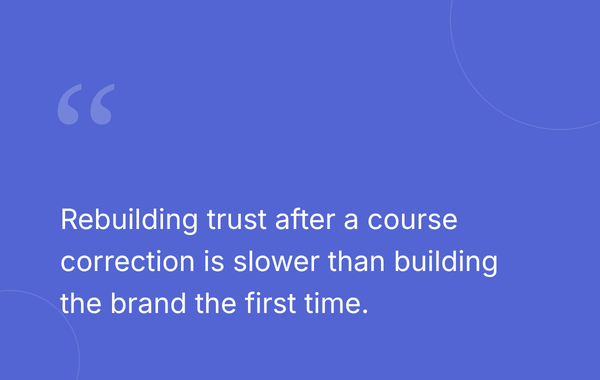
Rebuilding trust after a course correction is slower than building the brand the first time, so it pays to get this part right before anything is designed.
Tip 2: Brief employees before the public launch
Brief employees before the public launch, and bring them along with you.
When we launched new branding, some people on the team didn't fully understand it. Instead of going with it, they defaulted back to what they knew, and mixed messages went out externally. The window before launch is valuable and underused. Here's how I'd make the most of it for a successful launch:
Early internal previews show people they're trusted with something before it goes public.
Alongside the why, give the team clear guidance on what the change means for the work they do.
Make the new assets easy to find and use. Brand guidelines buried in a SharePoint folder or a shared drive create friction, and friction sends people back to whatever has worked for them in the past.
Explain the why. My colleague Kate Rhodes, a marketing consultant who led a global rebrand across 23 office locations, believes that colleagues outside marketing don't always see why a logo or a strapline matters, so explaining why consistency matters works better than handing over a guidelines document.
Tip 3: Agree who owns the brand decision
Write down who decides what on brand before the deal closes (or before the rebrand is finalized), and make sure a marketer is in the room when it's agreed.
Kate Rhodes, believes that when marketers aren't in the room, many of the brand decisions only reach marketing when they're already decided. She believes a company buying 10 businesses needs a brand strategy for the next five years, and she sees fewer CMOs in organizations now, so fewer marketers hold a seat at that table.
My view is that ownership is genuinely cross-functional. Marketing holds brand strategy, and legal and IT hold the legal implications and the technical rollout between them. You need a framework agreed up front that says who decides what and by when, and who signs off at the end. That prevents the delays and reversals that derail most transitions. If you don't have a CMO ally, Kate's advice is to make friends with IT, finance, and legal from day one, because the rollout depends on them.
Tip 4: Plan brand governance well past go-live
Plan a named owner and a governance period that runs well past launch day, and treat it as permanent if you acquire regularly.
My colleague James Wayne, who hosted our Rebranding and M&A webinar, says the organizations that come through a brand transition with the brand intact build governance into the plan and maintain it after go-live. He has seen customers still using outdated branding years after events like these. Exclaimer platform data points the same way, because the typical customer updates its email signature about once a year.
Vancity, a credit union with 2,600 users, started with a pilot by a cross-functional team and expanded to brand champions before rolling out its rebrand organization-wide in early 2026. Its marketing team now manages email signature updates without IT involvement, according to the published customer story.
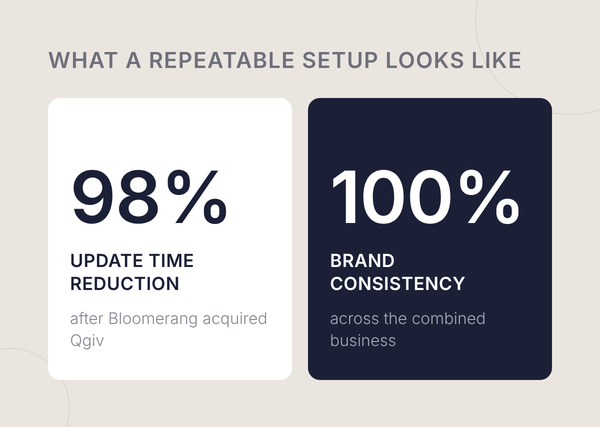
For serial acquirers, Kate calls buy-and-build a moving target for as long as it lasts. Bloomerang shows what a repeatable setup looks like. After it acquired Qgiv, its update time fell by 98% and it reached 100% brand consistency, according to the published customer story.
Tip 5: Check outbound email for the old company name
Check outbound email for the old company name and outdated details before launch, because correct names on business correspondence are a legal requirement in some jurisdictions.
Entity names are where reputational risk and compliance risk genuinely overlap. If a business has formally changed its registered name and employees keep sending email under the old one, that's a trust issue and, in the UK, a legal one.
Jurisdiction | Rule | What it requires |
UK | Companies Act 2006 and the trading disclosure rules under it | Correct registered company name on business correspondence, email included |
US | FINRA Rule 2210 | Member firms must prominently disclose their name in retail communications and correspondence, including electronic ones |
Kate saw this firsthand, because her company had 10 legal entities. Clients were asked to use the new brand name while invoices still carried the old one, which pulled in procurement, legal, and finance and made the brand feel less important than the entity behind it.
Ed Bodey, our General Counsel, says regulators and auditors ask for more than a written policy. They want evidence it's applied consistently in practice, and confidence that controls sit in systems instead of depending on individual behavior. By that standard, a rollout that relies on each employee updating their own details has a weak answer. That puts email compliance on the rebrand plan from the first week.
Tip 6: Give AI tools the approved brand from day one
Give AI tools the approved brand from day one, because they compound whichever mistakes they start from.
AI's starting point is what we teach it. If teams aren't teaching it the same thing from the beginning, the differences snowball. After a rebrand, an AI tool that drafts company email works from whichever version of the brand it was given, so retire old assets and point every tool at one source of truth.
James Wayne, our Senior Product Marketing Manager, makes the governance point. Companies are no longer governing only people, because emails are now written by generative AI and read by AI agents that summarize them, and email policy has to support that. Ed Bodey, our General Counsel, adds the legal layer. If an AI tool generates the content, the legal obligation still sits with the business, and mandatory disclosures and company identification still apply.
Recipients are already paying attention. In Exclaimer's When it Matters research (OnePoll, 2,000 UK and US adults, May to June 2026), 41% had questioned whether a message was genuine. Full contact details (45%) and a professional company email address (44%) ranked as the top trust signals in email. A company name or an email domain can change in a rebrand, and recipients already check them.
Start with the email audit
Start with the cheapest check, which is what your old company name is still doing in outbound email today.
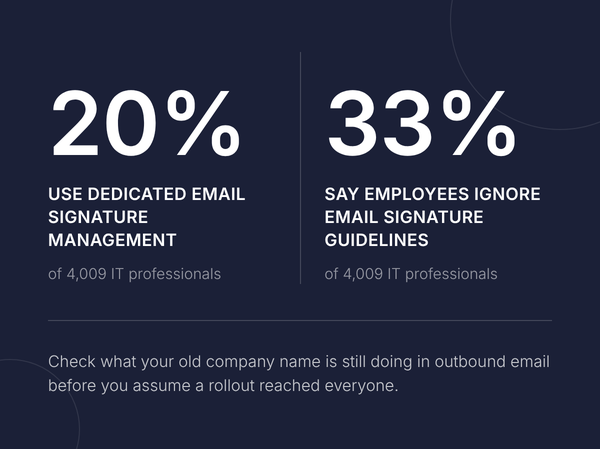
In Exclaimer's State of Business Email 2025 research (Censuswide, 4,009 IT professionals), only 20% use a dedicated email signature management solution and 33% say employees ignore email signature guidelines, so it's worth checking before you assume a rollout reached everyone.
Then name the owner for the rest. Compliance leads will say this belongs to legal, and marketers will say it's theirs. I think both are wrong, because neither function can hold the brand alone.
Planning a rebrand or an acquisition? See how to manage email signatures after a rebrand with Exclaimer