Dave is a marketing expert with 15 years experience in the tech and SaaS world. He specializes in educating IT and channel audiences, with a focus on security, privacy, compliance, and marketing technology. With a talent for storytelling and a deep understanding of the industry, Dave transforms complex IT topics into clear, engaging, and impactful narratives.
The real cost of email signature non-compliance in financial services: How to fix it

TL;DR
Email is a regulated communication channel in financial services, and email signatures fall under the same disclosure and governance expectations.
Manual or inconsistent signature management creates compliance gaps that increase audit exposure and regulatory scrutiny.
Missing or outdated disclaimers, especially across mobile and hybrid environments, are common failure points during audits.
The cost of non-compliance shows up in remediation work, legal review cycles, IT overhead, and reputational trust, not just fines.
Centralized email signature governance helps financial institutions apply disclosures consistently, prove control during audits, and reduce operational risk.
Financial services organizations operate under intense regulatory scrutiny. Every outbound communication is subject to expectations around accuracy, disclosure, and consistency. Email is no exception.
Yet financial services email signatures are still commonly managed manually, left to individual employees, or enforced through fragile scripts and transport rules. In regulated environments, that lack of control introduces avoidable risk.
Missing or incorrect disclaimers, inconsistent sender details, and unmanaged mobile signatures can all create compliance gaps. Over time, those gaps increase audit exposure, slow regulatory responses, and place unnecessary pressure on IT and compliance teams.
In financial services, email signatures are part of communications governance. When they aren't controlled centrally, the cost shows up in audits, remediation work, legal review cycles, and reputational trust.
This article examines the real cost of email signature non-compliance in financial services, including:
Regulatory and audit risk
Legal and disclosure exposure
Operational overhead for IT teams
Brand and trust implications in regulated markets
Financial conduct requirements: SEC, FINRA, SOX, and FCA
Financial services regulators expect firms to maintain control over all outbound business communications. That includes email signatures, which often contain legal disclaimers, regulatory disclosures, and sender information relied on during audits and investigations.
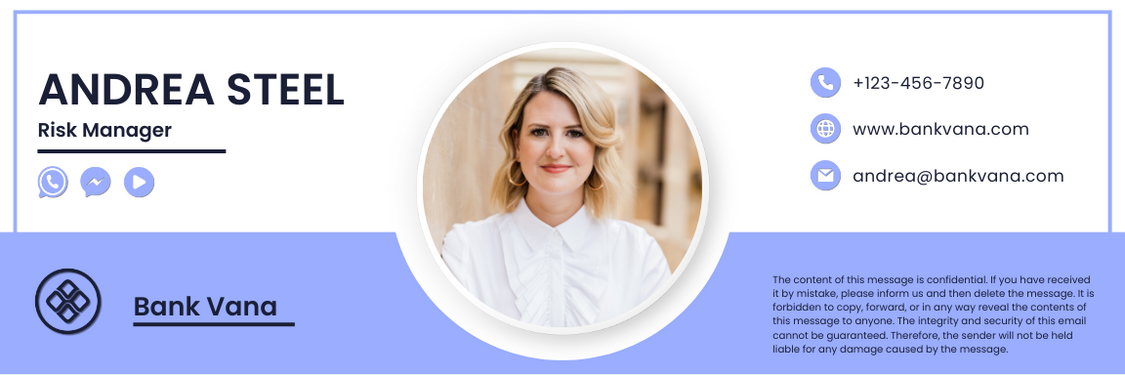
When signatures are inconsistent or unmanaged, firms can struggle to demonstrate that required disclosures were applied accurately and consistently at the time an email was sent.
In the United States, regulators such as FINRA (the Financial Industry Regulatory Authority) and the SEC (the Securities and Exchange Commission) treat business email as regulated communication. Firms are expected to supervise, retain, and produce communications that relate to financial activity.
Email signatures play a supporting role in that oversight. Missing or outdated disclaimers can raise questions during audits, especially when firms cannot prove what information was included in historical correspondence.
In the UK and EMEA, the Financial Conduct Authority (FCA) requires firms to communicate with clarity and accuracy. Under COBS 4, the FCA Handbook's rules on communicating with clients, disclosures must be fair, clear, and not misleading across all channels. Email signatures that vary by department, device, or individual raise the risk of inconsistent disclosures, and 40% of financial firms now consider communication compliance a board-level issue.
Regulation | What's required | Penalty exposure | How email signatures help |
|---|---|---|---|
SEC (U.S.) | Supervised, archivable communications | Enforcement action, no fixed cap — Robinhood paid $45M in 2025 (see below) | Adds disclaimers that indicate monitoring and retention policies |
FINRA (U.S.) | Fair and accurate investor communication | Up to $1 million per violation, plus restitution | Prevents missing or misleading disclosures in outbound messages |
SOX (U.S.) | Traceable records and internal controls | Civil and criminal liability, case-by-case | Applies consistent role-specific legal language to support audits |
FCA (UK) | Transparent and verifiable client communication | Formal enforcement action, case-by-case | Standardizes information in outbound emails across teams and regions |
Data protection requirements: GDPR, CCPA, and GLBA
Separately from conduct rules, data protection frameworks govern what personal information a signature can safely carry.
Under GDPR and similar frameworks, organizations are expected to handle personal data responsibly and transparently. Email signatures often include personal identifiers such as names, job titles, phone numbers, and email addresses — when those details are unmanaged or outdated, firms risk breaching internal data accuracy policies and creating unnecessary compliance exposure.
For multinational financial institutions, manual email signature management makes it difficult to sustain regional disclosure requirements alongside consistent governance across the whole email environment.
Regulation | What's required | Penalty exposure | How email signatures help |
|---|---|---|---|
GLBA (Gramm-Leach-Bliley Act) (U.S.) | Safeguarding financial customer data | FTC enforcement action, case-by-case | Warns users not to share sensitive account or personal details |
| GDPR (EU) | Transparent use of personal data | Up to €20 million or 4 percent of global revenue | Includes legal identity, intent, and privacy access details in every message |
CCPA (U.S.) | Clear consumer data handling rules | Between $100 and $750 per affected individual | Embeds regulatory messaging and access options for recipients |
A real-world example: the Robinhood fine
The SEC fined Robinhood $45 million for recordkeeping failures and weak internal controls. Among the issues: inconsistent signature content, missing disclosures, and no system in place to monitor outbound communication. These gaps raised red flags regulators couldn’t ignore.
The real cost of non-compliance
Email signature non-compliance rarely shows up as a single, visible failure. The cost is spread across audit preparation, legal review, IT overhead, and reputational trust — and the penalty figures above are the floor, not the whole bill.
Audit and remediation. When auditors ask how disclosures are applied and controlled, manually managed signatures mean slower answers. Compliance and IT teams end up reconstructing historical policies, reviewing old scripts and transport rules, and manually confirming which disclaimers were live during a specific period — time that isn't captured in any regulator's fine schedule but shows up as a real internal cost every time.
Legal and disclosure risk. When updates are delayed or partially applied, organizations send communications carrying outdated disclosures, which can trigger extra legal review cycles, internal policy exceptions, and corrective action — and the cost lands on legal and operations both, not just legal. The average data breach costs $4.88 million, but in the financial industry that climbs to $6.08 million. It only takes one unmanaged email to set it off.
Ongoing IT overhead. Without centralized control, IT becomes the default owner of signature enforcement — processing update requests, troubleshooting inconsistent behavior across clients, and handling one-off exceptions by department or region. What starts as a small task turns into recurring operational work.
Reputational impact. In financial services, consistency signals control. Emails with missing or inconsistent signatures can undermine confidence with regulators, partners, and institutional clients — harder to quantify than a fine, but it shapes how closely an organization gets scrutinized in the next review.
Tip
Exclaimer gives financial institutions a single platform to control every email signature.
Who is responsible for email signature compliance in financial services?
In financial services organizations, email signature compliance forms part of broader communications governance. Regulators expect firms to demonstrate control over how disclosures are defined, applied, and enforced across all business communications.

That responsibility is shared, but it must be clearly defined.
IT as the enforcement layer in regulated environments
IT teams are responsible for how email systems operate in practice. In financial services, that includes:
Ensuring required disclaimers are applied consistently
Covering all email clients and devices used by regulated staff
Maintaining reliable, repeatable enforcement mechanisms
During audits or supervisory reviews, IT teams are often asked to explain how disclosure controls are applied, even when they do not own the content itself.
Legal and compliance as disclosure owners
Legal and compliance teams define:
Which disclosures are required
When wording must change
How regulatory updates should be reflected in communications
In regulated environments, these teams are expected to demonstrate that approved language is not only defined, but consistently applied. Gaps between policy and execution are where audit findings tend to emerge.
Why clear ownership matters during audits
When regulators or auditors ask how disclosures were applied at a specific point in time, unclear ownership creates friction.
Common challenges include:
Delays in confirming who approved changes
Difficulty proving when updates went live
Uncertainty over which teams were responsible for enforcement
Clear ownership, supported by consistent technical controls, reduces audit risk and improves confidence across IT, legal, and compliance teams. This closes out the gap the previous section put a number on: this is the difference between a slow, manual scramble and a fast, defensible answer.
"The wording of a disclaimer is usually fine. What often breaks is how the disclaimer is deployed. A signature pushed through a GPO logon script or an Outlook add-in only works on the machine and client it's installed on. Email written on phones or from webmail in a browser means the disclaimer just won't appear. And when an auditor asks for evidence of disclaimer usage, they're not going to accept it if it works most of the time. They'll ask if every outbound email carried the disclosure, and 'as long as they're at their desk' won't cut it."

Financial firms waste an average of 83 working days per year (0.4 FTE) on manual email signature updates. That's $28,000 in IT time alone, based on a 500-employee organization. Legal and compliance review time on top of that isn't captured in this figure, which is why the real number is higher than any single stat can show.
What to look for in email disclaimer software for finance
A finance-fit disclaimer tool should answer seven questions before it answers any feature question.

Named-regulation support. Can the tool apply different disclaimer text by regulator and by line of business, not just by department? Exclaimer's Disclaimers feature applies legal text by team, location, or entity, so a US broker-dealer's disclosure and a UK FCA-regulated entity's wording (governed by FCA COBS 4) can run from the same rules engine without manual per-user edits.
Locked, centrally controlled disclaimer text. Once legal approves the wording, can an employee edit or remove it? Exclaimer's disclaimers are applied server-side by rule and can't be edited or removed by the employee, so what left the building is what legal actually approved. That's the upstream problem a records system alone can't fix: SEC Rule 17a-4's electronic recordkeeping requirements govern how a firm's own archiving system preserves communications, not what a signature tool puts in them — locking the content at the source is what keeps an inconsistent disclaimer from ever reaching that archive in the first place.
Role-based access for supervisors. Is template editing restricted to the people who should be making changes? Exclaimer's Role-Based Access Control keeps editing rights with designated administrators and includes a separate Auditor role, so compliance can review configuration without holding edit access, supporting the supervisory approach FINRA Rule 2210 expects firms to take toward member communications.
Directory sync for accurate, per-role data. Does the tool pull current role and location data automatically, or rely on someone remembering to update it? Exclaimer syncs with Microsoft Entra ID and Google Workspace Directory, so the attributes that drive disclaimer logic stay current without manual upkeep.
Named, independently audited certifications. SOC 2 Type II, ISO 27001, and ISO 27018 are the baseline the New York Department of Financial Services' Cybersecurity Regulation (23 NYCRR 500), and the GLBA Safeguards Rule expect from any vendor handling customer financial data. Exclaimer holds all three.
A rules engine built for multi-entity, multi-jurisdiction firms. Can one deployment serve a US RIA and a UK FCA-regulated entity with different disclosure text, without separate installs? Exclaimer's rule-based targeting by entity, region, and team is built for exactly this kind of split.
Vendor-management evidence on request. Can the vendor produce a SOC 2 report, ISO certificates, and security review documentation without a weeks-long back-and-forth? Exclaimer's Trust Center makes certificates and policy documentation available directly, which is the kind of evidence the Federal Financial Institutions Examination Council (FFIEC)'s vendor-management guidance expects firms to maintain for their technology service providers.
For pricing factors and a per-seat structure, see Exclaimer's pricing page.
How Exclaimer makes email compliance easier
Manual email signature management is slow, inconsistent, and creates unnecessary risk. Exclaimer replaces this with centralized control. That means no user edits, no scripts, no workarounds.

Built for financial services teams that can’t afford inconsistency
Exclaimer integrates with Microsoft 365, Google Workspace, and Exchange (Hybrid, SE, Online). It syncs with your user directory to keep signatures accurate across every role, team, and office.
Works across hybrid, mobile, and office-based roles.
Updates are pushed automatically, with no ticketing and no delays.
Everything is controlled from a central platform, so you can make changes quickly and know they've been applied.
Email disclaimers that follow policy every time
The Disclaimers feature lets IT apply legal text based on user attributes. You set the rules, and the platform applies them automatically.
Apply disclaimers by team, location, or entity.
Set fallback messages when no attribute match is found.
Place disclaimers above or below banners or contact details.
Keep layout consistent with the rest of the signature.
Roll out updates instantly without touching templates.
This helps meet requirements for GDPR, GLBA, PCI DSS, and SEC 17a-4, without requiring user input.
Why it matters
When signatures are managed manually | When signatures are managed with Exclaimer |
|---|---|
$28,000 in IT time lost annually | Fixed platform cost with minimal admin time |
83 days spent on manual updates | Under 10 hours per year |
Risk of regulatory gaps and fines | Controlled content with version history |
Delayed review cycles | Instant updates with audit-ready logs |
Audit-ready, by design
Disclaimer and signature content is centrally controlled, so what's approved is what goes out, with no per-user edits to track down after the fact. Role-based access, including a dedicated Auditor role, gives compliance visibility into configuration without needing edit rights.
No last-minute fixes. No scrambling to reconstruct what a disclaimer said last quarter.
Trusted across financial services
IT leaders in financial services already know email signatures are a weak point. What they need is control.
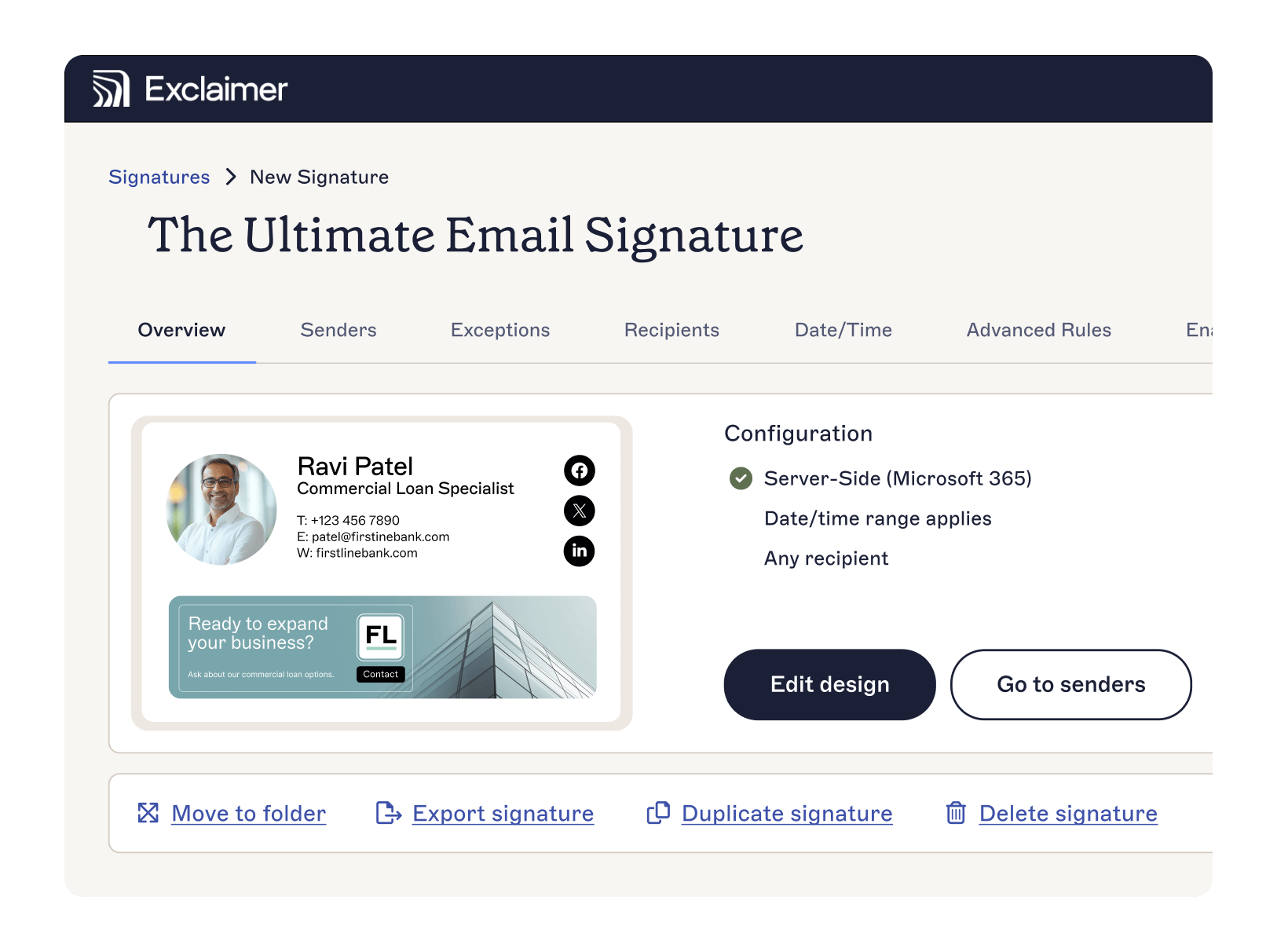 Exclaimer manages email signatures for financial institutions across branches, offices, and regulatory environments, without adding to IT's workload.
Vancity, a Canadian credit union, unified email signatures across 2,600 users with 100% adoption using Exclaimer.
What financial services firms are saying
“Great way to standardize signatures for branding and compliance, and removes the need for employees to manage their own signatures, for Compliance to approve them, for Marketing to approve them, for Technology to teach people how to do it, and for our MSP to have to write scripts to handle our many disclosures. That's a lot of people who don't have to worry about signatures anymore.”
“As a tightly regulated business, we must ensure all required legal information is provided on all outbound emails we send. The disclaimer field in the signature does precisely that.”
“Creating a signature in their template design is very easy and pretty much builds itself. We were able to create signatures for our separate departments and have them up and running in no time. This makes compliance issues of people doing whatever they want completely go away.”
“I love how easy it is to add signatures for users. The implementation was great. It took about one week to figure everything out. We use it every day. It integrates with office 365 and works in the backend.”
Financial institutions worldwide use Exclaimer to reduce risk and cut down on repetitive IT tasks.
See how other financial firms like yours are improving compliance and gaining control.
Simplify email signature compliance without IT headaches
Email signature management shouldn’t eat up IT time or create risk. With Exclaimer, financial institutions get:
Compliance | Consistency | Control | Efficiency |
Apply the right disclaimers by entity, region, or team—meeting regulations like SEC 17a-4, GDPR, and GLBA. | Ensure every message includes approved legal content and accurate sender details—across all platforms and devices. | Manage everything from one place, with no user edits and full version history for audits. | Sync with your directory and roll out updates in minutes—not days. |
Exclaimer already helps financial institutions simplify email signature management. Now it's ready for your environment.