Karl heads up Information Security at Exclaimer, where he’s focused on keeping data secure and ensuring compliance with standards like ISO 27001 and SOC2. With years of hands-on experience, Karl is dedicated to simplifying security processes and staying ahead of potential threats. He’s passionate about using automation and smart practices to strengthen security without adding unnecessary complexity.
Email signature management for financial services: A complete guide

TL;DR
In financial services, the email signature carries regulated content, sender identity, branding, and often a required disclaimer, so keeping it consistent is a matter of governance, not appearance.
FINRA, the SEC's Rule 17a-4, GLBA, and the UK's FCA don't mandate a signature, but they expect communications to be supervised, retained, and carry the right disclosures, and the signature is where that wording usually sits.
A managed signature supports these obligations; it doesn't replace the archiving, supervision, and data-safeguarding the rules require.
Manual and built-in approaches break down at scale: 80% of organizations still manage signatures by hand, only 18% do it centrally, and native tools can't handle rules that vary by entity, role, and jurisdiction.
Centralized management fixes that, applying the correct branding and disclaimer by entity, region, and role automatically and syncing details from your directory, so every applied signature reaches every message accurate and intact.
When comparing tools, weigh deployment fit, rule granularity, locked server-side disclaimers, audit trails, and the vendor's own security credentials, not just the surface features.
In financial services, every outbound email is both a client impression and a regulated record. The email signature carries real weight: the sender's identity and credentials, the firm's branding, and often a legal disclaimer the firm is expected to apply to every message it sends.
Yet at most firms, that signature is left to individual employees. No two look quite alike, disclaimers depend on who remembered to paste them in, and no one can say with confidence what sat at the bottom of everything the firm sent last quarter.
For a bank, broker-dealer, advisory firm, or credit union, that gap matters. Regulators expect communications to be consistent and accurate. Clients read professionalism into the details, and IT inherits a job that grows with every new hire, promotion, and rebrand.
Email signature management for financial services is how a firm controls that detail centrally, so every email carries the right disclosure, accurate sender information, and consistent branding without depending on individuals to get it right. This guide covers the challenges specific to finance, the regulatory context behind those disclaimers, what a compliant email signature should include, and how firms deploy and govern signatures across multiple entities and jurisdictions.
Quick answer
Email signature management for financial services means controlling every employee's email signature from one central platform, so each message carries the correct regulatory disclaimer, accurate sender details, and consistent branding across every entity, device, and location. It brings together four things: consistent disclosures on every email, brand consistency across the firm, IT efficiency through directory sync and automation, and the audit-ready control that regulators expect.
Why email signature management matters in financial services
Most businesses want their email to look professional. A financial services firm needs more than that: every message has to hold up to client and regulatory scrutiny.
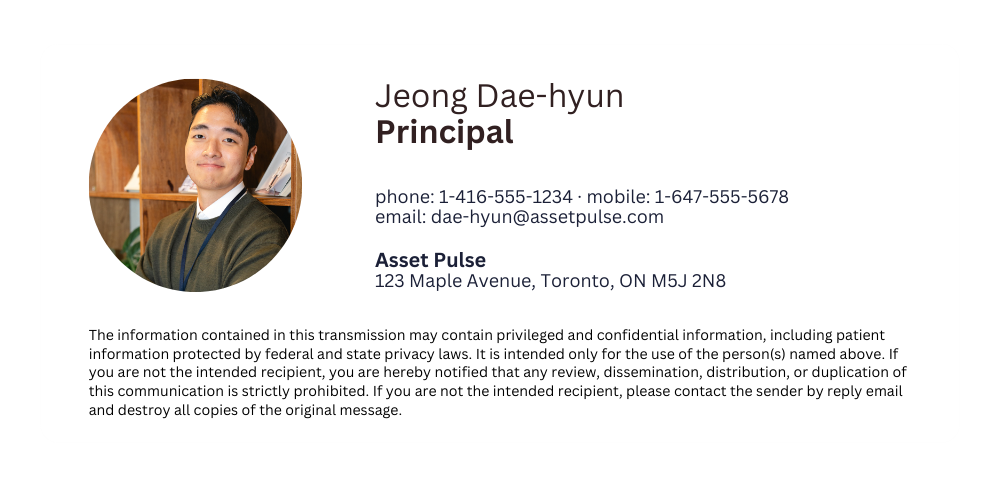
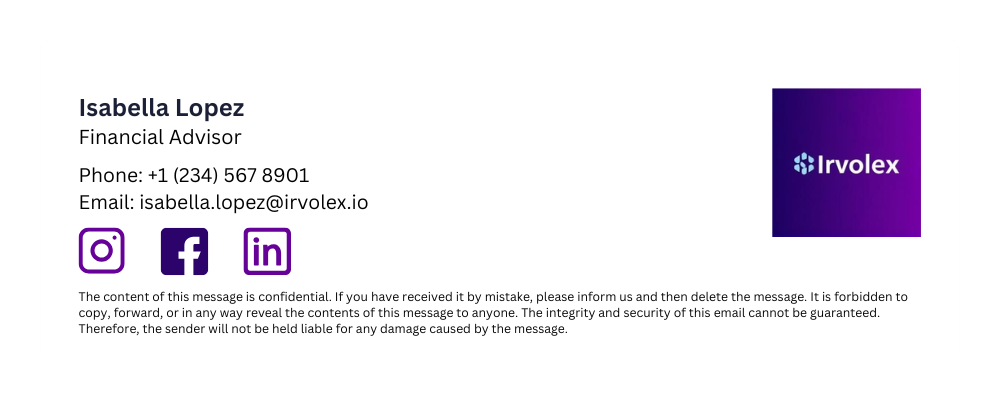 Clients and partners notice how a firm presents itself. An email signature that's precise and consistent, showing the correct name, title, licenses, and contact information, reads as a firm that gets the details right. One that renders differently from one colleague to the next, or drops the branding on a phone, suggests the opposite.
The email signature also carries regulatory weight a normal corporate footer doesn't. It's often where required disclosures and legal disclaimers sit, and that obligation applies to every email a firm actually sends, not just the policy that says it should. When the wording is inconsistent or absent, the firm loses a simple, repeatable way to show it applied the right disclosure at the time it mattered.
Operationally, the strain lands on IT. Manual email signature management doesn't scale across branches, regions, and constant role changes, so keeping every signature current turns into a steady stream of edits and tickets. A well-governed email signature works on all these fronts at once: one controlled footer protects client trust and keeps the required disclosure in place, while IT is freed from fixing signatures by hand.
The email signature challenges facing financial services firms
A manual approach to email signatures holds together at a small firm. Across branches, regions, and legal structures, it starts to come apart.
The reason is almost always the same: signatures built and maintained by hand, one person at a time. In a regulated firm, that produces a familiar set of problems.
Disclaimers missing from trade confirmations, statements, and audit responses: These are the messages a disclosure can least afford to miss, yet a manual signature leaves it to the sender.
Credentials that go stale after staff changes: Titles, licenses, and registrations shift as people are promoted or move between entities, and manual updates rarely keep pace, so outdated details linger.
Branding that drifts across desks, regions, and devices: When employees build their own signatures, fonts and logos fall out of alignment, and a layout that looks right on a desktop often breaks on a phone.
Slow disclosure updates by entity or jurisdiction: When a disclaimer has to change for one regulated entity or region, applying it by hand across the right people is slow, and the wrong wording stays live in the meantime.
Compliance and marketing waiting on IT: Every change to legal text or branding routes through IT, so the teams that own the content can't apply it themselves, and the requests pile up.
No audit trail: Locally edited signatures leave no record of what changed or when, so the firm can't easily show which disclosure was live during a given period.
Any one of these is manageable on its own. Stack them across every mailbox and regulated entity a firm runs, and there's no reliable answer to a simple question: what's actually on the email we send?
What are the compliance requirements for financial services email signatures?
In financial services, email is a supervised business record, and the disclosures a firm is expected to apply live partly in the email signature. That's what turns signature consistency into a compliance question rather than a cosmetic one.
Tip
A managed email signature supports compliance; it doesn't deliver it. Consistent disclosures help a firm show control, but they sit alongside the archiving, supervision, and access controls each organization actually requires.
FINRA and SEC (U.S.)
In the United States, the Financial Industry Regulatory Authority (FINRA) and the Securities and Exchange Commission (SEC) treat business email as regulated communication they must supervise and retain. FINRA Rule 2210 sets the standard that communications with the public be fair, balanced, and not misleading, and a consistent disclaimer keeps that required language on the messages that carry it.
SEC Rule 17a-4 governs how broker-dealers preserve electronic records, including communications, so it's about how the archiving system retains what was sent, not what a signature puts on an email.
Recordkeeping remains a live examination priority, even though the enforcer has shifted: the SEC's own headline sweep on off-channel communications wound down after early 2025, around the same time as the SEC's $45 million settlement with two Robinhood broker-dealers, which covered off-channel communications failures alongside several unrelated charges. FINRA has picked up where the sweep left off.
Its 2026 Annual Regulatory Oversight Report keeps books-and-records and off-channel communications on its 2026 examination priorities, and specifically flags retention of GenAI chatbot interactions with customers as a new area of focus. A managed email signature helps keep the right disclosure consistently present in the messages that then get archived, whichever regulator is asking.
GLBA (U.S.)
The Gramm-Leach-Bliley Act (GLBA) requires financial institutions to safeguard customer data and be transparent about its use. An email signature can carry a privacy or confidentiality notice that supports that transparency, though the notice is a communication rather than a safeguard, working alongside the encryption, access controls, and data-handling practices the GLBA Safeguards Rule expects.
FCA (UK)
For firms operating in the United Kingdom, the Financial Conduct Authority (FCA) requires client communications to be fair, clear, and not misleading. Under COBS 4, the FCA Handbook's rules on communicating with clients, that standard applies across every channel, email included. A firm with entities in more than one jurisdiction has to reflect different disclosure wording in each, which is hard to hold together when signatures are built by hand.
Regulation-to-signature mapping
Regulation | What it requires | What a managed email signature supports | What it can't replace |
FINRA Rule 2210 (U.S.) | Fair, balanced, and not-misleading communications with the public | Consistent required disclaimers on the messages that need them | Supervision procedures and communication review |
SEC Rule 17a-4 (U.S.) | Preservation of electronic communications by broker-dealers | Consistent disclosure content in the emails that get archived | The recordkeeping and archiving system itself |
GLBA (U.S.) | Safeguarding of customer financial data | A privacy or confidentiality notice on outbound email | Encryption, access controls, and data-handling safeguards |
FCA COBS 4 (UK) | Client communications that are fair, clear, and not misleading | Standardized disclosure wording by entity and region | The firm's own review and approval of client communications |
The exact disclaimer wording varies by regulator and entity; our U.S. email disclaimers guide covers the laws, examples, and best practices.
What to include in a financial services email signature
A financial services email signature has to identify the sender accurately and carry the disclosures the firm's obligations call for. What counts as correct depends on the entity, the role, and the jurisdiction.
Most firms want every email signature to share a consistent core, then adjust the elements that genuinely differ from one person to the next. The core should look the same whether a message comes from a branch advisor or a head-office executive.
The consistent core:
Sender identity: Full name, job title, and the legal entity the person represents, not only the parent brand.
Contact information: Direct line and office location, so recipients can confirm who they're dealing with.
Approved branding: The correct logo, colors, and layout, rendering the same way on desktop, mobile, and web.
The required disclaimer: The confidentiality, privacy, or regulatory notice the message calls for.
What varies by role and entity:
Credentials and licenses: A registered representative, a mortgage advisor, and an operations manager hold different qualifications, and the signature should show only the ones that apply to that person.
Entity and branch disclosures: A firm running several regulated entities needs the disclosure that matches the sending entity, so a single generic footer won't do.
Jurisdictional wording: A US broker-dealer and a UK entity under the FCA need different notices, and the signature must reflect where the sender sits.
One practical point matters more in finance than in most sectors: keep the disclaimer as selectable text rather than baking it into an image. Live text renders reliably across devices, stays accessible to every recipient, and is captured as text wherever the email is archived. The same wording locked inside a graphic gives up each of those advantages.
Why manual email signature management doesn't work at financial services scale
Most firms already know their signatures are inconsistent. What they underestimate is how much manual effort it takes to keep them even close to right, and how quickly that effort loses ground as the firm grows.
 In Exclaimer's State of Business Email 2025 research, which surveyed 4,009 IT professionals, 80% of organizations still rely on manual methods or user self-service for email signatures, and only 18% manage them centrally. More than a third of IT teams name signature management one of their two most time-consuming tasks. In a regulated firm, much of that time goes on chasing a consistency that a manual process can't quite hold.
Firms generally try three ways to manage signatures without dedicated software, and each hits a wall in a financial services environment.
Letting employees manage their own: the most common approach, and the least controllable. Disclaimers get pasted inconsistently, branding drifts, and there's no way to enforce or prove what's on outbound email.
Deploying signatures by script: more control, but brittle. Scripts break with platform changes, need ongoing maintenance, and rarely handle per-entity or per-jurisdiction logic without becoming a project in themselves.
Built-in mail platform tools: Microsoft 365 and Google Workspace can append a disclaimer at the server, but they were designed for straightforward, org-wide disclaimers, not for the entity, role, and jurisdiction rules a financial services firm needs.
That third option is where many firms start, so it's worth being specific about where native tools stop and dedicated management begins.
Capability | Built-in mail platform tools | Exclaimer's cloud solution |
Disclaimer application | Basic org-wide or group-level append | Rules by entity, region, department, or role |
User details in signatures | Directory tokens supported, but lines with missing data are skipped | Accurate details synced from the directory |
Consistency across devices | Varies, and can break on mobile and web | Consistent rendering across desktop, mobile, and web |
Delegation | Admin access, largely all-or-nothing | Role-based access for legal and marketing without full IT control |
Native tools are fine for a single generic footer. They struggle the moment a firm needs different disclosures per entity, accurate credentials per person, or a record of what changed and when. Closing that gap is what centralized email signature management does.
How centralized management solves it for financial services
Centralized management flips the model. Instead of every employee assembling their own signature, IT defines the rules once, and every message follows them automatically.
In Exclaimer's State of Business Email 2025 research, 94% of IT leaders said they felt confident in their compliance posture, yet only 47% felt very confident. That gap, between feeling covered and knowing it, is what centralized management closes. Here's how that works in a financial services setting.
Control by entity and region. Signatures are governed from one place using Signature Rules that apply the correct branding, credentials, and disclaimer by legal entity, region, department, or role. A firm running several regulated entities can give each the disclosure it needs, without maintaining a separate manual process.
Automated disclaimers. Required notices are applied by rule, not by memory, so the right disclaimer lands on the right message every time. When wording has to change for a regulation or a jurisdiction, IT updates it centrally and the change reaches every affected user at once.
Directory sync. Signatures pull names, titles, and contact details from Microsoft Entra ID or Google Workspace Directory, so they stay accurate as people join, move, or change roles.
Safe delegation. Role-based access lets compliance handle the disclaimer wording and marketing handle the branding, while IT keeps oversight of the platform. Each team updates its own content without raising a ticket, and without reaching anything it shouldn't.
"This creates a critical blind spot at the point where communication exits the organization, affecting compliance, brand integrity, and customer trust. Without centralized governance, businesses have limited control over how disclaimers are applied, how regulatory requirements are met, or how consistently the organisation is represented across every interaction."

Access logging and locked enforcement. Exclaimer's audit log records who signed in to the platform and when, available to Owners and Auditors, and server-side enforcement means an applied signature can't be altered, removed, or duplicated down a reply chain by the user. Firms can show that platform access stayed with authorized people and that the signature reaching each message was approved.
Aprio shows what this looks like at scale. The professional services firm, which spans audit, tax, advisory, and wealth services, manages nearly 4,000 email signatures with Exclaimer, with room to tailor them across a varied workforce. Vancity, a Canadian credit union, shows the same discipline under a different regulator: it answers to its own provincial framework rather than FINRA, the SEC, or the FCA, but the operational problem is the same shape, and Vancity unified email signatures across 2,600 users with 100% adoption, one of the customer stories Exclaimer has published across regulated and multi-entity organizations.
The specific regulator and the specific disclosure requirements may change by entity type and jurisdiction, but the governance problem, and the fix, doesn't. Holding that many signatures consistent and current, without hand-editing a single one, is the practical payoff of managing them centrally.
What to look for in email signature software for financial services
Most email signature tools can put a logo and a disclaimer on an email. The ones built for financial services apply it consistently across entities and jurisdictions, and record every change.
 If you're evaluating options, these are the criteria that separate a tool suited to a regulated, multi-entity firm from one that only looks the part.
Deployment that fits your stack. Support for Microsoft 365, Google Workspace, and Exchange, including hybrid setups, with server-side application so the signature appears correctly whether the sender is on a desktop, a phone, or webmail.
Directory sync. The tool should pull user details from your directory automatically, so signatures stay accurate as people join, move, or change roles.
Rule granularity. The ability to apply different branding, credentials, and disclaimers by legal entity, region, department, or role. A multi-entity financial services firm leans on this most, and it's the capability native tools handle worst.
Locked, server-side disclaimers. Required notices should apply at the server and stay locked, so no individual user can alter or delete them. They should also apply once per message rather than stacking on every reply in a thread, so the right wording reaches every message exactly once.
Access logging and delegation. A downloadable record of who accessed the platform and when, so you can evidence controlled access during a review, plus role-based access that lets legal and marketing update content without full administrative rights.
How the vendor handles your data. A signature tool syncs your directory and processes your outbound mail, so the vendor's own security and reliability matter as much as its features. Look for independent certifications and a proven track record at scale.
The last point is easy to overlook and expensive to get wrong. Exclaimer's cloud solution holds ISO 27001, ISO 27018, and SOC 2 Type II certifications, and the company has managed email signatures for more than 20 years, now for 80,000+ organizations worldwide. For a financial services buyer deciding who should handle its directory data and outbound branding, independent assurance and a long track record are worth as much as any feature.
Book a demo to see how Exclaimer applies the right signature, disclaimer, and branding across every entity, device, and jurisdiction, from one place.