Elisabeth leads Exclaimer’s global brand narrative, thought leadership, and research-led storytelling. With over 15 years’ experience in PR and B2B technology marketing, she is known for turning complex ideas into clear, compelling communications that resonate with global audiences.
The EU AI Act confirms what UK consumers already suspected about AI in email, new Exclaimer research discovers
An email lands that looks perfectly polished, and something about it still doesn't sit right. Nearly half of UK adults (46%) say they've questioned whether a message they received was genuine or legitimate, months before any regulation told them to look twice. Article 50 of the EU AI Act, coming into force on August 2, 2026, requires businesses to disclose when a customer is talking to a chatbot rather than a person. This conversational AI rule doesn't extend to email.
The Act sits alongside other EU disclosure requirements already shaping business email, and new research from Exclaimer suggests the instinct behind it, wanting to know who's actually on the other end, existed well before regulation caught up with it.
This is based on a nationally representative online survey of 1,000 UK adults, conducted by OnePoll between May 26 and June 2, 2026, as part of a wider 2,000-person study across the UK and US. Figures are rounded to the nearest whole number.
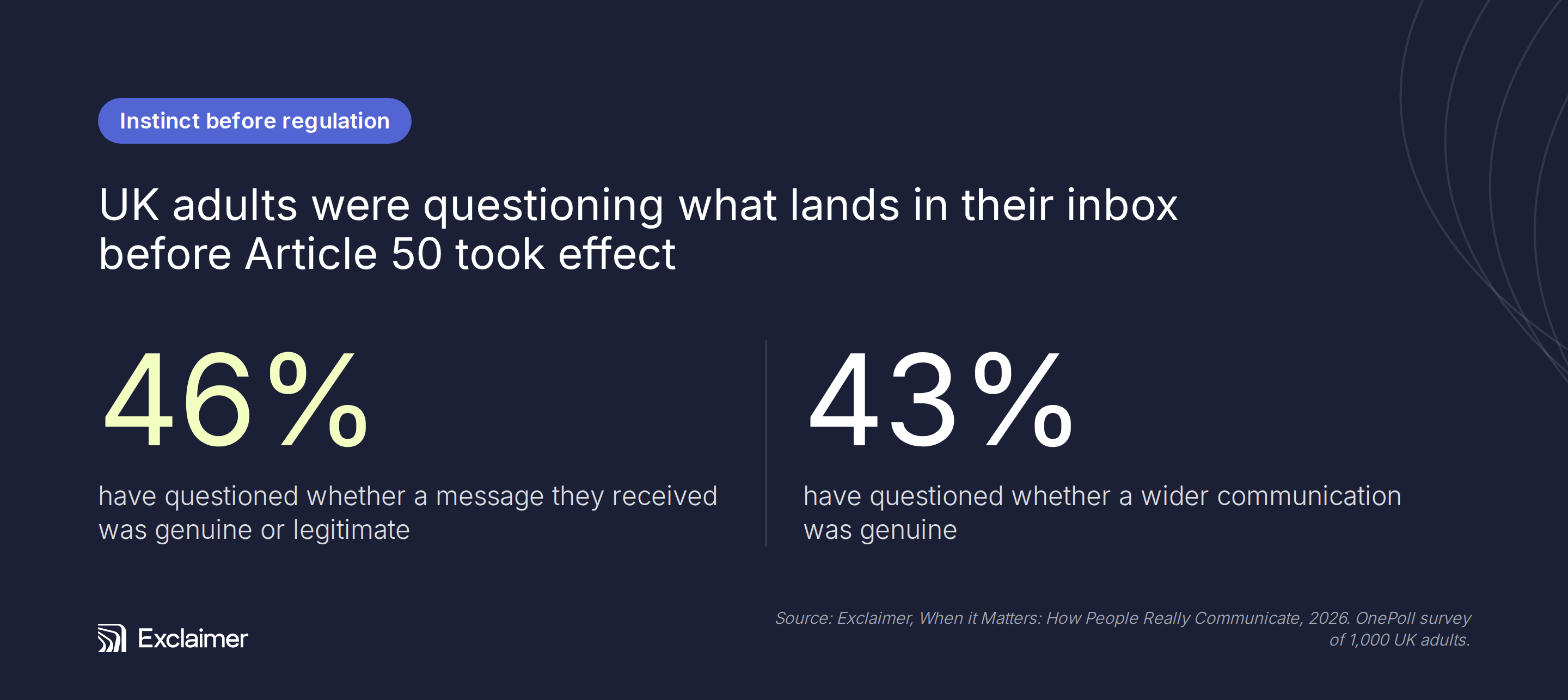
How many UK adults already question what lands in their inbox?
For 43% of UK adults, the doubt goes beyond a single message. They've questioned the genuineness of a wider communication altogether, and they'd formed that view before Article 50 required any business to disclose its use of AI at all.
Ed Bodey, General Counsel at Exclaimer, points to this as the real story behind the regulation:
"While the EU AI Act will require businesses to disclose AI system usage in customer conversations, our research shows that people are already questioning the authenticity of messages. Regulation is simply catching up with instinct. Nearly half of UK adults already question what lands in their inbox, and people are conscious of the giveaways in emails, whether it's a correct company domain or a strong signature. Businesses must continue to prioritize trust in communications regardless of changes in regulation, because even the smallest detail can make or break a customer relationship."
Ed's point about giveaways, a correct domain, and a strong signature is what threads the rest of this research: what those signals actually are, and how age shapes people's relationship with AI in the first place. Separate UK-specific rules around what has to appear in business email cover the legal minimum. This research is about something people expect well beyond it.
How is AI reshaping the way UK adults communicate?
Half of UK adults, 50%, now use AI somewhere in their communications. Most of that is straightforward: 22% use it to fix grammar and spelling, and another 22% to sound more professional.
For a smaller group, AI is doing something the writing itself won't show:
11% use it to sound more confident
13% use it to soften a difficult message
7% use it to avoid an awkward conversation altogether
That kind of use doesn't leave a trace in the writing, since fluency alone doesn't tell a reader anything about who's actually behind a message. It's a pattern Exclaimer's earlier research into AI and email sentiment picked up on too, well before it showed up this clearly in the data.
Why does AI use and distrust split so sharply by age?
AI use falls off sharply with age. Just 26% of UK adults 65 and over use it anywhere in their communications, compared with 76% of 25-to-34-year-olds. Distrust runs the other way: 51% of the 65-plus group have questioned whether a message was genuine, against 31% of 18-to-24-year-olds.
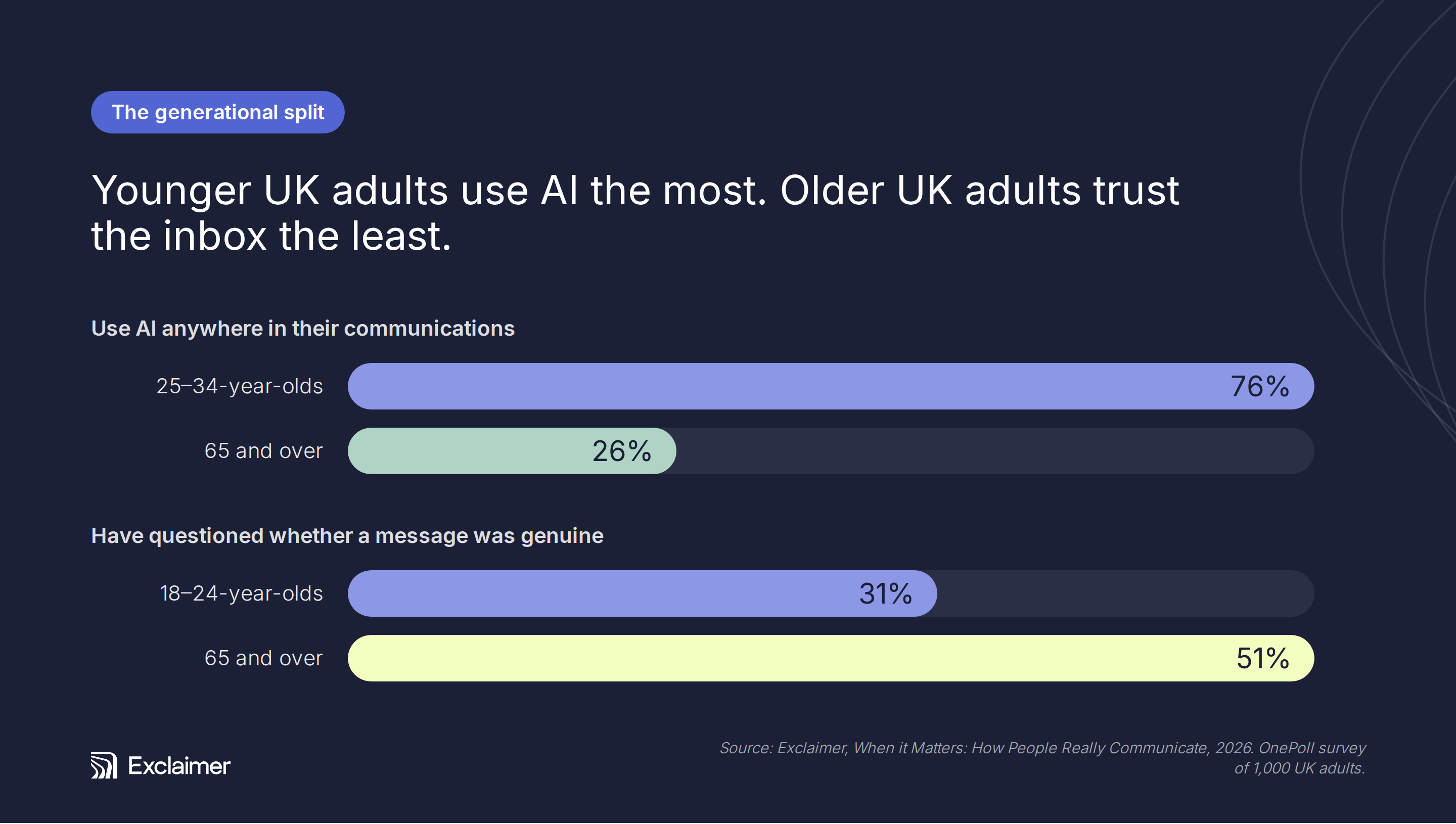
The split is sharpest on the more deliberate uses of AI. Almost a quarter of Gen Z, 24%, use it to soften a difficult message, and 16% to avoid an awkward conversation altogether. Among Boomers, that's 4% and 2%.
Two things are true at once here: younger UK adults are the ones shaping their tone with AI, and older UK adults are the ones most likely to say they don't trust what they're reading. The research doesn't say those two facts are connected, only that they're both true of the same population at the same time.
Why does the platform matter as much as the disclosure?
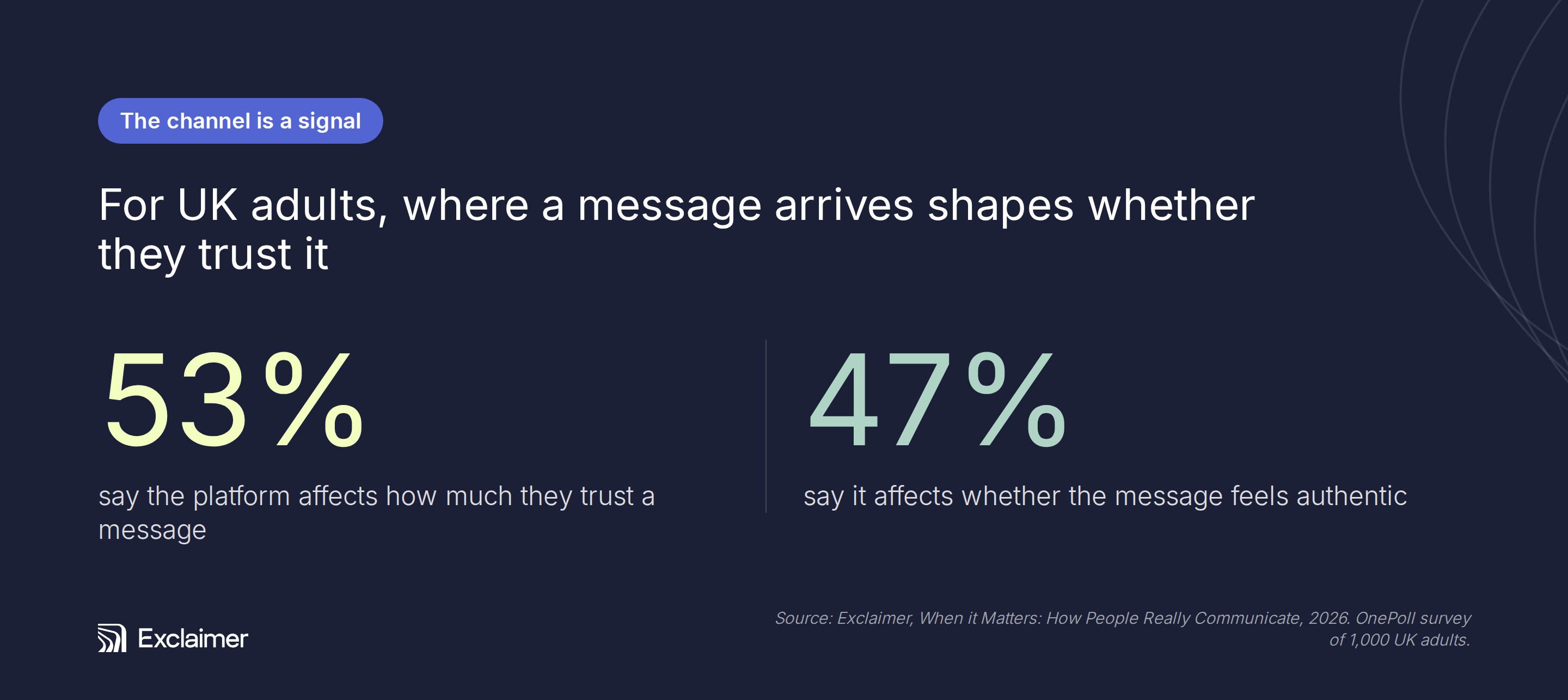
A joke to a friend goes to WhatsApp. A last-minute change of plan goes to a phone call. Neither goes anywhere near an inbox: UK adults send last-minute plans by phone (33%) or WhatsApp (28%), and casual news by WhatsApp (36%) or a social media DM (13%). More than half of UK adults, 53%, say the platform a message arrives on affects how much they trust it, and 47% say it affects whether the message feels authentic at all. The channel itself is a signal, before a single word of the message gets read.
Fifty-four percent of UK adults have kept a message specifically so they could refer back to it later, and more than four in ten, 44%, have deliberately chosen email over another platform to create a permanent record. Email is also the preferred channel for a formal complaint (69%), an update from an employer on benefits or policy (58%), and a job application or work opportunity (44%). Even healthcare information tips toward email over a phone call, 32% to 20%.
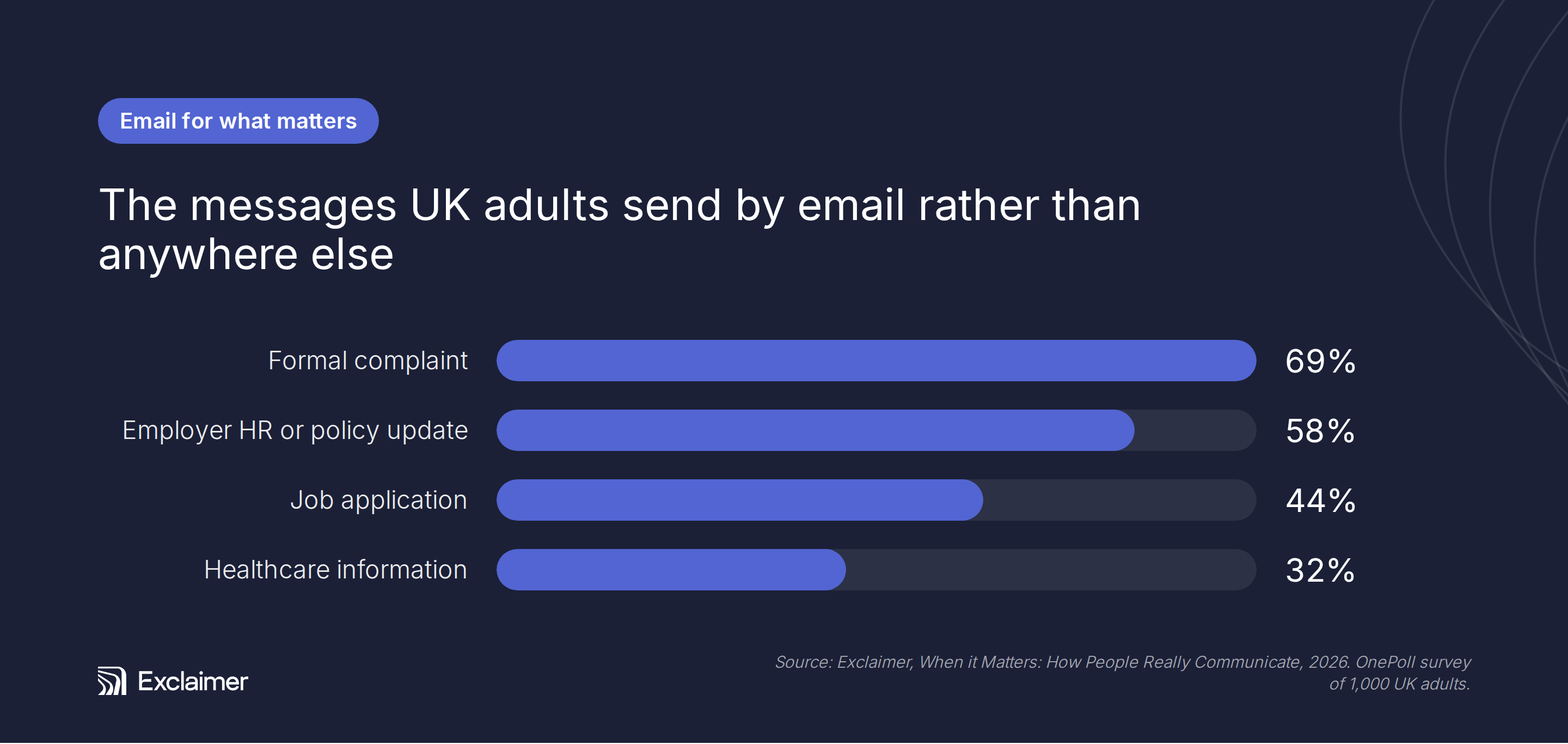
People are already sorting their communications by how much each one needs to be trusted, reaching for email specifically when the stakes are highest. That's a pattern regulation didn't create and won't touch, and it's why the platform itself does real trust work long before any disclosure requirement does.
Exclaimer's UK Business Email Report 2025 found the same pressure showing up from the other side of the inbox, in how UK organizations manage what goes out.
What do UK consumers look for to trust a business email?
This is what Ed's "giveaways" actually look like in the data. Full contact details matter to 51% of UK adults, and a professional company email address to a near-identical 53%. A third look for a clear sender name.
None of these signals require reading a word of the message itself. A recipient can register all three before they've processed a single sentence, which is exactly the point: when anyone can generate the sentence, the sender still has to prove who they are some other way.
The full When it Matters: How People Really Communicate study covers more than what's in this piece: how trust and AI use vary across every generation, what people do with messages they can't afford to lose, and how UK and US habits compare. Read the full report.