Naimh is a seasoned marketer of 12 years, including in SaaS and tech. She’s an expert at simplifying complex technology concepts, bridging the gap between IT and marketing. Naimh specializes in turning tech speak into actionable insights, helping marketers get the most out of their tools and technology.
How to protect brand identity through a rebrand or M&A

Key takeaway
Agree who decides what, by when, and who has final sign-off, and lock brand strategy and positioning before creative work starts.
Brief employees before the public launch and tell them what the change means for their own work. People who don’t understand the new brand fall back on the old one.
Update email signatures from one platform so emails carry the new brand from go-live day. Teams often leave them until late, even though they touch every outbound email.
Exclaimer, which makes email signature management software for Microsoft 365 and Google Workspace, rebranded in 2023 to appeal to a new audience. About a year later, it was clear the rebrand hadn’t worked, and the brand had to course-correct. It was a partial reversal that went back to some of what came before. In 2024, the company went through what it deliberately called a brand refresh, to signal evolution.
Elisabeth Goossens, Exclaimer’s Director of Brand Communications, has led brand communications through two Exclaimer rebrands. Her view is that rebuilding trust after a course correction is slower than building the brand in the first place.
James Wayne, Exclaimer’s Senior Product Marketing Manager, hosted a webinar on rebrands and mergers and acquisitions (M&A), titled Rebranding and M&A: Managing Brand Identity Through Change. His other guest was Kate Rhodes, a marketing consultant. Kate was acquired by a parent company, then helped integrate several more acquisitions before leading a global rebrand across 23 office locations herself.
Elisabeth led brand change from inside Exclaimer. Kate went through it from the other side, as part of the company being acquired.
In a thought exercise, James described a 500-person organization sending roughly 50 emails per employee a day. That generates around 25,000 brand impressions daily from email alone. Elisabeth adds that email is frequently one of the last touchpoints to get updated.
What should happen to the brand in a merger or rebrand?
Decisions about a brand’s future tend to get made faster than they should. They’re often made by people several steps removed from what the brand is worth in the market and from the employees who have to live with the change.
What are the options when two brands come together?
Run both brands in parallel
Retire the acquired brand into the parent
Use the moment to build something new
No option is the universal right answer, and each has trade-offs.
What should drive the decision?
A planned rebrand should start with a reason rooted in strategy and never be done on a whim, Elisabeth said. She’s heard the idea that a new chief marketing officer (CMO) will want to rebrand the moment they arrive. A reason rooted in strategy isn’t always the right one, though, and you don’t find that out right away. The decision needs to rest on research into who and where your customers actually are.
Moving too fast risks retiring brand equity before the new direction is validated. A transition that drags on brings its own problem. People inside and outside the business stop being sure what the brand stands for, which means mixed signals externally and low confidence internally.
What does it look like from inside an acquisition?
As Kate understood it, brand decisions at her company were made between chief executive officers (CEOs), and in most cases, marketers weren’t in the room. By the time of the global rebrand, 10 agencies across 23 office locations had come together. She didn’t think any of those agencies had a CMO, so much of it reached the marketing team already decided, and they had to run with it.
For the most part, those decisions held up, thanks to a strong marketing team and a lot of collaboration, Kate said. With hindsight, she’d probably have done some things differently, but the calls weren’t hers to make. She thinks the people making them acted with the best intentions and the knowledge they had.
In Kate’s view, a company buying 10 businesses should have a brand strategy for the next five years.
What do people get wrong about a rebrand before it even starts?
The biggest misunderstanding about rebrands is that they’re mostly a visual exercise. Logos, colors, and fonts come from a much deeper process, and if that process gets rushed or skipped, the new look won’t hold. It's like an iceberg, with the visual identity above the waterline and far more sitting below it.
Most stakeholders outside the brand team underestimate how much lead time a proper rollout needs across every touchpoint, team, and market. You should also put internal alignment ahead of the external launch. If employees don’t understand the new brand or why it exists, the rollout is inconsistent from day one.
Many touchpoints don’t get picked up until after go-live. Email signatures are a classic example, often left until late in the process even though they affect every outbound email the business sends.
Why do employees default back to the old brand, and what actually stops it?
Employees who don’t understand a new brand fall back on what they know. That happened at Exclaimer. When the company launched new branding, some people on the team didn’t truly understand it, and mixed messages went out externally.
What does it feel like to be acquired?
Kate found out about her own company’s acquisition earlier than most, because she sat on the senior team. She’d spent six and a half years growing that brand. There wasn’t much space to process it before she was told to connect with her counterparts in Belgium and get on with it. The touchpoints still needed updating, even though a full rebrand hadn’t happened yet.
Being acquired was emotional, Kate said, and she compared it to a grieving process. People forget there’s emotion at the heart of a brand, and that everyone in the business cares about it, inside or outside. That’s part of what makes brands powerful.
How should you treat employees through the change?
False promises and top-down comms that dress the change up as perfect for everyone don’t help. Kate also takes issue with companies that talk about being a family. She describes that as close to gaslighting employees into thinking every decision puts them at the center, when businesses don’t work that way. Her advice is to acknowledge how people feel and give them space to say so, and to treat them like adults. Small chances to give feedback help, even if you don’t take it all on board.
Brand also means something different from one culture to another. On a global change, it pays to sit down and empathize both ways across the business.
What should happen before the public launch?
Elisabeth says employee buy-in has to be built before the public launch.
Internal previews and briefings, so employees feel trusted with something before it goes public
Clear, practical guidance on what the change means for each person’s day-to-day work
A way to ask questions without feeling they’re pushing back on a decision already made
Brand guidelines and assets that are easy to find and use, because friction in adoption leads to inconsistency
Senior leaders who commit visibly to the new brand and keep showing it in how they work after the announcement
What’s the biggest operational blind spot in a rebrand or acquisition, and how do you actually close it?
What goes wrong with email during a rebrand?
Every employee who sends an email with old branding or an incorrect entity name creates an inconsistency that’s visible to anyone the company works with. Updating the template centrally isn’t enough if the way the update reaches everyone falls short. People hold on to old branding for days or weeks after go-live.
How does centralized email signature management help?
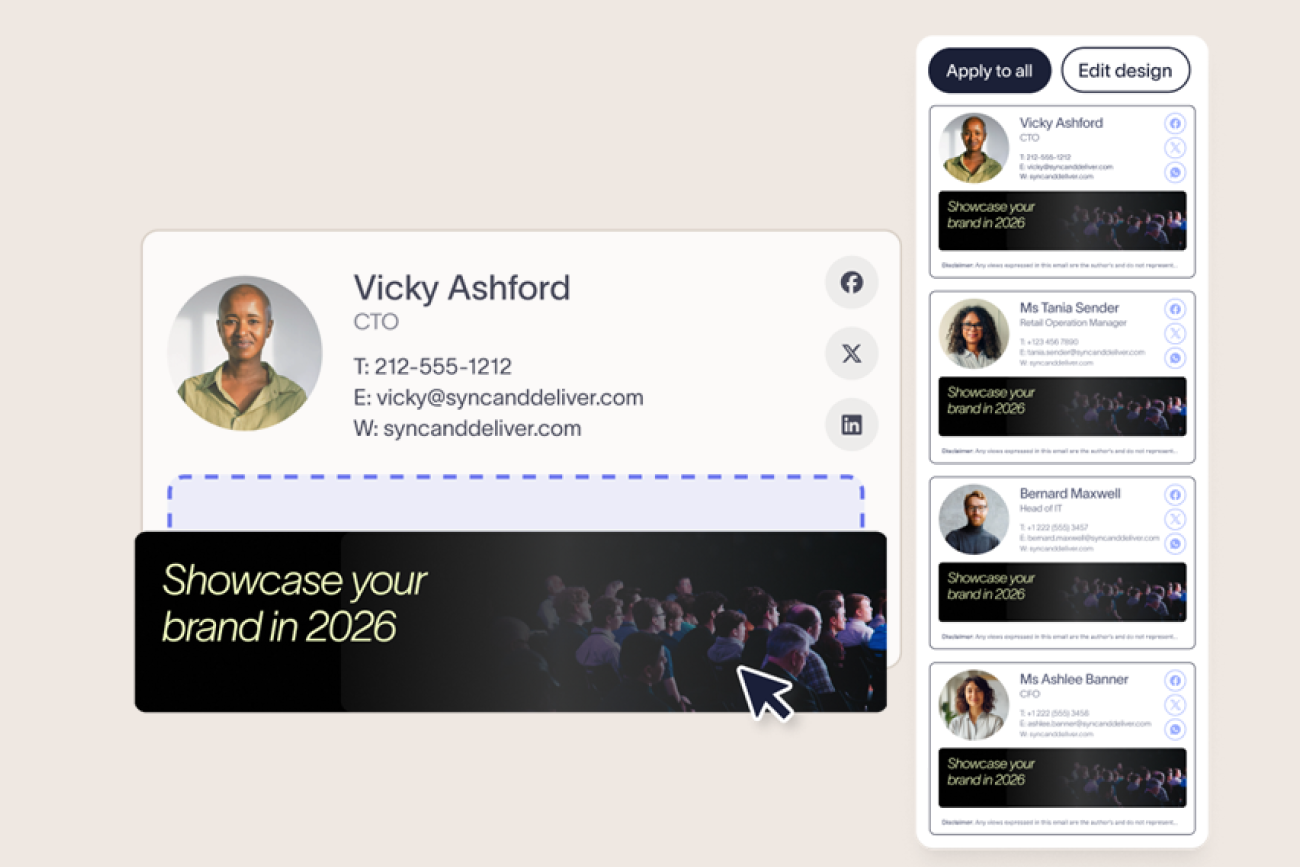
With centralized email signature management, she says, a single update reaches every user, device, and email client, so no one depends on employees switching it themselves. Go-live day should feel like nothing, because good tooling is invisible. She compares it to plumbing. Nobody thinks about it until it breaks, and once it does, the problem doesn’t stay contained.
After Bloomerang acquired Qgiv, its VP of Customer Marketing described updates that used to take weeks now taking 15 minutes.
Bloomerang results
98% reduction in update time and 100% brand consistency, per Exclaimer’s published case study.
Less than 20% of organizations use a dedicated email signature management solution, according to Exclaimer’s 2025 State of Business Email research, a Censuswide survey of 4,009 IT professionals in the UK, US, Germany, and Australia. The rest rely on patchwork processes, and IT-built scripts are the most common method at 34%.
How should marketing and IT work together?
The partnership between marketing and IT most often breaks down through siloed working, with no shared view of what’s happening. Each team assumes the other has something covered. Marketing updates the assets while IT manages the systems, and a shared project timeline and regular catch-ups keep the two in step.
When email signature management sits in one platform both teams can access, marketing controls design and content while IT controls deployment and permissions. The governance lives in the system. Exclaimer’s role-based access controls work this way.
Operations teams like IT, finance, and legal should be your best friends from day one, because you’ll rely on each other. She built that with her IT team early, and she calls it invaluable during the integration.
What about the touchpoints nobody can see?
The hardest gaps to close are the ones you can’t see. Marketers know where the official brand lives. The hidden material is harder, like a proposal template a colleague has squirreled away somewhere you can’t update it. It might come back out of the woodwork one day. Since you don’t know where that logo has ended up, you need people to be honest, uncover it, and update from a central system.
At Kate’s company, not every acquired business had an IT team or a marketing team, so the people who did exist had to find that material and update it on their behalf.
Does the work end at go-live?
Organizations that come through a brand transition with the brand intact treat governance as part of the plan, built into the process and maintained after go-live day. James added that Exclaimer has seen customers still using outdated branding years after events like these.
Where does brand risk turn into legal risk?
What do UK and US rules require?
In the UK, the Companies Act 2006 and the trading disclosure regulations made under it require companies to display their correct registered name on business correspondence, email included. If a company changes its registered name in a rebrand or acquisition and employees keep sending emails under the old one, that’s technically a breach.
In the U.S., the Financial Industry Regulatory Authority (FINRA) requires its member firms to prominently disclose their name in retail communications and correspondence, including electronic ones, under FINRA Rule 2210.
What does inconsistency do to trust?
Consistent branding earns trust, which builds slowly and can erode quickly. Every email that goes out with old branding or an incorrect name chips away at it. Customers watch more closely during a transition, so inconsistency lands harder than it would at any other time. The damage can be quiet. A client notices an old logo and wonders whether the transition is under control. That kind of doubt is hard to measure and hard to recover from.
How did reputation suffer at Kate’s company?
Reputation came under pressure in two places at Kate’s company, even though her legal and compliance teams were strong and she had no concerns on that front. With 10 legal entities, a client might be asked to use the new brand name while the invoice still carried the old one. That pulled in procurement, legal, and finance, and it made the brand feel less important, because a legal entity matters more than a brand name when you’re dealing with the law.
Kate’s relationships with journalists came under strain too. She’d spent a decade earning their trust through the stories she shared. Once they stopped understanding what the new brand stood for, that relationship started to break down and PR got harder. She calls it a touchpoint marketers overlook, and she wishes she’d managed it more cleanly.
When should brand decision-making start?
As early as possible, though in practice brand decisions are often an afterthought. Brand strategy and positioning need to lock down before creative work starts. Too often the two run in parallel, and the visual identity ends up built on shifting foundations.
Who should own the brand decision in a rebrand or acquisition?
Ownership has to be genuinely cross-functional.
Function | What it owns |
|---|---|
Marketing | Brand strategy |
Legal | Legal implications |
IT | Technical rollout |
Treating any one function as the sole owner is a mistake. The team needs a framework agreed up front that covers who decides what, by when, and who has final sign-off. That helps prevent the delays and reversals that derail most transitions.
In an ideal scenario, a CMO is aligned with the chief financial officer (CFO) and the CEO. Kate said she’s seeing fewer and fewer CMOs in organizations, though, so most people don’t have that luxury. Someone still needs a voice in the room, and she suggests the most senior marketer find an ally to vouch for them.
Without an ally, marketers can still do the groundwork at whatever level their team sits. They can think about the equity they’re bringing into the merger or acquisition, and how to communicate it to stakeholders who carry more weight or sit in more rooms than they do.
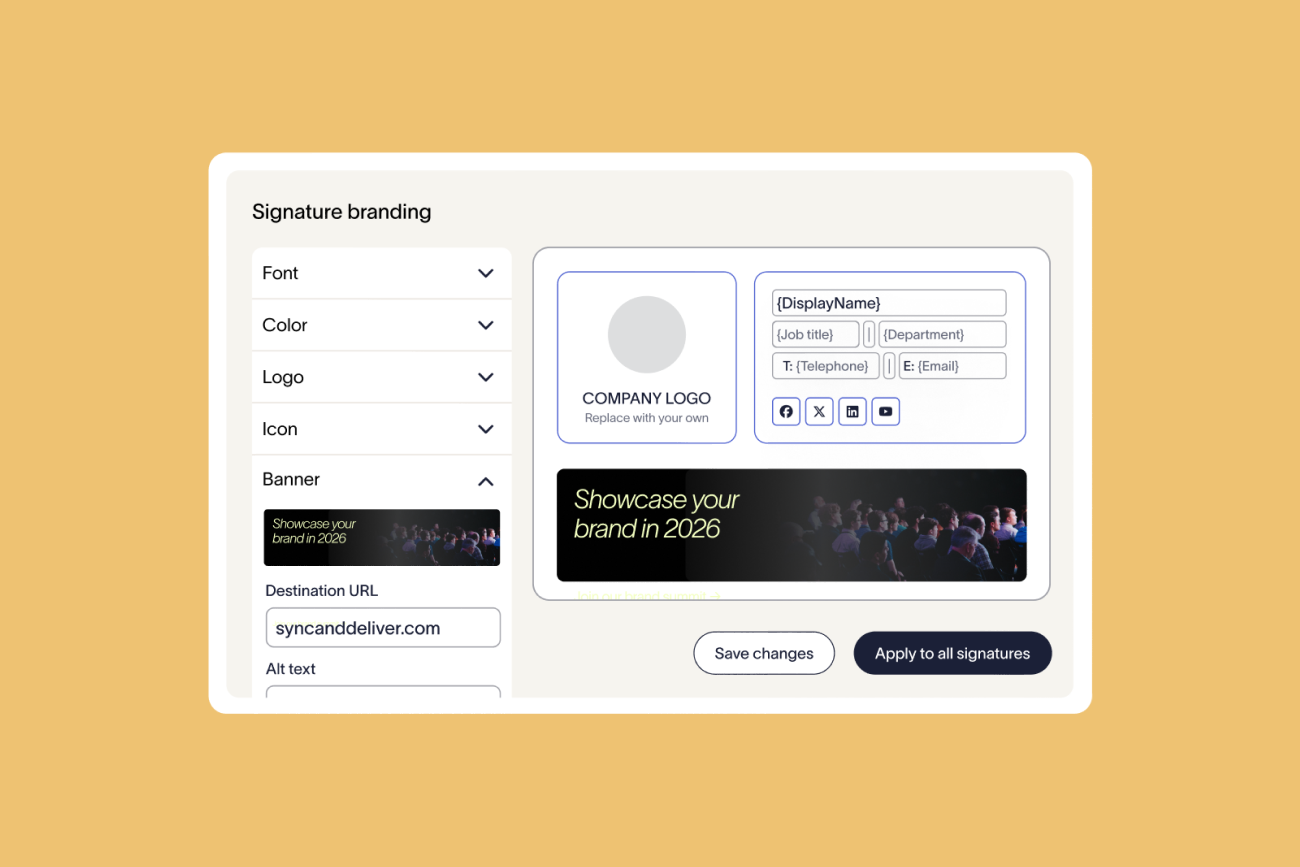
Once the brand decision is made, the new logos, fonts, and colors still have to reach every email signature. Exclaimer’s Brand Kits are built for that, especially for organizations going through rebrands, growth, or M&A. A Brand Kit stores approved logos, fonts, colors, banners, and disclaimers in one place, and updates apply automatically to every email signature the kit is linked to.
Elisabeth, Kate, and James go further on all of this in the full session, which you can watch on demand.