Dave is a marketing expert with 15 years experience in the tech and SaaS world. He specializes in educating IT and channel audiences, with a focus on security, privacy, compliance, and marketing technology. With a talent for storytelling and a deep understanding of the industry, Dave transforms complex IT topics into clear, engaging, and impactful narratives.
The risks of poor email signature management in law firms
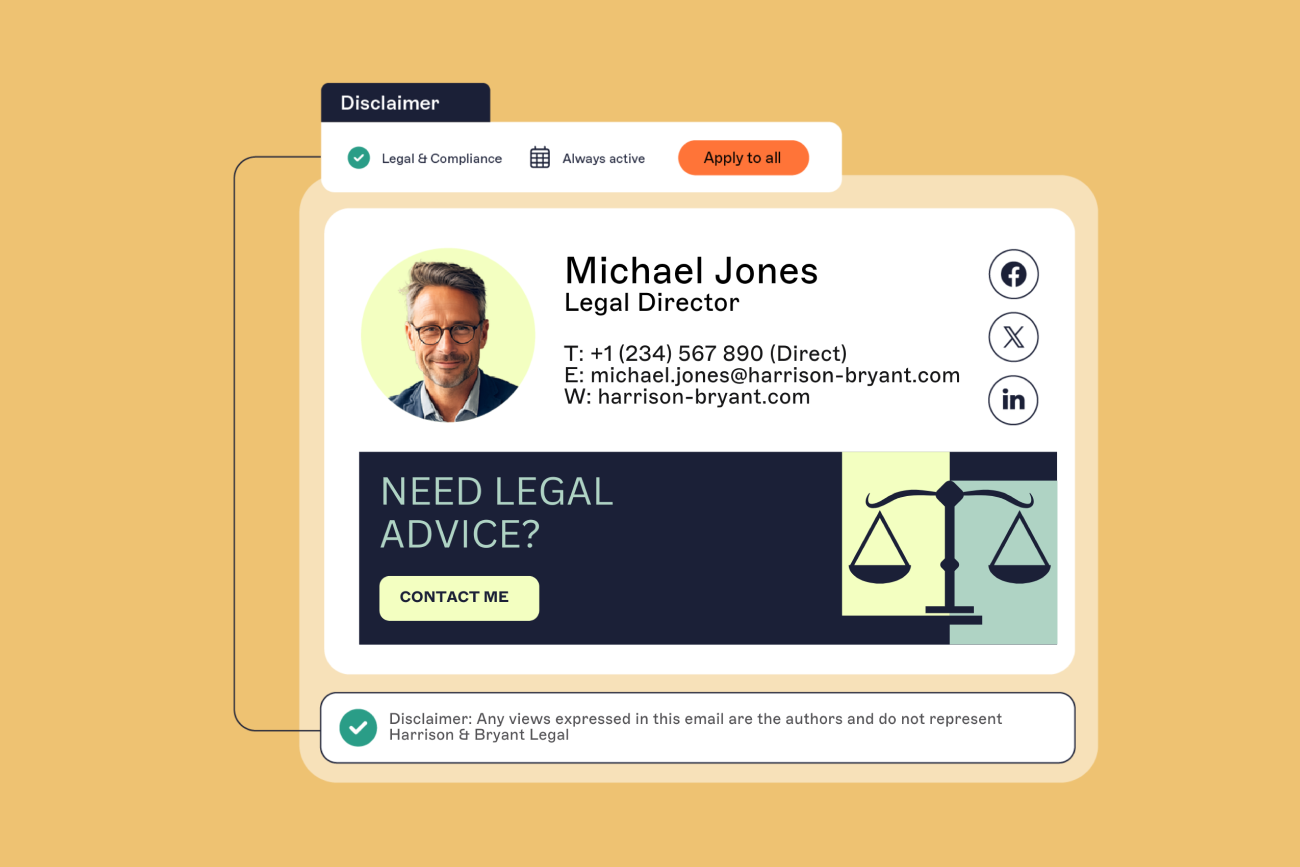
TL;DR
Poor email signature management exposes law firms to five material risks: confidentiality breaches, misleading communications, privacy-law non-compliance, spoofing and impersonation, and reputational damage.
These risks arise when attorneys use inconsistent, outdated, or user-edited signatures that omit required confidentiality notices, disclaimers, sender details, or regulatory disclosures.
Applicable obligations include ABA Model Rule 1.6 (client confidentiality), ABA Model Rule 7.1 (misleading communications), GDPR Articles 5 and 32 (lawful and secure data processing), HIPAA Security Rule 45 C.F.R. § 164.312 where protected health information is involved, and CASL sections 6 to 10 for Canadian commercial messages.
Centralized email signature management reduces these risks by enforcing approved templates, preventing user overrides, syncing contact data from directories, and maintaining consistent disclaimers across desktop, mobile, and webmail.
Law firms handle some of the most sensitive information in any industry. Every email sent must represent the firm's professionalism, security posture, and compliance with industry regulations. Improperly managed email signatures are a real risk.
Without a centralized approach to managing email signatures, law firms expose themselves to compliance violations, security threats, and reputational harm. Missing legal disclaimers, outdated contact details, and inconsistent branding lead to regulatory fines, legal disputes, and data breaches.
This post covers the key regulations, real-world consequences, and the security infrastructure that matters when choosing a platform to manage email signatures for legal communications
Which regulations apply to law firm email signatures?
Legal professionals are subject to strict regulations regarding confidentiality, data security, and professional responsibility. Missing standardized email disclaimers means missing legally required confidentiality notices, which increases the risk of compliance breaches.

Here's a look at key regulations and how they relate to email disclaimers.
1. American Bar Association (ABA), U.S.
The American Bar Association (ABA) provides essential guidelines to ensure confidentiality, transparency, and security in legal communications. These guidelines help protect client information and maintain ethical practices in the legal profession.
ABA Model Rule 1.6 states that a lawyer "shall not reveal information relating to the representation of a client" unless an exception applies, making confidentiality notices and secure handling essential in all email communications. ABA Model Rule 7.1 prohibits communications about a lawyer or legal services that are "false or misleading," which makes outdated titles, incorrect office locations, or unauthorized practice claims in email signatures a direct ethics risk. ABA Formal Opinion 477R further advises lawyers to take "reasonable precautions" when transmitting client information electronically, including stronger safeguards such as encryption when the sensitivity of the information warrants it.
The disclaimers within your email signatures support ABA compliance by:
Upholding attorney-client privilege and preventing unauthorized disclosure, as outlined in Model Rule 1.6 (Confidentiality of Information)
Ensuring all communications are truthful and not misleading, in line with Model Rule 7.1 (Communications Concerning a Lawyer’s Services)
Encouraging the use of encryption or other security measures for sensitive information, as recommended in Formal Opinion 477R (2017)
The UK and Australia also enforce strict legal standards for professional conduct, guided by the SRA Code of Conduct and the Legal Profession Uniform Law, respectively. Both emphasize confidentiality, often highlighted in email disclaimers about sharing privileged information.

2. Health Insurance Portability and Accountability Act (HIPAA), U.S.
A HIPAA email disclaimer does not, by itself, make a law firm's email compliant when the firm handles protected health information (PHI). If the firm is a business associate or otherwise handles electronic protected health information, the HIPAA Security Rule requires appropriate technical safeguards under 45 C.F.R. § 164.312, including access controls, audit controls, integrity controls, and transmission security. A confidentiality disclaimer in an email signature supports recipient handling by warning that the message may contain PHI, but it must be paired with encryption, access controls, and business associate agreements.
Including a HIPAA compliance disclaimer in email signatures helps healthcare organizations meet legal standards, secure sensitive data, and build trust with patients and partners.
3. Gramm-Leach-Bliley Act (GLBA), U.S.
The Gramm-Leach-Bliley Act (GLBA) applies where a law firm provides financial products or services for personal or household use, or handles non-public personal information (NPI) for covered financial institutions. Not all law firms are directly subject to GLBA, but those advising banks, insurers, or other financial-services clients may face obligations through client policy, engagement terms, or access to NPI under 16 C.F.R. Part 314 (the Safeguards Rule).
The Gramm-Leach-Bliley Act (GLBA) requires covered organizations to secure sensitive client information. Many include disclaimers in their email communications stating that:
Emails shouldn't be used to share sensitive information like account details
Confidentiality cannot be guaranteed, so caution is advised when exchanging sensitive data
4. The Financial Industry Regulatory Authority (FINRA) and Securities and Exchange Commission (SEC), U.S.
FINRA and SEC obligations generally apply directly to regulated financial entities such as broker-dealers and investment advisers, not to law firms themselves. However, outside counsel advising or communicating on behalf of regulated clients may face email recordkeeping and disclosure requirements through client policy, engagement terms, litigation holds, or regulatory investigations. Relevant rules include SEC Exchange Act Rules 17a-3 and 17a-4 for broker-dealer record retention and FINRA Rule 4511 for books and records.
Email disclaimers can help law firms follow these regulations by:
Ensuring communications meet disclosure requirements and transparency standards
Providing accurate information to avoid misleading clients or investors
Helping firms avoid fines or compliance violations due to missing critical details

5. General Data Protection Regulation (GDPR), EU
The General Data Protection Regulation (GDPR) governs how organizations handle the personal data of EU residents, ensuring its protection both at rest and in transit. This is especially vital for legal professionals managing sensitive client data.
Articles 5 and 32 of the GDPR highlight the importance of data security, particularly in email communications. Email disclaimers help support GDPR compliance by:
Communicating data security practices and confidentiality protocols
Ensuring clarity and openness in handling personal information
Guiding privacy rights and data protection policies
For serious infringements of GDPR's data security and processing obligations, Article 83 allows administrative fines of up to €20 million or 4% of annual global turnover, whichever is higher. GDPR also imposes breach notification duties when personal data is compromised in a way that risks the rights and freedoms of individuals.
6. Personal Information Protection and Electronic Documents Act (PIPEDA), Canada
The Personal Information Protection and Electronic Documents Act (PIPEDA) governs how personal data is managed in Canada. Lawyers must obtain client consent before sharing personal data via email, though implied consent may apply in professional legal contexts.
Email disclaimers support PIPEDA compliance by:
Demonstrating your commitment to data privacy and legal requirements
Building trust with clients and partners through transparent communication
7. Canadian Anti-Spam Law
The Canadian Anti-Spam Legislation (CASL) regulates commercial emails in Canada, requiring clear identification and opt-out options. CASL sections 6 to 10 set the core requirements for commercial electronic messages, including sender identification, contact information, and a functioning unsubscribe mechanism.
Email disclaimers support CASL compliance by:
Clearly identifying the sender of the message
Providing the sender’s contact information for transparency
Offering recipients an easy-to-use unsubscribe option unless exempted

What happens when law firms get email signatures wrong?
Poor email signature management creates five concrete categories of risk for law firms:
Risk | How it happens | Rule or authority | Consequence |
Client confidentiality breach | A lawyer sends client information with no confidentiality notice, or to the wrong recipient using outdated contact details. | ABA Model Rule 1.6 | Bar discipline, malpractice exposure, loss of client trust |
Misleading communication | A former partner, outdated office address, or incorrect practice area claim remains in an attorney's signature. | ABA Model Rule 7.1 | Ethics complaints, client confusion, reputational harm |
Privacy-law non-compliance | Signatures expose personal data, omit required contact information, or contain outdated details in regulated communications. | GDPR Articles 5, 32, and 83 (fines up to €20 million or 4% of annual global turnover) | Regulatory investigation, fines, breach notification duties |
Spoofing and impersonation | Recipients cannot verify authentic firm emails because signatures are inconsistent and sender authentication is absent. | Mitigated by SPF, DKIM, DMARC, and centralized signature enforcement | Fraud, phishing, credential theft, reputational damage |
Operational inconsistency | Attorneys manually edit signatures, resulting in outdated phone numbers, wrong titles, broken links, or missing disclaimers. | Governance obligation across multiple frameworks | Client confusion, increased IT burden, inconsistent compliance posture |
Real cases: What non-compliance cost these law firms
The cases below illustrate consequences of weak email and information-handling controls at law firms. Not every incident was caused solely by email signature failures, but each demonstrates why centralized controls over email identity, confidentiality notices, sender verification, and sensitive-data handling matter.

Incident | What happened | Outcome | Governance lesson |
ACS:Law, 2011 | Confidential client emails were exposed after a cyberattack and published online. | Fined £1,000 by the ICO; firm later closed. | Email communications containing client data require consistent confidentiality handling, secure transmission, and clear recipient instructions. |
Slater & Gordon, February 2025 | A hoax all-staff email allegedly sent by the outgoing Chief People Officer leaked salary details and triggered an investigation. | Firm condemned the message as fake; investigation launched. | Centralized signature controls, paired with SPF, DKIM, and DMARC, help employees and recipients identify authentic firm communications. |
Latham & Watkins, October 2024 | A federal judge found the firm in civil contempt for violating a protective order by improperly disclosing a confidential expert report. | Civil contempt finding. | Standardized confidentiality labels, disclaimers, and audit trails reduce the risk of unauthorized disclosure in sensitive matters. |
How centralized email signature management protects law firms
Managing email signatures manually in a law firm takes time and leads to mistakes. Centralized email signature management enforces consistency, compliance, and a professional appearance, with no reliance on individual users to maintain their own templates.
 Whether a firm runs on Microsoft 365 or Google Workspace, Exclaimer's platform applies the same compliance-grade policies across every email client, device, and user.
Key benefits:
Automatic compliance: Pre-approved legal disclaimers are applied to every outbound email through Signature Rules, with no user override possible. Changes go live across the entire firm in minutes.
Consistent and professional branding: Brand Kits enforce standardized logos, approved fonts, and correct contact details across every attorney, paralegal, and staff member in the firm.
Streamlined IT operations: Directory Sync pulls attorney details directly from Microsoft Entra ID or the Google Workspace directory, keeping contact information current without manual updates. Role-based access control (RBAC) lets HR or marketing manage email signature content independently, without IT handling each change.
Protection against impersonation: Signature Rules prevent unauthorized edits, reducing the risk of fraudulent or rogue communications going out under the firm's name.
Scalability: Centralized management handles any number of users, from a 10-person boutique to a multi-office global firm, without adding IT overhead.
What email disclaimers can't do
Email disclaimers don't replace encryption, access controls, consent, breach notification, retention policies, or professional judgment. A confidentiality notice in an email signature is one control in a broader email governance program, not a substitute for technical security measures or legal compliance obligations.
For HIPAA specifically, disclaimers do not satisfy the technical safeguard requirements at 45 C.F.R. § 164.312. For GDPR, a disclaimer doesn't replace the obligation to process data lawfully, implement appropriate security measures under Article 32, or notify authorities of a breach under Article 33.
Security features that matter for law firms
For a law firm, the right email signature platform should pair confidentiality-grade hosting with named, audited certifications, not empty claims about enterprise-grade security.

Exclaimer holds the following independently verified security and privacy certifications, each directly relevant to the confidentiality and data-sovereignty obligations law firms carry:
SOC 2 Type II, audited by BARR Advisory, P.A.: confirms that Exclaimer's security controls are not only designed correctly but are also operating effectively over an extended period. SOC 2 Type II is the standard most enterprise compliance teams request during vendor review. Exclaimer is the only dedicated email signature management provider publicly attested to SOC 2 Type II.
ISO/IEC 27001:2022: Certifies Exclaimer's Information Security Management System (ISMS) against the global standard for security governance. The most recent renewal passed with zero major or minor non-conformities.
ISO/IEC 27018:2019: Extends ISO 27001 to cover protection of personally identifiable information (PII) in public cloud environments. For law firms processing client contact data through their email infrastructure, this provides additional assurance around how that data is segregated, accessed, and handled.
Azure-hosted data residency by region: Exclaimer is hosted across 14 Azure datacenters in seven regions:
United Kingdom
United States
EU (West Europe and North Europe)
Australia
Canada
UAE
EU tenants have their data hosted in EU Azure regions. Firms with data sovereignty requirements choose their region at the point of account setup.
Encryption in transit: TLS 1.2 or higher: Data in transit between users and Exclaimer's platform is protected with TLS 1.2 or higher.
Encryption at rest: AES-256: Data stored within Exclaimer's infrastructure is encrypted using AES-256.
Microsoft 365 Certified: Exclaimer has passed Microsoft's independent security review for applications operating inside the Microsoft 365 ecosystem, providing an additional layer of validation for firms running on Microsoft 365.
GDPR for European law firms
European law firms processing client data through a US-headquartered vendor need to confirm two things: where their data is hosted, and the contractual basis on which the vendor processes it.
On hosting: EU tenants are processed and stored in Azure EU regions (West Europe and North Europe). Exclaimer processes client data on behalf of the customer under a Data Processing Agreement (DPA) aligned to GDPR Article 28, which governs the obligations of processors handling personal data on behalf of controllers.
Technical and organizational measures aligned to GDPR Article 32, the requirement to implement appropriate security for data processing, are evidenced by Exclaimer's ISO 27001 and SOC 2 Type II certifications. Standard Contractual Clauses (SCCs) and UK International Data Transfer Agreement (UK IDTA) coverage is available for applicable transfers.
For full DPA and privacy documentation, see Exclaimer's legal and privacy documentation.
Sample law-firm email signature disclaimers
The following examples illustrate common disclaimer types used in law firm email signatures. These are starting points only. Each should be reviewed by legal counsel and tailored to the firm's jurisdiction, practice area, and applicable regulatory requirements.

General confidentiality disclaimer
This email and any attachments are intended solely for the named recipient and may contain legally privileged or confidential information. If you have received it in error, notify the sender immediately, delete this message, and do not use, copy, or disclose its contents. |
HIPAA-sensitive matter disclaimer
This communication may contain protected health information (PHI) as defined under the Health Insurance Portability and Accountability Act (HIPAA). If you are not the intended recipient, you are prohibited from reviewing, disclosing, distributing, or using this information. Please notify the sender immediately and delete this message. |
Marketing/commercial email disclaimer (for CASL compliance)
This message is a commercial communication sent by [Firm Name], [Address]. To unsubscribe from future commercial messages, click here: [unsubscribe link]. This does not apply to transactional or legal-matter communications. |
Microsoft 365 vs centralized email signature management
Microsoft 365 mail flow rules can append disclaimers to outbound messages, but they aren't a complete email signature management system for a regulated law firm. The table below shows where native tools fall short:
Requirement | Microsoft 365 mail flow rules | Exclaimer (Centralized platform) |
Append a text disclaimer | Yes | Yes |
Branded HTML signature templates | Limited | Yes |
User-specific fields (name, title, direct line) | Limited | Yes |
Mobile and webmail consistency | Limited | Yes |
Prevent user edits | No | Yes |
Conditional disclaimers by practice group or jurisdiction | Limited | Yes |
Directory sync (Microsoft Entra ID, Google Workspace) | Limited | Yes |
Audit logs and version history | Limited | Yes |
Sources: Microsoft Learn: Mail flow rules in Exchange Online; Microsoft Learn: Organization-wide message disclaimers
Why Exclaimer is the right choice for law firms
Exclaimer is the right choice for law firms because it combines audited confidentiality controls, EU data residency, and a centralized enforcement model that directly addresses the brand and compliance risks covered in this post.

Named, audited security posture. Exclaimer holds SOC 2 Type II attestation (audited by BARR Advisory, P.A.), ISO/IEC 27001:2022 certification, and ISO/IEC 27018:2019 certification. These provide the form of independent evidence law firms need when satisfying their own clients and regulators during vendor due diligence. They align directly with confidentiality obligations under ABA Model Rule 1.6 in the US and the SRA Code of Conduct in the UK.
Centralized enforcement that closes the gaps listed above. Signature Rules prevent any user from editing or overriding the firm's approved template. Disclaimers, confidentiality notices, and required contact information are automatically applied to every outbound email. The compliance failures described in this post (missing disclaimers, inconsistent branding, unauthorized communications) become structurally impossible rather than dependent on individual user behavior.
Tenant-level data residency. Exclaimer's hosting spans seven regions. Law firms choose their region at account setup. EU-based firms have their data processed and stored in EU Azure infrastructure, supporting data sovereignty requirements without additional configuration.
Book a demo and review Exclaimer's Trust Center documentation, including the current SOC 2 Type II report and ISO certificates.