Karl heads up Information Security at Exclaimer, where he’s focused on keeping data secure and ensuring compliance with standards like ISO 27001 and SOC2. With years of hands-on experience, Karl is dedicated to simplifying security processes and staying ahead of potential threats. He’s passionate about using automation and smart practices to strengthen security without adding unnecessary complexity.
Email signature management for manufacturers: A complete guide
TL;DR
Manufacturing estates are fragmented across plants and acquired brands, so leaving email signatures to individual employees means a different logo, disclaimer, and job title on messages that are all supposed to come from the same company.
Only 18% of US organizations manage email signatures centrally, so most manufacturers are doing it by hand or by script.
Server-side deployment is the strongest enforcement model, because the email signature is applied after the message leaves the device and the sender can't edit or remove it.
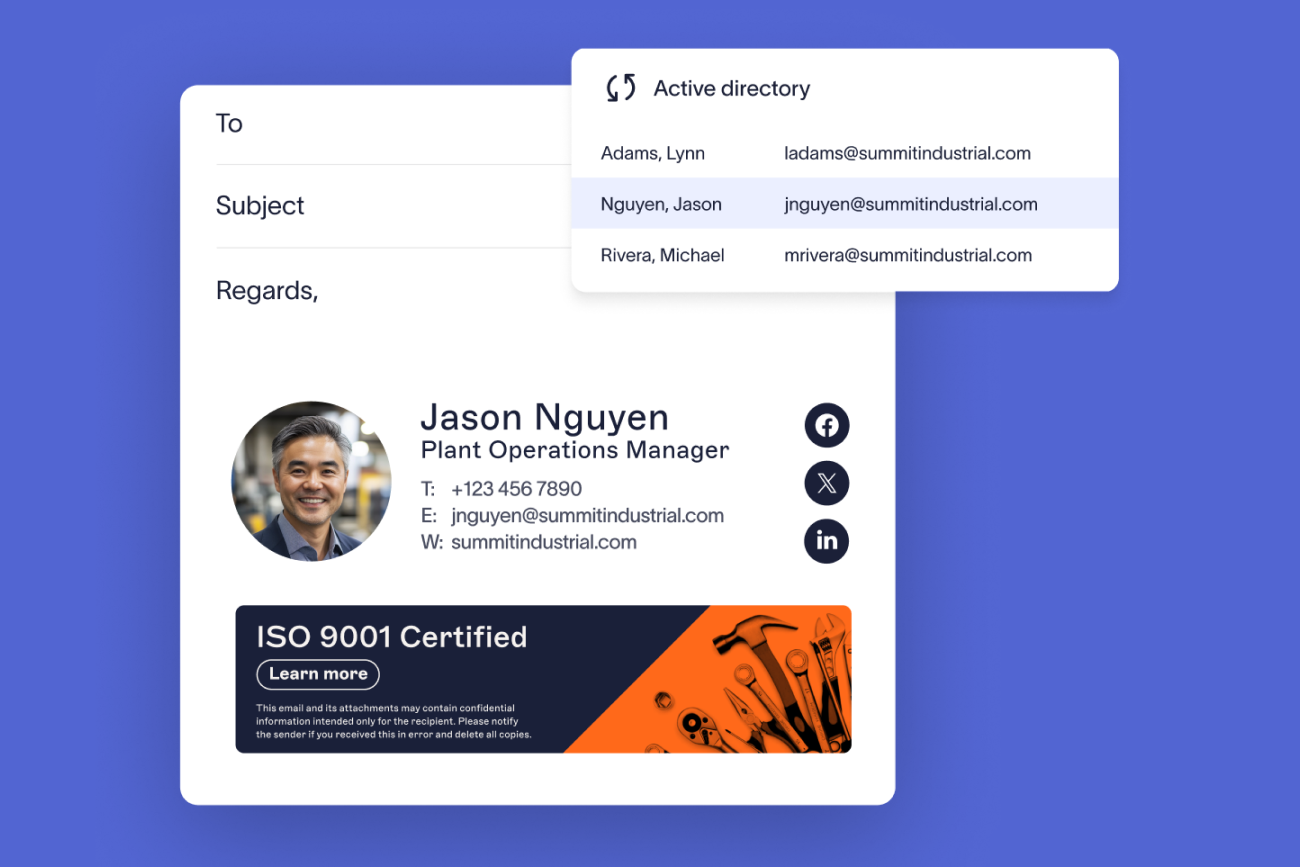
Directory sync from Microsoft Entra ID or Google Workspace Directory keeps every employee's details accurate as they move between plants and roles, with Signature Rules applying the right template by site, entity, or department automatically.
A single fraudulent wire transfer cost chemical manufacturer Orion S.A. around $60 million in 2024, according to the company's own filing with the US Securities and Exchange Commission. It was approved because the email asking for it looked close enough to genuine to pass.
Run that risk across the plants, shift patterns, and acquired brands a manufacturing group typically carries, and close enough stops being rare, because nobody agreed on what a real message from the company actually looks like. A part gets specified to the micron and a supplier certificate gets checked line by line, but those standards have never reached the email signature block, and every acquisition adds one more version to reconcile.
The inconsistency surfaces when a quality review asks how export-controlled correspondence is supposed to be marked, or a new plant manager has to explain why three different logos are going out under the same company name. Email signature management for manufacturing is how a group brings those email signatures under central control.
Quick answer
Email signature management for manufacturing puts one system in control of what every mailbox sends under the company's name. It covers consistent sender identity across every site, the correct disclaimer for the jurisdiction and legal entity, accurate contact and role details as staff move between plants, and one place to change all of it.
Why does email signature management matter for manufacturers?
Manufacturing email runs outward. Suppliers, contractors, freight forwarders, and certification bodies judge whether a message is genuine partly on whether it looks like the last one they had, and much of that mail leaves from shared mailboxes and mobile devices that no per-user setup will reach.
Shift supervisors share mailboxes and maintenance teams work from mobile, so any approach that depends on each person configuring their own email signature will miss them. Contractors arrive and leave faster than a manual process keeps up with. Every acquisition adds another set of domains and conventions, and consolidating them lands on whoever owns email compliance.
"Manufacturing organizations run on precision. Processes are optimized, systems are engineered for scale, and controls are designed to ensure consistency across plants, suppliers, and regions. Yet one area of the operation often escapes the same level of discipline: everyday digital communication."

Email is also a live route into these environments. Manufacturing is one of two sectors where phishing, spoofing, and spam rank as the top email issue reported by respondents, at 51%, alongside media and entertainment at 55%, according to Exclaimer's State of Business Email 2025 survey of 4,009 IT leaders.
Sophos, in its State of Ransomware in Manufacturing and Production 2025 study of 332 manufacturing organizations hit by ransomware, found malicious email the second most common root cause at 23% of incidents, down from 29% the year before.
While email signature management is not a form of security control, a consistent, enforced house standard helps people notice the messages that don't match.
What every manufacturing email signature should include
A manufacturing email signature carries more operational information than a standard corporate one, because the recipient usually needs to know which site they're dealing with and which legal entity they're contracting with.
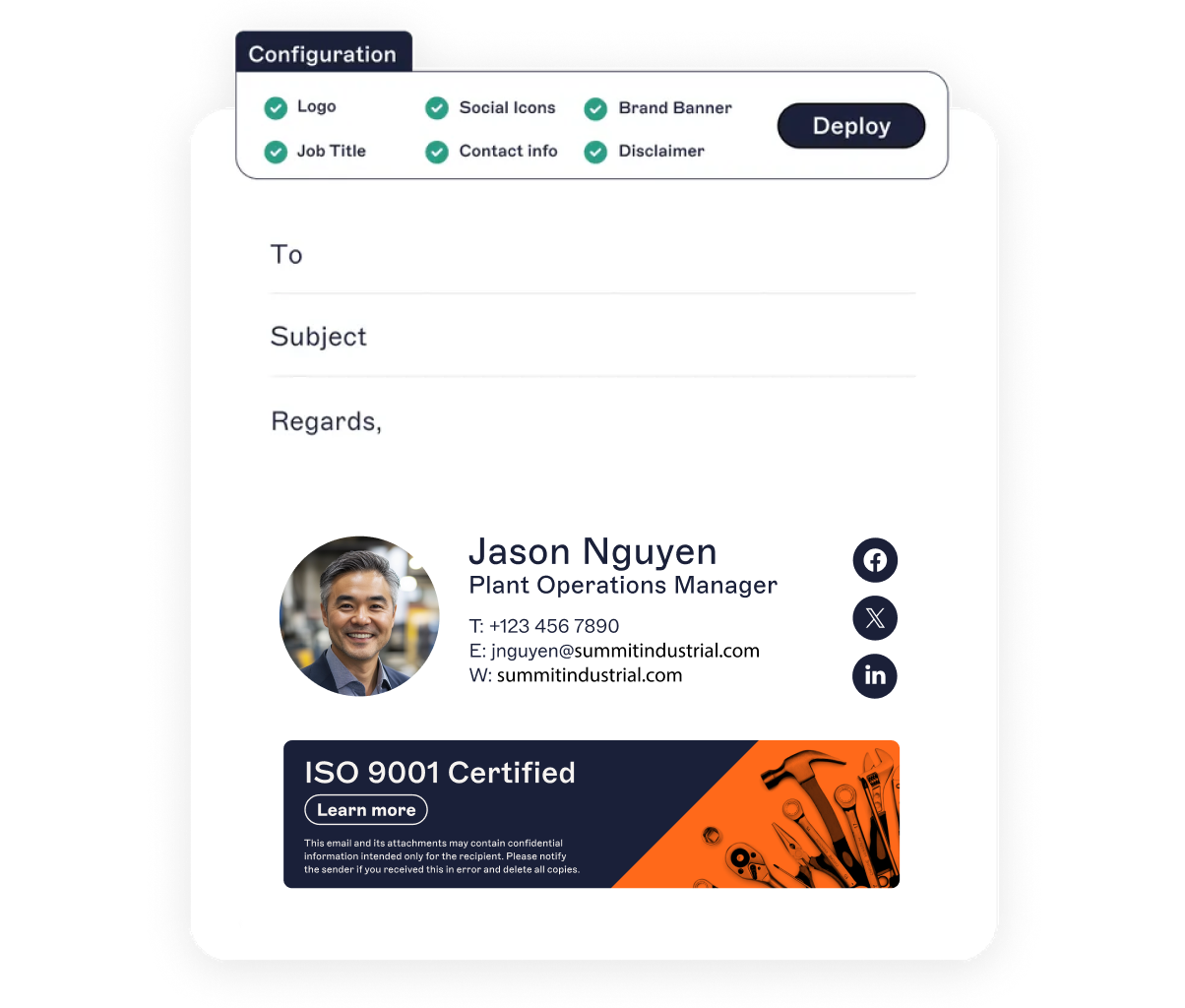
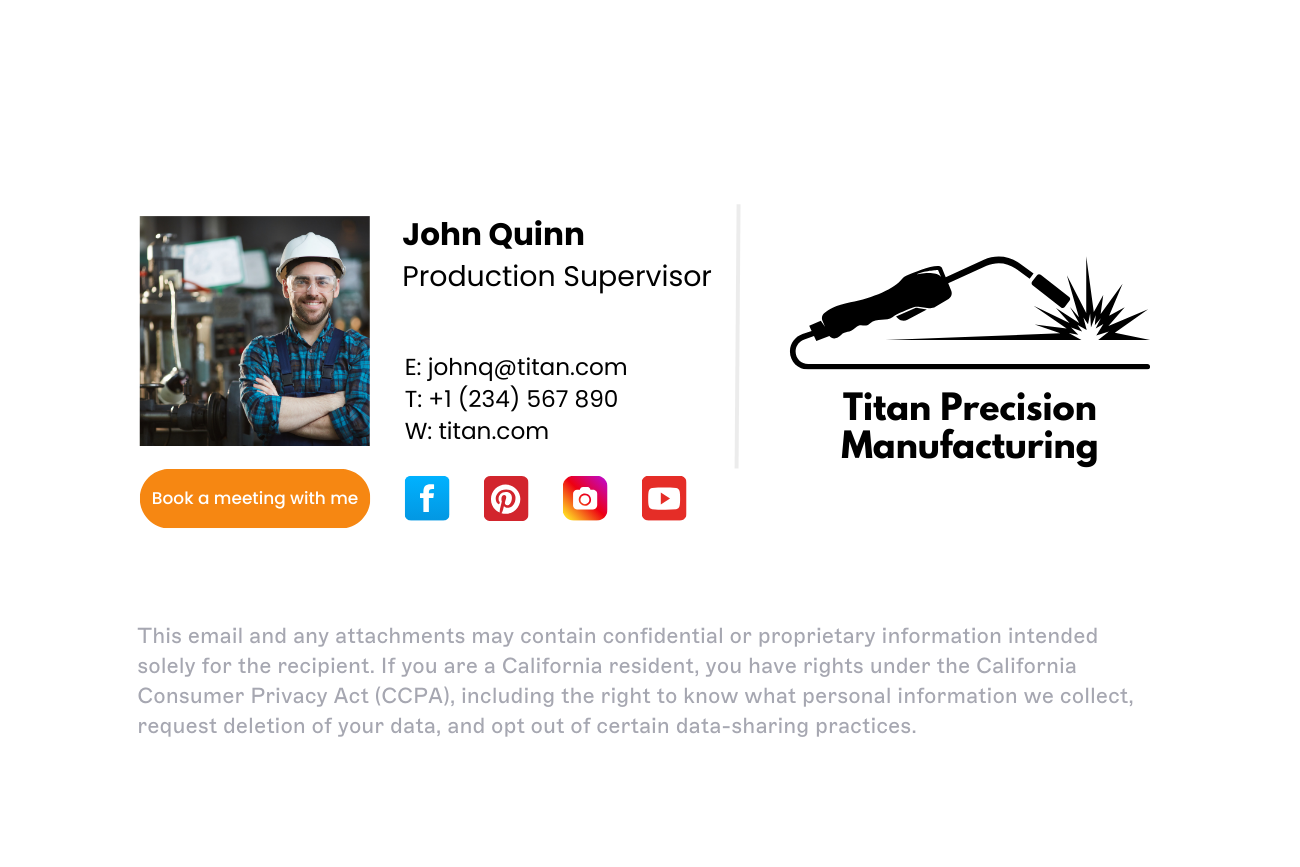 The core fields are the ordinary ones: full name, job title, department, company name, direct phone, and the company logo. Manufacturers may also need business correspondence to name the plant, legal entity, and registered address and company number, depending on jurisdiction.
Other elements vary by role. A quality manager may need certification references. A procurement lead needs a clear route for suppliers to verify a change of payment details. An engineer working on defense contracts needs export-control language a marketing coordinator doesn't. What stays fixed is the logo, the color palette, the company name, and the disclaimer that applies to everyone in that entity.
Keep disclaimers, certification references, and export-control notices as selectable text instead of baking them into an image. Recipients need to search and copy that text, and images fail to render more often than you might expect.
Manufacturing email signature elements by role
Role | Required fields | Optional fields | Compliance note |
Plant operations | Name, job title, plant or site name, legal entity, direct phone | Shift pattern, site switchboard | Site name should match the entity on the contract, not the informal internal name |
Quality and compliance | Name, job title, department, legal entity, direct phone | Relevant certification references (for example ISO 9001) | Only reference certifications currently held by that entity, and remove them promptly when scope changes |
Engineering and R&D | Name, job title, department, legal entity, direct phone | Site location | Where the team handles export-controlled technical data, apply the appropriate export-control notice by rule instead of by hand |
Procurement and supply chain | Name, job title, department, legal entity, direct phone, supplier verification line | Purchase order contact, accounts payable contact | The verification line should state how a supplier confirms a change to payment details, and it should be identical on every message from the function |
Sales and account management | Name, job title, legal entity, direct phone, website | Booking link, product line | Where terms of sale are referenced, link to the current published version |
Executive | Name, title, legal entity, direct phone | LinkedIn profile, group company reference | Where the group runs several trading entities, name the one the executive is signing for |
What compliance requirements apply to manufacturing email signatures?
No regulation says, "you must have an email signature." But some require that specific information reaches the right people and that certain communications carry defined notices. A centrally applied email signature is how an organization meets both consistently.
Regulation and disclaimer mapping
Regulation or standard | What it asks of communications | What a centrally applied email signature does | What it doesn't replace |
|---|---|---|---|
| ISO 9001 | Documented, controlled communication as part of a quality management system | Applies one approved format and set of details across the entity, defined centrally | The quality management system itself, document control, and management review |
OSHA (Occupational Safety and Health Administration) | Clear identification of roles and responsibilities in safety-related communication | Carries accurate job title and site on every message from safety-accountable staff | Safety programs, training records, and hazard communication requirements |
CMMC (Cybersecurity Maturity Model Certification) | Protection of Controlled Unclassified Information (CUI) for defense supply chain contracts | Applies approved CUI-related notice text to defined groups automatically | Access controls, system security plans, assessment, and the wider set of practices in the model |
ITAR (International Traffic in Arms Regulations) | Control of export-related technical data and who may receive it | Applies export-control notice text by rule to the teams and entities that need it | Licensing, technology control plans, screening, and access restriction |
Customs and trade compliance | Traceable documentation attached to import and export activity | Keeps sender identity, entity, and site consistent on correspondence tied to shipments | Customs records, classification, and declaration processes |
SOX (Sarbanes-Oxley Act) | Documented, accountable financial communication for public companies | Keeps role and entity accurate on finance correspondence | Internal control over financial reporting and its testing |
HIPAA (Health Insurance Portability and Accountability Act) | Safeguards for protected health information, where a manufacturer handles it | Applies a consistent confidentiality notice to the teams that handle it | Encryption, access controls, audit controls, workforce training, and business associate agreements |
GDPR (General Data Protection Regulation) | Transparency about who is processing personal data and on what basis | Carries entity identity, a privacy notice link, and DPO contact details where applicable | The privacy notice itself, lawful basis, and data subject rights processes |
CCPA (California Consumer Privacy Act) | Disclosure and consumer rights information for California residents | Carries the required disclosure link consistently on relevant correspondence | Rights request handling and the disclosures themselves |
ESG (environmental, social, and governance) reporting | Accuracy in environmental and sustainability claims | Keeps any sustainability statement in email signatures aligned with what the business has published | The reporting itself and the evidence behind the claims |
What a disclaimer can and cannot evidence
A disclaimer is a notice. It doesn't create a legal protection on its own, and having one doesn't make an organization compliant with the regulation it references. An ITAR export-control notice doesn't authorize the export or substitute for a technology control plan, and a CUI marking doesn't satisfy CMMC. The notice makes an expectation explicit, and the control still has to exist underneath it.
What central management adds is that the notice actually gets applied. Exclaimer's General Counsel, Ed Bodey, says that when auditors review communication governance they look for "confidence that controls are built into systems rather than relying on individual behavior," and that relying on individual behavior is "one of the most common ways organizations get this wrong."
When disclaimer text is defined once, approved, and attached to groups by rule, an organization can show what its standard is and how it's configured to apply. That's evidence about the arrangement, and a reasonable thing to bring to a review.
→ Full guide: What is an email disclaimer
→ Full guide: 25+ disclaimer statement examples and templates
How do email signatures help defend against supplier impersonation and invoice fraud?
A consistent house standard gives recipients something to compare an unusual message against, and a standing verification line on procurement mail tells suppliers how to confirm a change of payment details without relying on the message in front of them.
At Orion S.A., the employee involved wasn't a named executive. They approved multiple fraudulent wire transfers after a criminal scheme got in through a message that looked legitimate enough to act on.
Cases like that are why finance and procurement functions verify payment changes out of band, by calling a number they already hold instead of one supplied in the message. Email signature standards support that process. Prevention belongs to payment controls, out-of-band verification, and the authentication and filtering layers your security team runs, including SPF (Sender Policy Framework), DKIM (DomainKeys Identified Mail), and DMARC (Domain-based Message Authentication, Reporting, and Conformance) on your sending domains.
Exclaimer's own security lead was unconvinced at first that consistency counted as a trust signal. As Karl Bagci, Director of IT and Information Security, puts it:
"I initially hated it, I said this isn't a form of security at all. But I've come round to it. There's real value in consistent branding, because people get used to seeing it, and when they stop seeing it, they know something's wrong and to go and check the other factors, the headers, the sender address. It never replaces good hygiene, but it's a way to tell at a glance that someone is who they say they are."

How do IT teams deploy email signatures across multiple plants and shifts?
Centrally, at the server, with templates assigned by rules that read directory attributes. Server-side application makes coverage independent of the device, so nothing has to be configured at the sender's end.

Server-side, client-side, and hybrid deployment
The three models differ mainly in who gets the last word on what the recipient sees.
Deployment model | Where the email signature is applied | Can the sender change it | Best suited to |
Server-side | In transit, after the message leaves the sender's device | No | Enforcement across shared mailboxes, mobile users, and anyone without a managed client |
Client-side | In the composing client, as the sender writes | Yes | Desk-based staff who want to reply beneath their email signature |
Hybrid | Client-side for the preview, server-side for the version that goes out | Not the applied version | Most multi-plant manufacturers |
Native Microsoft 365 and Google Workspace versus a managed platform
Both platforms can apply text to outbound mail. Neither assigns templates by legal entity or keeps details current from the directory unless someone builds and maintains that themselves.
| Microsoft 365 and Google Workspace native | A managed email signature platform |
Who applies the email signature | The user on their device, or an admin-configured transport or content compliance rule | The platform, centrally, after the message is sent |
Can the sender change it | Yes, where it's user-configured | No, where server-side application is used |
Different template by site, entity, or department | Possible through separate rules, maintained by hand as rules multiply | Assigned by Signature Rules from one console, using directory attributes |
Keeping details current | Manual, or scripted against the directory and maintained in-house | Synced automatically from Microsoft Entra ID or Google Workspace Directory |
Rich formatting and images | Supported in user-configured signatures; transport rule disclaimers are limited and render inconsistently | Designed once, applied consistently across clients |
Who can make a change | Whoever holds Exchange admin or Google Workspace admin rights | Delegated by role, so marketing can update a banner without admin-level permissions |
Testing before rollout | Test manually | Signature Tester checks which template a given sender will get before it goes live |
Native tooling suits a single-entity business with one disclaimer and a stable structure. Linn Foster, Exclaimer's Director of Engineering Management, describes what happens once an organization outgrows that: "You start with one policy for one region, then you're managing multiple departments, multiple templates, and people who need exemptions, so you're writing logic to handle exceptions instead of core work. Then the signatures won't render, or they stack at the bottom of a thread, or they don't show up right on mobile, and you're debugging HTML across email clients instead of doing engineering."
For a procurement comparison, see this fuller breakdown of native Microsoft 365 email signatures against a managed platform.
→ Full guide: How to create and set up Microsoft 365 email signatures
→ Full guide: How to create a Google Workspace email signature
One template, several legal entities
Multi-entity groups often assume the only option is a separate template for every trading company. Conditional visibility means it isn't. Individual elements inside one template can be set to appear only when a sender attribute matches, so a small number of templates per brand, with conditional elements inside them, is usually enough.
Shared, shop-floor, and shift-based mailboxes
Manufacturing runs a lot of mailboxes that don't belong to one person:
Dispatch
Maintenance
Quality hold
Plant reception
A shift handover account
These are prone to being overlooked, because there's no individual to prompt. Server-side application covers them by default, since it works on the message and not on the person.
What can be trickier is deciding what email signatures from those mailboxes should say. Naming the function and the site works better than naming an individual, with a monitored contact route in place of a personal number. Any shared mailbox suppliers use for invoices should carry the same verification line as the rest of procurement.
→ Full guide: Microsoft Entra ID and Active Directory email signatures
Where does your email and employee data actually go?
That depends on the architecture. Some products in this category route outbound mail through the vendor's own infrastructure in order to modify it. Others apply the email signature inside the mail platform's own transport path without taking custody of the message.
The difference matters for data residency, for what your data processing agreement has to cover, and for what happens to mail flow if the vendor has an outage. For a manufacturer with plants under different data protection regimes, that's a procurement question well before it's a technical one.
Before choosing a vendor, get answers to:
Whether mail leaves Microsoft 365 or Google Workspace to be processed, and if so, where it goes and who operates that infrastructure
Which regions directory data can sit in, and whether that can be set per tenant
Which sub-processors are involved
Whether the certifications are current
Exclaimer processes messages in transit to apply the correct email signature, then delivers them. Nothing is kept, no message content, no subject lines, no attachments, no conversation history. Processing stays in regional Azure data centers, so customer data doesn't leave its region. The platform runs across 14 Azure data centers arranged in seven geographically separated active-active pairs, covering the US, Canada, Europe, the UK, Germany, Australia, and the UAE, at 99.99% average availability. Exclaimer is certified to ISO 27001, ISO 27018, and SOC 2 Type II, holds Cyber Essentials and CSA STAR, and is compliant with GDPR, HIPAA, and CCPA.
→ Learn more: Exclaimer security
How do you manage email signatures across multiple brands after an acquisition?
Hold each brand as its own template and assign it by directory attribute, so people pick up the right one as soon as their accounts land in the directory.
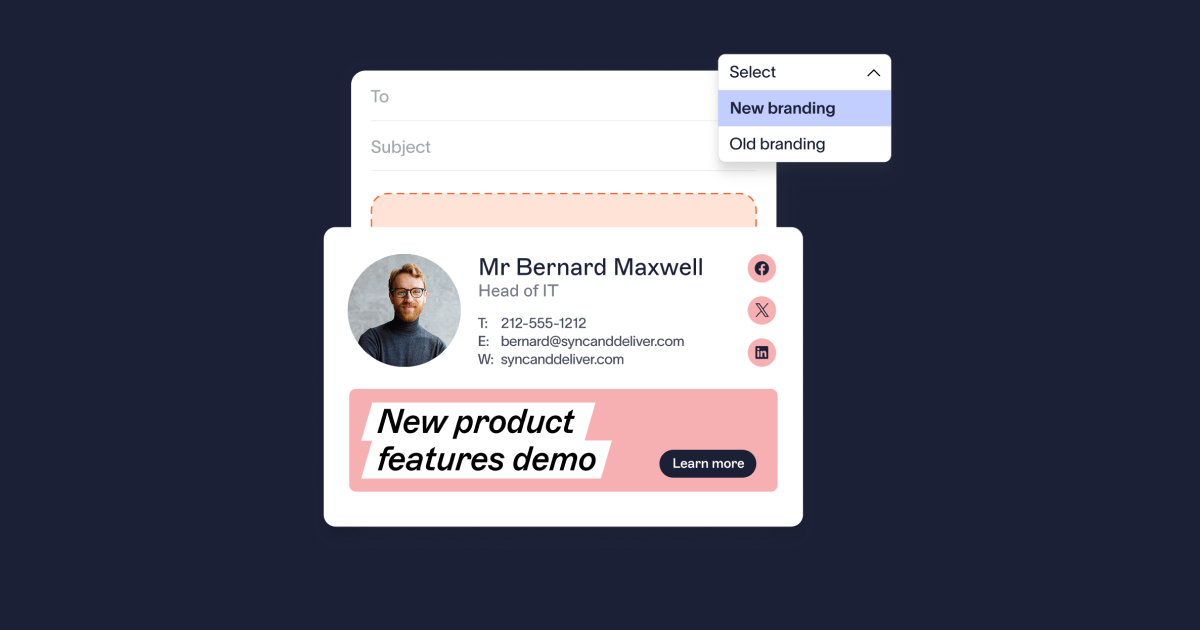
Acquisitions are a common trigger for this work, because a deal creates a deadline the old approach can't meet. The requirement is rarely to make everyone identical. Acquired brands often keep trading under their own name for years, and the group needs each entity to look like itself while still being governed from one place, with new staff arriving on their own domains and directory records that may not merge for months.
Separating the template from the people is what makes that workable. A brand becomes a template and a rule, and moving a site onto the group brand becomes a change to that rule. The same applies in reverse during a divestment. The Italian art-materials group F.I.L.A. S.p.A. runs exactly this pattern: 1,400 users, templates organized by subsidiary brand across Dixon, Canson, and the rest, and around 200 users onboarded from newly acquired companies without disrupting the ones already there.
→ Full guide: Multi-brand email signature management
→ Full guide: How to manage email signatures during a merger
What's the operational case for centralizing email signature management?
Only 18% of US organizations use a centralized email signature solution, according to Exclaimer's U.S. Business Email Report 2025, which surveyed more than 1,000 US IT leaders. Of the rest, 41% leave it to employees and 41% rely on IT scripts or other workarounds.
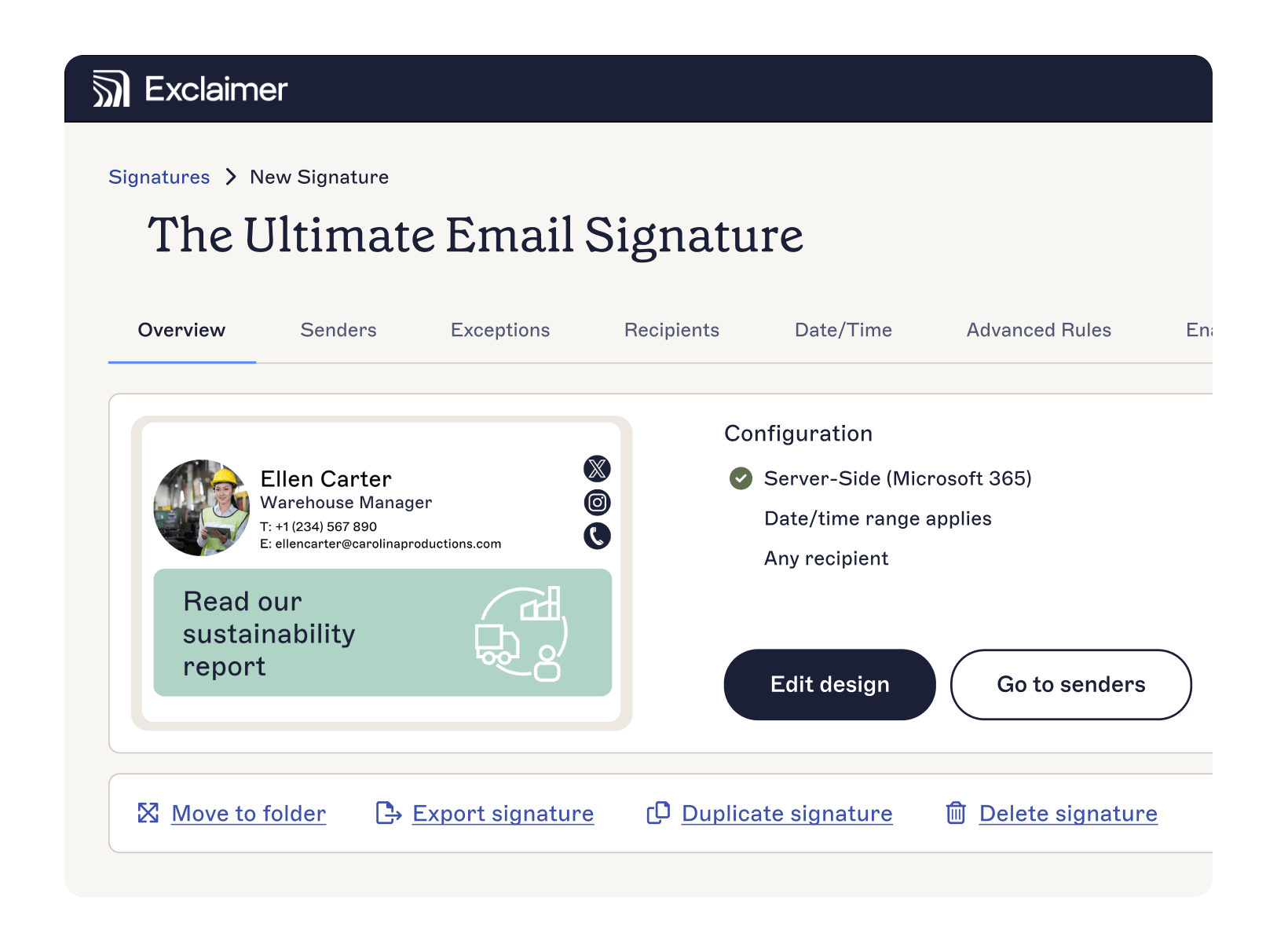
The scripts-and-workarounds group is where the hidden costs of building in-house sit, because a script is something somebody has to maintain, and the person who wrote it usually isn't the person maintaining it two years later. Exclaimer's Build vs Buy report, a 2025 survey of more than 2,000 IT and security decision-makers, found that 71% of in-house IT builds are eventually abandoned, rising to 83% in manufacturing and finance.
As Exclaimer's Chief Product and Technology Officer, Paul Hammond, puts it:
"Total cost of ownership is, evidently, non-linear. A business that builds three or four non-core systems does not just get three or four times the complexity. The maintenance time, costs, and energy are a permanent tax on engineers, with nearly two thirds of teams burning 10 to 50 hours a month just to keep projects alive."

For a multi-plant manufacturer with several entities, that maintenance work lands in the same places every time: new starters, leavers, role changes, a rebrand, a legal text update that has to reach a specific group of people in a specific country by a specific date.
Directory-driven management removes most of that work. When directory sync makes Microsoft Entra ID or Google Workspace Directory the source of truth, a new starter is correctly branded on their first message, a promotion updates a title without a ticket, and removing a leaver from the directory removes their assigned email signature with them. Role-based access lets marketing update a campaign banner or a logo without holding Exchange admin rights.
→ Full guide: The true cost of manual email signature management
→ Full guide: Role-based access with centralized email signature management
What should manufacturing IT look for in email signature software?
Start with two things. Server-side application, so coverage doesn't depend on the sender's device, and rule-based assignment from directory attributes, so a template follows a person when they change plant or role. Most of the rest follows from those.
Deployment across Microsoft 365, Google Workspace, and Exchange, including hybrid and on-premises, so a legacy environment you haven't migrated off yet doesn't become the one gap in coverage.
Directory sync from Microsoft Entra ID or Google Workspace Directory, so accuracy is a consequence of the directory and not a task.
Rule-based template and disclaimer assignment by entity, site, department, country, and language, with a fallback where no attribute matches.
Conditional visibility inside a template, so one design can serve several legal entities.
Multi-brand support, so several trading names can be governed from one console.
Delegated access, so marketing and legal can maintain their own content without IT admin rights.
Data handling that fits your regions, with current certifications, and clarity on whether mail is routed outside your mail platform.
Check which capabilities sit in which plan tier before you compare prices, since recipient-based rules and some controls aren't in entry-level plans.
Do you need a managed platform?
Yes, if you run multiple sites on Microsoft 365 or Google Workspace, staff changes are driven through a directory, disclaimer requirements vary by country or legal entity, or you have acquired brands to keep separate.
Probably not, if you run a single site with one legal entity, one disclaimer, and fewer than about 50 mailboxes. Native settings will do the job, and a platform would be solving a problem you don't have yet.
If that first answer is yours, buy the mechanism: templates defined once, applied server-side, assigned by Signature Rules against directory attributes, and maintained by the teams that own the content. That's what Exclaimer does across Microsoft 365, Google Workspace, and Exchange, for 80,000+ organizations worldwide.
See how it works in a multi-plant environment: Exclaimer for manufacturing.