Karl heads up Information Security at Exclaimer, where he’s focused on keeping data secure and ensuring compliance with standards like ISO 27001 and SOC2. With years of hands-on experience, Karl is dedicated to simplifying security processes and staying ahead of potential threats. He’s passionate about using automation and smart practices to strengthen security without adding unnecessary complexity.
University email signature policy: A template and enforcement guide

TL;DR
Audit before you write, because a test email from every academic unit and campus shows which logos and notices have drifted and where.
A university email signature policy needs a defined scope, directory-sourced contact details, a rule against local email signatures, and a separate standard for student employees.
Clauses hold when a platform setting enforces them, such as directory sync for contact details or Signature Rules for scope.
When staff and students sit on different platforms, each Microsoft 365 tenant or Google Workspace environment needs its own setup built to the same template.
Reviewing the policy at the start of each academic year catches new staff and restructured departments before the recruitment cycle begins.
Many universities already publish email signature guidance for staff, often as a generator on the brand site. Turning that guidance into a policy means defining who it covers, then pairing each clause with something that enforces it.
In Exclaimer's State of Business Email 2025 research, a Censuswide survey of 4,009 IT professionals, 33% said employees ignore email signature guidelines. At a university, that can mean an applicant who emails two departments gets two different logos back.
Key takeaway
A university email signature policy is the written standard for what staff email signatures contain and who they apply to, enforced through centralized email signature management for universities.
Audit your email signatures before you write the policy
An audit shows how far current email signatures have drifted from the brand, and each gap it finds points to a clause the policy needs.
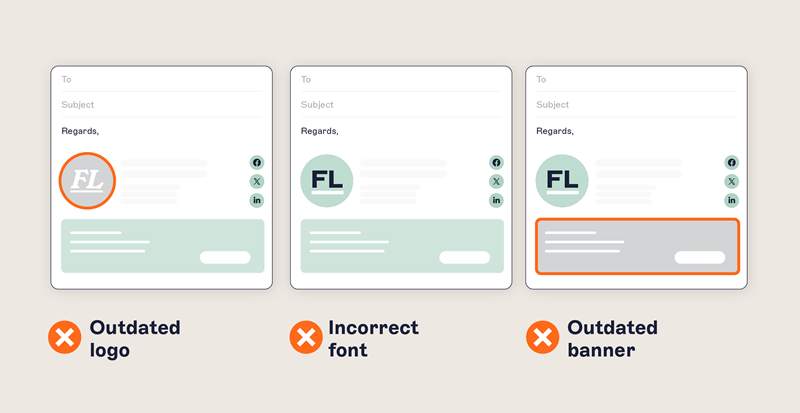 In a 2024 EDUCAUSE Review study of 340 US institutions, just 16.5% reported fully centralized IT, which leaves academic units and their local IT staff to build templates of their own. A platform migration can undo even a working setup. When City of Bristol College moved from on-premises Exchange to Microsoft 365, the scripts that had applied its email signatures stopped working, and staff were left copying them between Outlook versions.
To run the audit, send a test email from one mailbox in every academic unit and campus, then check each for email signature drift against the table below.
Email signature audit checklist
Check | How to test it | Red flag | Policy clause it informs |
Logo and layout | Compare with the brand guidelines and approved template | A retired crest or a department-built template | Standard |
Contact details | Match job titles against the directory | Titles that don't match the directory | Content |
Legal text | Check external email for required notices | Missing notices, or a pre-merger name | Legal text |
Banners and links | Click every banner and link | Last cycle's open day banner | Campaign banners |
Coverage | Send extra tests from a phone and a shared inbox such as admissions | Default or missing email signatures | Scope |
University email signature policy template
For a quick start, copy the policy below into your staff handbook and replace the bracketed items.
[Institution name] email signature policy
Scope: All staff, including faculty and contractors, who send email from an [Institution name] account, plus shared and departmental mailboxes. Student accounts are excluded unless the student is employed by [Institution name] and emails in that role.
Standard: Email signatures are applied automatically from templates managed by [Marketing and Communications]. Don't add a separate email signature in any email client or mobile app.
Content: Name, job title, department, and contact details come from the staff directory. Correct them through [HR system or IT service desk].
Self-service fields: Pronouns and working hours can be added through the self-service editor.
Legal text: Required notices are added automatically and must not be removed or edited.
Accessibility: Images carry alt text, and contact details appear as live text rather than inside an image.
Campaign banners: [Marketing and Communications] approves and schedules all banners.
Student employees: Email signatures show only the student's name and job role.
Review: This policy is reviewed at the start of each academic year. Send exception requests to [brand owner].
Legal text is an institutional choice for U.S. schools, since FERPA doesn't require any email disclaimer. UK institutions should check the content and student employee clauses against UK GDPR's data minimization principle.
How to enforce each clause of the policy
Each clause in the template needs a platform setting behind it, so the policy holds without anyone checking individual mailboxes.
Policy clause | Enforced by | Setup note |
Scope | Signature Rules | Target mail-enabled security or distribution groups, excluding student mailboxes |
Standard | Server-side deployment | Applies the approved template after sending, so a local email signature can't override it |
Content | Directory sync | Map Microsoft Entra ID or Google Workspace Directory fields to the template |
Self-service fields | User Details Editor | Staff update pronouns and working hours inside the template IT controls |
Legal text | Disclaimers | Assign by department, location, domain, or language |
Accessibility | Accessibility Controls | Add alt text and descriptive link labels in the designer |
Campaign banners | Campaigns and role-based access | Give marketing editing rights for campaigns without full admin access |
Student employees | Signature Rules | Assign a separate template by group or directory attribute |
City of Bristol College, which manages email signatures for three organizations from one portal, uses mail-enabled security groups to keep thousands of student mailboxes out of scope. Its rollout took five days.
Entra ID dynamic groups can't be targeted by Signature Rules directly, so assign email signatures by a directory attribute such as department for the same self-updating behavior. That works with Entra ID and Google Workspace Directory alike, provided the directory fields you map use consistent names.
If staff and students use different platforms
Some institutions run students and staff on different platforms, and mergers can leave two staff tenants behind. Exclaimer connects one Microsoft 365 tenant to one Exclaimer tenant, and Google Workspace runs on a separate subscription, so each environment gets its own setup built to the same template. Align department names and job titles across both directories before writing rules against them.
When students sit on a separate domain, staff email to them leaves the sending tenant and can count as external, so external-only banners and disclaimers may reach students. Exclude student domains by recipient rule if that isn't intended.
When to review the policy
Review the policy at the start of each academic year, after new staff join and before the recruitment cycle begins.
Applicants see staff email signatures on every personal reply from admissions officers and academics. UCAS reports that UK universities and colleges made 2.07 million offers to applicants who applied by the January 2026 deadline. In Exclaimer's When It Matters research, a 2026 OnePoll survey of 2,000 UK and US adults, full contact details were the most cited trust signal in an email, at 45%.
A merger or a brand refresh should trigger an extra review. With logos and fonts held in Brand Kits, one update changes every linked email signature, and the switch can be scheduled in advance of the rebrand. Campaign banners run on their own shorter cycle, with each open day email signature campaign planned on a six-week schedule.
Putting the policy to work
Across 25 years and 80,000+ organizations, Exclaimer has found that email signature standards slip wherever staff are asked to apply them by hand.
 Start with the audit, then see how Exclaimer enforces each clause for education.